Bossypants by Tina Fey

Bossypants by Tina Fey

While I am a big fan of literary novels and an occasional reader of non-fiction (more in the last few years than prior to my Peace Corps service), I had a real soft-spot for this new genre of comedy/memoir book that seems to have sprung up in the last few years. (Now that I think about it, maybe it has been there all along and I am just rediscovering it. I remember pulling dusty Erma Bombeck books off the shelf in our family room at home and devouring those during naptimes, when I didn’t have to sleep, but I did have to entertain myself quietly so my parents could have a few minutes of sanity each afternoon, all summer long.)

There are many things to like about these comedy/memoirs. The chapters are usually rather short, which are perfect for reading in a bubble bath or the taxi on the way to work. (Who ever thought a bubble bath and a taxi in Chengdu would have anything in common?)  Also, the chapters, while all tied together, stand alone, making it okay if the books sits on my nightstand for a week or two, unread, because I somehow picked up another book and haven’t made it back to the first.  Often times there are pictures or charts or comics to break up the various sections of the book, which let’s face it, even as adults, we like to see.

I was excited when I heard Tina Fey had a new book, Bossypants, coming out soon. I guess not excited enough though, since it took me over a year to actually get my hands on a copy and read it. In retrospect, I have to say that that is okay.

Tina Fey is awesome. I loved her in “Weekend Updates” on Saturday Night Live and her Sarah Palin was spot on during the 2008 presidential campaign. But, the book wasn’t everything I ever hoped it would be.

It was funny, at times. It was entertaining, at times. But, for comedy, it seemed to take itself a little too seriously, at times. There were points where I felt like I was getting a lecture about being a proper feminist, about how females can be funny, can have jobs and families, their cake and they can even eat it too.

I’m living the life I want to live. I don’t need Ms. Fey to give me a self-esteem boost. I just need a laugh after a long day of gray skies.

Don’t get me wrong, I’m not totally panning the book. There were great parts to it and it did make me laugh. I loved hearing the backstories of the path that lead her to producing an award winning television series and some behind-the-scenes peeks at SNL. I especially got a kick out of the chapter about when her mom gave her the “special” booklet about becoming a woman, which had three best friends chatting with each other about their changing bodies. I clearly remember getting a similar pamphlet in the sixth grade, after sitting through a truly horrifying presentation by the school nurse, in which three flowers are going through “the change” and discussing what is happening to them. (On a total tangent, but are the flowers as main characters a snarky nod to “the birds and the bees?”)

Maybe I went into this book with a misconception about what it was. It isn’t really a memoir in the sense I expected, but rather a comedic look at the winding road required for women to be successful in a male-dominated field, like comedy. I would offer the book to a friend, for sure, but I would also warn them that it isn’t just a laugh-along look at the life and times of Ms. Tina Fey. It attempts more depth than that and definitely achieves a sharper edge. Overall, Bossypants was a great break from the longer novels and more intense non-fiction books that have been on the top of my reading pile lately. Tina Fey’s Bossy Pants earns a solid:

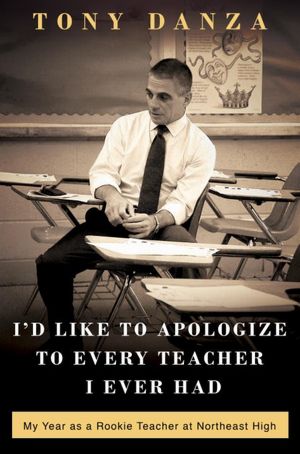
 

I’d Like to Apologize to Every Teacher I Ever Had by Tony Danza

I’d Like to Apologize to Every Teacher I Ever Had by Tony Danza

Schools and teachers are a hot topic in Idaho right now, as the November ballot includes Propositions 1, 2, and 3, which deal with a variety of education related issues. As a registered Idaho voter, former teacher (although hopefully I’ll be back in the game at Thad’s next posting) and concerned constituent, I’ve been watching the battle between the sides rage this entire fall. (You would think being in China would put me out of that loop a bit, but at least the Pro-Props 1,2 and 3 side seem to have found me. In the last three weeks, I’ve gotten nine of the exact same flyer from their group. Nine! The same flyer! My goodness. Whether I agree with the position or not, sending me nine of the exact same piece of literature is going to do little to change my mind folks.)  With schools being on the forefront in many states this season,  I thought it would only be appropriate that I jump back on the book review bandwagon with an education-related review. (It has been a while since I’ve added to my Book Musings category, not because I haven’t been reading, but it has just fallen to the wayside between the move to the other side of the world, a new job, and finding my place in a new community. But, I hereby declare that book reviews, shell-rated and all, are back!)

Tony Danza is not someone I would expect to turn to for insightful thoughts on education reform and the realities of classroom life for teachers, and yet, like with so many things in life, I was pleasantly surprised. In his new book, I’d Like to Apologize to Every Teacher I Ever Had, he takes on the role of a teacher in a tough, urban school in downtown Philadelphia. After being fired from his latest Hollywood role, that of a daytime talk show host, he was looking for a way to give back to his community and seriously considered the Teach for America program. But, I think the limelight is just bred in to some, and he found a way to mesh his California-career with his Philadelphia upbringing, in the form of a documentary that is filmed over the course of a year teaching high school English.

Skeptical yet? I was at this point! I imagined him going in for a few weeks, doing bit parts and then moving on to the production and selling of his latest film-creation. But, while I do take issue with parts of the gig, after reading the book, I can see how genuinely dedicated he was to his role as a teacher and how touched he was by his students. (He taught a single English class, granted, it was a double period, for a year. He also did some other duties around the school, but the strain that shows from his single class of students needs to be multiplied, as teachers don’t get to plan for, teach and review work for a single class a day.)

Danza faces the realities of many teachers in America today. He must find a way to get his students to embrace great literature when they prefer the crass rhymes of less-than-stellar role models they hear on the radio. He must teach his high school students to communicate effectively, through written and spoken word, when they constantly revert to the LOLs and OMGs of modern-text-talk. On top of this, he learns that teaching a subject area is only half of the battle educators face each day. He soon sees that his kids are lacking in positive role models at home, that they are coming to school hungry and tired and that they don’t dare dream, as they’ve seen too many dreams crash to the ground and die.

I am probably partial to Danza’s newest work because he spends his year in an English classroom, something I am missing right now. But, his book is full of touching moments, but also very real, tough moments. I’d Like to Apologize to Every Teacher I Ever Had should be on the top of Christmas lists for all the teachers in your life (they will understand and appreciate his perspective),  as well as all of those folks who think a few laptops and online classes are the solution to crowded classrooms and not hiring enough trained, certified and experienced teachers.  I’d Like to Apologize to Every Teacher I Ever Had  by Tony Danza earns a solid:

The Paris Wife by Paula McLain

The Paris Wife by Paula McLain

Hemingway is a divisive figure in literature. Some people love his style and try hard to emulate his unique way of writing, while others are turned off by the seemingly mundane details included in each chapter.  But, whether you love the man or hate the man, Paula McLain’s The Paris Wife is a book worth picking up, as it shows an earlier side to the man who would change American literature forever.

Hadley robs the cradle when she marries Ernest, a man eight years younger than her. But, after living a life of coddling and seclusion, and one where she was staring old-maidhood in the face, Hemingway paints a picture of a future filled with adventure and society and excitement. Against the judgment of their families, the two marry and soon decide to move to Paris, where Hemingway can work on his craft in the midst of other artists. While they are portrayed as being deeply in love, I have to admit that the dialog expressing this love tended to be a bit over the top and stereotype-ridden. At one point Hadley says, “Did you ever think it could be like this?” I felt like I had been thrown into the cinematic debut of Nicholas Sparks’ latest romance.

Paris in the 1920s was a place where traditional marriage was no longer looked upon as sacred, at least the Paris of the Hemingway coterie. Within their circle of friends, extra-marital trysts were common and ignored. Apparently, if they were not openly discussed, they were not an issue. The Hemingways fare well for a while, but after the birth of their son, as pressure mounts on Ernest to become the published writer he has always dreamed of being, a woman Hadley considers her friend wedges her way in to their relationship, soon making a mess out of what had been so strong. The book actually begins with Hadley discussing the disintegration of her marriage, so there is no spoiler alert needed in saying that what started as roses and kisses and long letters morphed in to angry words and late-night fights and a parting of ways forever.

Getting an inside look at Hemingway’s early days is fascinating and was enough to have me hooked throughout the length of the novel. There were times where I thought that if the book had not been based upon a writer whom I enjoy reading and had not been as well-researched as it was, I would never have made it through as a simple novel. Hadley as a character is insufferable when it comes to motherhood. I couldn’t believe how many times she left her child with a nanny so that she could go on a ski-vacation in the Alps or attend the running of the bulls in Spain. The worst was when the boy had whopping cough and had to be quarantined, rather than stay with him through the difficult time, she called on the nanny to come and nurse him better so she could go out in the evening for drinks with their group. Maybe that was the norm for their set in Paris in the 20s, but it did not make her a sympathetic character.

While name-dropping is not normally looked upon as a social grace, in Paula McLain’s The Paris Wife it is a compelling aspect of the Hemingway-centered narrative. Cameos are made by Ezra Pound, F. Scott Fitzgerald, James Joyce and Gertrude Stein, just to name a few. Reading this book was like watching an ensemble cast movie, with all the top names of the day signing on to a single project. But unlike many of these Hollywood heavy-hitter filled movies where a lot of A-list names aren’t enough to satisfy the viewer, readers of this book walk away intrigued and ready to read more about each character. At times, both Hadley and Hemingway are hard to stomach, and the whole book leaves me feeling a bit more negative towards Hemingway as a person, the book is an entertaining read, both historical and literary points of view. McLain’s The Paris Wife earns:


The Unquiet by Jeannine Garsee

The Unquiet by Jeannine Garsee

If you are one to skip to the “shell rating” at the bottom before reading the review itself, I think it is only fair for me to include a bit of a disclaimer on this one. There is no gentle way to put this, no beating around the bush, no softening of the harsh reality. I am a chicken. I can’t watch scary movies; heck, I can’t even watch the commercials/trailers for scary movies. I hate being the last one awake at night, which works out well since my husband is a total night owl. And I can’t handle creepy books. I read James and the Giant Peach when I was in elementary school and woke up to nightmares about gargantuan bugs having a tea party in my bedroom.  That is the extent of my wimpy-ness. So, while the shell-rating isn’t as high as one might hope for in a book review, keep in mind much of that designation has its foundation in the fact that for many years, I considered Roald Dahl’s writing to fall firmly in the horror genre.

The Unquiet is creepy. That is the first and most important thing a reader should know. The tale centers on Rinn, a teenage girl who has recently moved back to her mom’s hometown in middle America from a sunny southern California upbringing. The move is precipitated by the fact that her mother and adopted father are having some marital problems, stemming from the fact that Rinn, a bipolar teenager who has experienced psychotic episodes, accidentally started a fire that killed her grandmother. After the death of her grandmother, Rinn tries to kill herself. Once she is released from the care of the mental ward of a hospital, her parents decide some time apart and away would be best for everyone.

Rinn, while not thrilled with the move, soon makes friends at her new high school, which is odd in itself, as she was never the stereotypical social butterfly. But, not long after moving in, she learns that the school is haunted by a girl who died in the pool. That doesn’t necessarily set off any alarms for Rinn, but when she learns that the dead girl’s grandmother hanged herself in the bedroom Rinn now sleeps in, things start to spiral out of control.

The sleep Midwestern town is suddenly plagued by inexplicable accidents and deaths and Rinn is tied up in the middle of all of them.  She and her new friends (who as characters are rather flat and underdeveloped, but that is a whole different discussion) seem to be the epicenter for the evil that emanates from the pool room.

Some will love the creep factor that this book offers. It kept me awake more than one night this last week. But, that isn’t all Garsee’s novel has to offer. Instead of just being your run of the mill horror story, it tackles the issue of mental illness in teenagers, a tough subject, but one that is a reality for some young adults. Watching Rinn struggle with her perceptions of reality and the side effects of her medication create a deeper story than if the author just stuck with a teenage ghost story. This element of the novel creates some redeeming moments that make me more apt to recommend it to students.

In the end, Jeannine Garsee’s The Unquiet, is a more than a bit spine-chilling, but that is the point, after all. If a few nights of curled up under the blankets covered in goose bumps and jumping at every creak of the house sounds like a good read to you, this is your book. While I understand the draw, it is not my cup of tea, so The Unquiet earns:

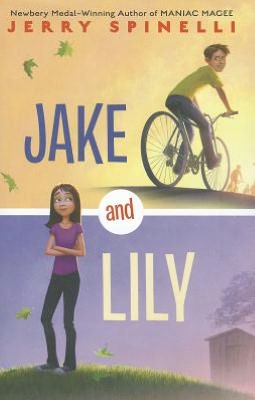
Jake and Lily by Jerry Spinelli

Jake and Lily by Jerry Spinelli

Twins. It is not a new topic for fiction, especially not  for young adult fiction, so Jerry Spinelli breaks no ground with his newly released novel, and yet,  even knowing that the same-birthday sibling world has been explored numerous times, if you are going to go there again as an author, you need to create something new. Spinelli attempts to make his mark in the twins-literature world by having pre-teen, differing-sex, opposite ends of the personality-spectrum kids tell their story in a first-person point of view through alternating chapters.

It’s a shtick.

A shtick I could get behind in other circumstances, if it was done well. (My going-into-sixth-grade niece was working on a book this summer and she was considering narrating the story from two points of view-one human and one animal-in an alternating chapter format. She was on to something. She’s also eleven years old.) But really, the format isn’t the problem as much as the stereotypical portrayal of twins.

I’ve known twins, not ever been super close friends with any, but I’ve been around them growing up and through my adult life. I realize they have a special connection, but the story told by Jake and Lily is one made for Maury Povich! They can read each other’s minds, they sleepwalk to the same destinations and they can never, ever play a game of hide-and-go-seek.

Outside of its stereotypical twin-ness, the tale is a great one that will be relatable for many middle school kids. Jake and Lily are siblings, and also best friends, but as they get older, their interests differ and they begin to grow apart, which Jake is fine with, but the transition becomes a painful one for Lily, who feels deserted and left behind. This type of relationship transition is as common as pimples amongst the middle-school demographic. As kids expand beyond the world of elementary school, their personalities evolve and old friendships don’t quite fit like gloves anymore.  The twin-part is irrelevant.

On top of the expansion and evolution of friendships, Spinelli digs into the ever-more-talked-about world of bullying. His presentation of the bullies is one that rings true. The boys don’t start out trying to be mean, but a small comment from one, which garners a laugh from the others, grows into ever bigger words and actions that quickly become hurtful to others. The group of boys being bullies didn’t start out with that as their intention, but though a single leader, with a strong personality, the boys all soon fall into his patterns, accepting his actions until property destruction brings their behavior into a new light.

Jake and Lily is a great young adult novel that explores themes near and dear to the hearts of those entering the scary world of middle school. Most kids pushing the boundaries of adolescence will feel the pain of changing friendships, will experience the sting of bullying (on one or, more likely, both ends) and will be forced to expand their own horizons. Jerry Spinelli does a great job of illuminating what could be considered rather mundane, day-to-day growing pains, giving them the spotlight to shine in the eyes of the readers.

If only he would do it without the twin-gimmick…

Jerry Spinelli’s newest publication, Jake and Lily earns:


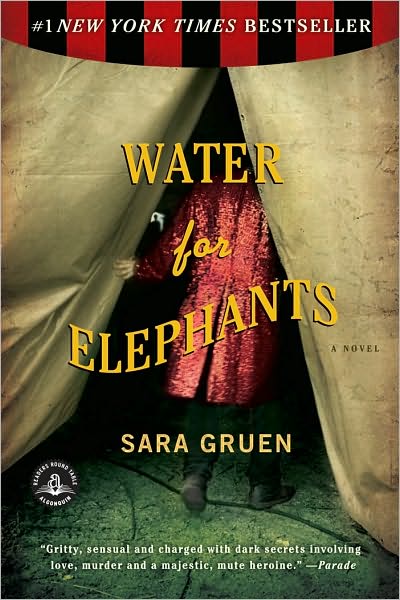
Water for Elephants by Sarah Gruen

Water for Elephants by Sara Gruen

I feel like a late-blooming middle schooler on this review. The new kid came to school, was a hit, so popular it made the A-team of actors/actresses in its movie form; all the while I was sitting on the bleachers, engrossed in pursuits that fully ignored the cool kid. Coming to Water for Elephants late, I was wary- it became too big, too popular and too commercial- was it really any good?

The answer is an unequivocal, yes!

If, like me, you ignored this book when it first came out (although judging from it sales, I may have been the only one) it is not too late to run away with the circus.

Water for Elephants is a beautifully written tale, told by Jacob Jankowski,  an old man (either ninety or ninety-three) sitting in a retirement home in the twilight of his life, watching a big top go up in the parking lot across the street, reminiscing about his days with a traveling circus. The story jumps from his present situation of declining mental capacity and depression to the beginning of the end of the heyday of the traveling menageries, where our narrator worked as a vet, fell in love with a performer and watched the demise of the Benzini Brothers Most Spectacular Show on Earth.

Jacob’s personal tragedy leads him away from the Ivy League school where he was about to graduate with a veterinarian’s degree and to the Benzini Brothers’ show, where he joins first the ranks of the working men, but soon is embroiled in a web of intrigue with the Marlena, her husband August, and the newest addition to the menagerie, Rosie, an Polish-understanding elephant.

What I loved about this book was the depth of the connections between characters. When Jacob’s world crumbled around him after the sudden death of his parents, his despair is palpable. When Marlena and August’s relationship comes to a tipping point, there is no denying the hurt and betrayal, but also the relief and freedom she feels after making her decision.  When Camel must be protected from Big Al’s ruthless “red-lighting” of unwanted workers, compassion and subterfuge take over.

Rosie, the circus elephant, is every bit as much a character in this book as Jacob, Marlena, August or Uncle Al. We feel her deep connections to the various human characters and her pain when she is treated treacherously and abusively. The wheels turning in her head are as obvious as if she were a person placed in similar circumstances. As the pain builds, there is no denying the emotional pain that goes in to her eventual resolution of the situation at hand.

Sarah Gruen’s novel’s sensational popularity is not unearned. It is a tale of romance and mystery, of the happiest place on Earth turned abusive and lethal, and of an old man reconnecting with his roots before it is too late.  As I read this tale, I was enraptured, just a like a child would be sitting next to the center ring under the big top, eating pink flossy cotton candy off of a paper stick and slurping lemonade from a plastic cup, and for this, the Water for Elephants earns:


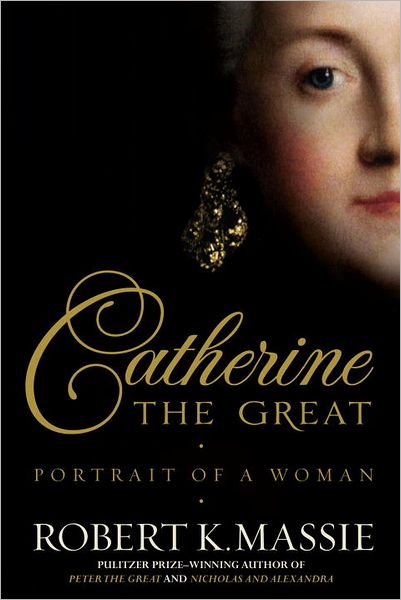
Catherine the Great: Portrait of a Woman by Robert K. Massie

Catherine the Great: Portrait of a Woman by Robert K. Massie


If it is drama you crave, Russian history is probably one of the best non-fiction outlets for your desire.  It is filled with love and betrayal, possible marriages and definite assassinations, and intrigue beyond what Hollywood can manufacture. Catherin the Great: Portrait of a Woman covers all of these possibilities, as well as a glance at ancient frenemies, haters, posers and every other modern label for the spectacle-loving folks!

Catherine, originally Sophia, born in 1729, had ties to European nobility through her mother, but it took a summons from Russia for her to ascend to the rank of empress. But such a monumental climb would take years, as well as royal amounts of patience on her part. After her betrothal and eventual wedding to the decidedly undesirable (both in physical and emotional contexts) Peter III, Catherine is forced to bend to the will of her over-bearing mother-in-law and her immature new husband.

After the death of Empress Elizabeth, it quickly becomes apparent that Peter is not fit for the throne. He doesn’t have the intelligence, the interest or stamina one would need to rule a country as large and diverse as Russia in the mid 1700’s. With his true love remaining in his native Europe, Peter aligns himself with countries out of nostalgia rather than through a determination of what is strategically the best for his adopted country. When this mindset of ruling starts to show cracks, it doesn’t take long for the strong-willed Catherine to step in, take control of the court and crown herself Empress Catherine II.

Catherine the Great follows the empire-leader from the time she was a young girl, a mere teenager, called away from her family by the Empress Elizabeth to be the wife of the empress’ nephew and future successor, Peter III, to the stroke that eventually took her life. Throughout these decades, readers are treated to not only Catherine the Great’s political dealings, but her personal triumphs and failures as well.

Massie’s book has an extraordinary amount of detail in it, which is both its top asset, as well as one of the biggest detractions. While I was fascinated with where Catherine (then Sophia) came from and her rise to power and fame, at times the digressions into history, philosophy and personal dalliances became a distraction to her tale. While there is no way to whittle the life of a royal down to a few hundred pages, I feel as though Massie could have edited some of the divergences, which at times rambled down paths that, while illuminating specific points of Russian history, were not necessary for the reader to understand Catherine’ s trek to the throne.

With much of my Russian history being the much more current studies in most curricula today, including the time of USSR and the Cold War, Catherine the Great was a fascinating tale of one woman’s triumph over a deadbeat husband and her rise to the ultimate seat of authority. Robert K. Massie has crafted a biography that reads as smoothly as a work of fiction, drawing the reader in to the tale of the ancient Russian royalty’s inner lives and political leanings. While I believe a bit of editing would have created a more finely tuned tale, Massie’s Catherine the Great: Portrait of a Woman is a solid biography of a bold woman, earning it:


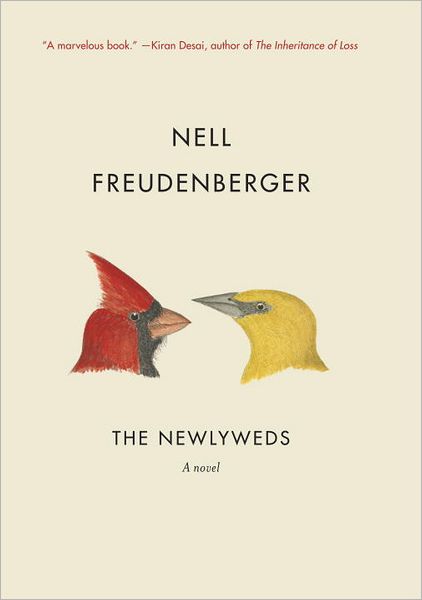
The Newlyweds by Nell Freudenberger

The Newlyweds by Nell Freudenberger

I love fiction set outside the United States, the more far-fetched the better, as it holds a window up to parts of the world that I may never get a chance to see and experience. Nell Freudenberger’s newest novel, The Newlyweds is a wonderful entanglement of two very opposite worlds- that of Amina, a Bangladeshi young woman and her new husband, George, an American who went looking for love online.

George and Amina  meet on AsianEuro.com, where he has gone in search of love to console a heartbreak he isn’t as over as he thinks he is and she is looking for love, or at least a connection, that will allow her and her parents to leave behind the life they have in Bangladesh and start over in what they imagine is the Land of Dreams- America. After an online courtship with just a few bumps, George flies to Bangladesh with an engagement ring in his pocket, to meet the woman with whom he has been exchanging emails filled with stories of who he is (although, Amina will soon learn that there are secrets left untold.)

With their engagement behind them and Amina’s successful application for a visa, she travels to the United States alone, to be married and start a life with George, knowing that she will apply for her parents to follow as soon as it is legally possible. She and George settle in to married life and get along fine, but between George’s past love affair and Amina’s future plans, there are certain aspects of themselves that they are each unwilling to share.

Having never been to Bangladesh, I can’t say how accurate the portrayal of the country is, but I was struck less by the poverty described in certain sections and more by the brutality employed, seemingly with impunity, by Amina’s distant family members who feel that her father has stolen from them. Between the attempt by one to burn her and her mother alive in their apartment to the acid thrown on her father in the market when she has come home to help her parents secure visas, the violence and lack of punishment for it is astounding. Bangladesh is made out to be rather lawless, especially when it comes to the villages. It seems like a terrifying place to live, let alone raise a family, and it is understandable why Amina and her mother have worked Amina’s entire life to find her a way out.

I love that this story is a realistic look at what marriage might be. In the US, we are conditioned to think love is the one and only basis for a happy marriage, but there are other ways to reach that same level of contentment in a relationship. George and Amina have some tough times and are forced to deal with a variety of difficult issues early on in their marriage, but that doesn’t mean they don’t work through them and create what could ultimately be a lifetime of happiness, despite their cultural differences. Nell Freudenberger’s beautifully written latest work, The Newlyweds, was outstanding and easily earns:


The Impossible State: North Korea, Past and Future by Victor Cha

The Impossible State: North Korea, Past and Future by Victor Cha

It has probably become apparent by now that I am fascinated with North Korea and how such an isolated country can still exist in this world of ever-increasing abilities to communicate with people from around the globe. (I write this review from my couch in Chengdu, China, where I just got off Skype with my parents who live in Idaho, have emailed several friends back in the States and caught up on world news via a variety of online newspapers. I know what I am talking about when it comes to being connected!) Recently, I reviewed Escape from Camp 14 which was a memoir of one man’s time in the horrific camps of Northern Korea. The Impossible State is quite a different look at the country- taking an in-depth approach to everything from the history of the country to detailed looks at each of the Kim family members who have ruled throughout the last decades to the economy as it is today and why it can’t sustain itself.

Victor Cha’s new book is filled with fascinating insight into North Korea, but it reads more like a college textbook than an average non-fiction book published for the run-of-the-mill reader would. I especially enjoyed the chapter on the Kim family and how each successive leader had to create a place for himself within the government, but at times the information seems to get bogged down in technical language that isn’t necessary. It is almost as if the book is trying to push itself to be picked up by professors of classes about the Koreas, thereby helping it reach a higher profit margin.

The other thing that I really struggled with while reading Cha’s book was the writing itself. Yes, I feel that it was too textbook-y, but maybe I just wasn’t the intended reader. I found the book at the library and picked it up because it looked interesting, but maybe Cha was really pushing for a more academic setting for his research. Being written in a technical manner doesn’t mean, though, that it can’t be well-written and well-edited. There were many times throughout the book where the writing just became ungainly, with confusing modifiers and the occasional antecedent left to hang on its own.  More than once I had to reread sentences and paragraphs, not to tackle difficult vocabulary, but to decipher the meaning behind poorly edited writing.  Going back to my days of Six-Traits Writing instruction, I would say Cha really needs have someone help him focus his organization and conventions.

This newly released book is great because the subject is so relevant, as North Korea’s new constitution just named it as a nuclear-power, thereby trying to bully its way into international talks and aid. The research and discussion is current, dealing not only with Kim Jong-Il, but also his successor, the country’s current leader, Kim Jong-Un.  In a world that is as politically fluid as is ours, it is rare to get such a contemporary viewpoint. It seems as soon as books are published, the landscape has changed and they are out of touch with this moment’s crisis.

I enjoyed this book, but I think a lot of that had to do with my inherent interest in the topic. The book is filled with fascinating insights into what is easily the world’s most isolated and possibly most brainwashed nation, giving the reader both facts and theories about where the country has been and where it is headed. The writing itself leaves something to be desired. Victor Cha’s The Impossible State earns:

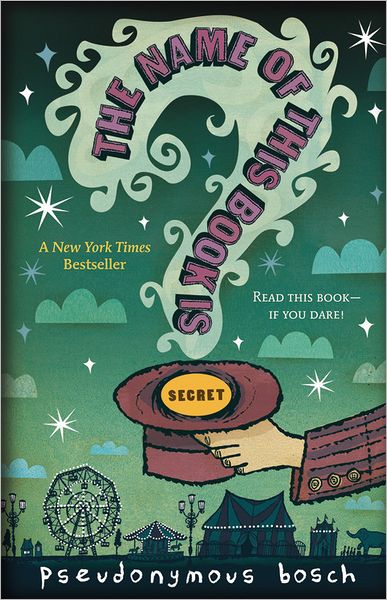
The Name of This Book is Secret by Pseudonymous Bosch

The Name of This Book is Secret by Pseudonymous Bosch

When I’m not wandering the aisles of a bookstore, filling my arms with more than I can carry, or sitting on the couch in my pajamas surfing library e-book catalogs in search of the next fabulous read, I find book suggestions through the recommendations of fellow bookworms. My latest find comes courtesy of my oldest niece, Kelsey. When we were at the bookstore together the other day she suggested I borrow her copy of The Name of This Book is Secret. What a great suggestion!

The Name of This Book Is Secret is a young adult (on the younger side of the YA genre) in the vein of The Series of Unfortunate Events.  The book tells the story of Cass, a survivalist who is prepared for anything, and her sidekick, Max-Ernest, who finds his way in to her mystery-filled adventure. The tale begins when her grandpas, who own an antique store, find a box containing the Symphony of Smells. From there, she gets herself entangled in a world of magic, mayhem and murder.  She and Max-Ernest (who never goes by a shorter version of that moniker) discover that the Symphony of Smells is a cry for help from a missing magician, and in their quest to rescue him, they end up at a secretive spa where the search for immortality takes precedence over manicures and massages.

One of the things I loved most about this book is the way the narrator speaks directly to the reader. The book starts with an admonition to not read it, as it could be dangerous, which made my mind jump back to one of my favorite childhood books, The Monster at the End of this Book. (If you’ve not had the chance to enjoy this fabulous tale, skitter to your nearest bookstore and get a copy!)  Throughout the story, the reader is repeatedly given instructions to forget certain details that would identify the leading characters and the recipe for making the best “Super Chip” trail mix- made with no raisins!

On top of the direct dialog with the reader, the book is filled with codes to be deciphered, anagrams to puzzle over and mysteries to be solved. While sitting on the sofa reading a book may seem like an inactive way to spend an afternoon, but with this novel there is no such thing as passivity. You are definitely on your toes (at least mentally) from start to finish.  Pseudonymous Bosch’s The Name of This Book is Secret is an amusing way to spend a few hours, and it doesn’t hurt that it includes an aging basset hound.  The smiles and grins produced by this novel earn it: