The Whole Story of Half of a Girl by Veera Hiranandani

The Whole Story of Half of a Girl  by Veera Hiranandani

This debut young adult novel by Veera Hiranandani sets out to tackle a handful of difficult topics in just under 150 pages and in a manner that is readable for a middle school student. The book attempts to deal with ethnic and religious identity, public vs. private school systems, the meaning of true friendship and clinical depression.  I applaud the ambitious efforts undertaken by the author, as each of these topics is not only important, but relevant in the lives of many adolescents, but I just seems like too much crammed into too short of a space.

The main character, Sonia, is forced to transfer from her private school to the public one just as she is starting the 6th grade. This move is precipitated by her father losing his job as a book publisher. For Sonia, who is half Indian (her father having been born and raised in India) and half Jewish (her mother having been raised in a strict kosher home),  the new school means confronting issues of how she labels herself and how those around her label her. On top of her ethnic and religious confusion, her father spirals into a deep depression brought on by his unemployment, which she must face each evening when she returns home.

One of my favorite parts of this novel is the fact that the main character is both Indian and Jewish. While I don’t know how many kids fall into that exact category, the fact that Sonia is dealing with figuring out who she is reflects  a universal struggle for middle school students.  It may be their ethnicity or their religion or their sexuality or some other aspect of their identity, but the struggle is there for most teenagers.  Watching as Sonia tries to find her place in her new school, sometimes giving in to the pressures of others and sometimes being strong and true to herself, rings true to me after having spent a decade wandering the halls of a middle school.  Towards the end of The Whole Story of Half a Girl, Sonia says, “Sometimes I feel like I am the only one like me.” Whether teenager or adult, we all have days where this is where we are at.

It is great to see young adult books not shying away from dealing with difficult, real-life topics, but when this many weighty issues are all pushed together, I think it is hard to do them justice on an individual level. Depression, whether in themselves on in their loved ones, is an issue than many people will deal with throughout the course of their lives.  Hiranandani could have written this entire book with just this as a central theme and still come out with a book worthy of a middle school library shelf.

Hiranandani has a point of view to share with the young adult world that will resonate well with many students. As a debut novel, I think she has made a statement about wanting to deal with serious issues in a way that is accessible for young adults, and there is a need for this type of writing. With that said, I think she needs to tackle fewer issues in a single book and deal with them on a deeper level.  In the fashion world it is always said that before leaving the house you should look in the mirror and take off one accessory. Hiranandani would do well to heed this same advice when it comes to story planning. Veera Hiranandani’s  The Whole Story of Half a Girl earns:


The Robber Bride by Margaret Atwood

The Robber Bride by Margaret Atwood

Having previously read a novel by Margaret Atwood that fell firmly into the dystopian genre, I expected something along the same lines with The Robber Bride. It took me probably fifty pages to finally realize that is not the direction in which this one was headed and to get beyond constantly looking for a science fiction twist.

The Robber Bride weaves a rather tangled web anchored on the sides by three friends, Tony, Roz and Charis, in the middle of which rests the ultimate black widow, Zenia. Zenia works her way, one by one, through the men in each of these women’s lives, poisoning both sides of the relationship through her deceptively detailed lies and her lack of genuine emotion towards any other human being.

The novel, while taking place in present day Canada, spends a majority of its pages flashing back through the stories of how each woman’s love was lured away by Zenia and then how the women were left to pick up the pieces of their lives, their relationships and their memories.  For one this mean welcoming back the husband that strayed, for one it meant remaking her husband’s suicide into an accident to protect her children and for one it meant never really knowing what happened to her boyfriend after she watched him sail away from their island home on the daily ferry.  These jumps in time and place have the potential to confuse the story and the timeline, but Atwood is able to seamlessly make these transitions in a way that never leaves the reader wondering how they got from an aging island shack to an upscale corner office in Toronto.

Zenia is the epitome of a novel’s antagonist. She is a dark-haired, pale-skinned beauty who can calmly lie her way in and out of any situation.  Her skills are perfected to a point where her character is almost unbelievable. Until her death, there is nary a flaw in her plans. She is able to walk all over every man she desires. While this makes for a smooth flowing story, it does not necessarily make for believable characters.

The idea of three women who become friends based on one single connecting link- the woman who lured away each of their men-is, again, a bit of a stretch. These women meet once a month for lunch, never bringing up their singular connection until Zenia resurfaces in their lives.  What is it that keeps them coming back to that lunch before her return? Guilt? Self-loathing? The need to keep turning the knife in the wound? I am not sure most women would want this constant reminder of the darker moments in their lives.

Maragret Atwood is a skilled writer. She infuses her story with references to an old Grimm Brothers’ fairy tale and pulls on Tony’s interest in wars to enlighten the reader on the battles these women each face. It isn’t the writing the lacks, but the characters, which, at times, seem a bit forced. The book was entertaining enough to have me wanting to know how these women finally disentangle themselves from the arms of Zenia, but not enough to not wish is was a few less than its 528 pages long. Margaret Atwood’s The Robber Bride is awarded:

The Maze Runner by James Dashner

The Maze Runner by James Dashner

A decade of teaching middle school has left me with a deep and abiding love of young adult novels. The YA genre has really gained steam over the last ten years, with much of that energy going into great literature that allows students, along with the novels’ protagonists, to explore the ups and downs of adolescence, to consider a variety of ethical and moral dilemmas and to hopefully expand their horizons in terms of culture and lifestyle.( At the same time, the genre has also opened the door to a ridiculous amount of vampire and werewolf novels, but I’ll take the spin-offs on each popular novel if it means kids are engaged and wanting to pick up books.)

The Maze Runner by James Dashner falls into one of my favorite YA categories- dystopian science-fiction. Ever since I picked up Ender’s Game years and years ago, I’ve been drawn to books that imagine a future world where life has been significantly altered through a series of catastrophic events. The Maze Runner is a great addition to a genre that includes The Giver, City of Ember and The Hunger Games.

Dashner’s novel starts out as the main character, Thomas, arrives in The Glade via an elevator from an unknown origin. Having only cursory memories of life before his appearance, Thomas is confused by his new whereabouts, but also somehow more comfortable with the transition than his predecessors.  His ease in this new home not only creates confusion on his own part, but leads to suspicion on the part of the boys already dwelling in The Glade.

The Glade is a large courtyard surrounded by high stone walls.  It isn’t long before, like any teenage boy, Thomas is questioning what lies beyond the boundaries of those walls. He quickly learns that a select group of Gladers venture into that unknown territory each day in an attempt to map the ever-changing maze patrolled by deadly Grievers.

No one seems to know why The Glade exists or whether an escape is possible, but prior to Thomas’ arrival, the Gladers could expect weekly shipments, via the elevator, of necessary goods and a monthly addition of a new boy. Thomas’ arrival changes all of this, as just one day after joining The Glade, another new member is added to the band of boys- a girl. She will turn everything the all-male society knows on its head and throw into motion changes that will alter everything they think they know about their home.

The Maze Runner is a captivating start to James Dashner’s trilogy. While the book initially gets off to a bit of a slow start as a foreign setting has to be introduced, the book was well-worth sticking out the long beginning and knowing that two more follow, the time devoted early on to setting will hopefully payoff throughout the two subsequent novels. There are moments in this book that harken back to Golding’s Lord of the Flies and the difficulties a band of teenage boys would face in forming their own society, but The Maze Runner heads in a whole new direction, taking the character most like Piggy and turning him into a hero and showing that order can be formed from an utterly puzzling starting point.

With a dystopian premise that I am so drawn to and the promise of two more books that I won’t be able to put down James Dashner’s The Maze Runner earns:


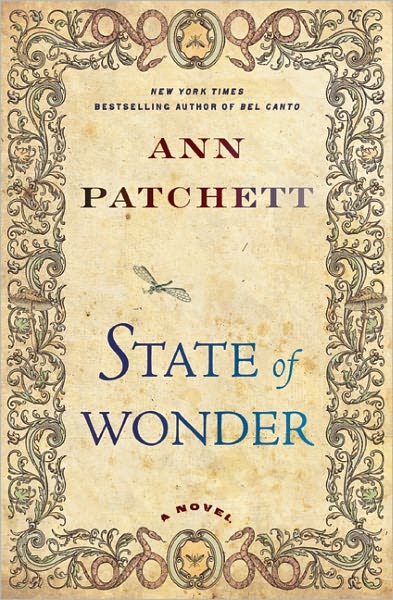
State of Wonder by Ann Patchett

State of Wonder by Ann Patchett

As with many of the books I read, I was first drawn to this novel by an online review I happened to stumble across. The premise of a lab-bound doctor venturing into the unknowns of the Amazon basin on behalf of a huge pharmaceutical company was one that contained the potential to go in so many directions, I just had to find out which overgrown jungle trail Patchett would follow.

State of Wonder is an interesting mix of a fictional adventure/travel genre and a more literary discussion of a large drug companies’ ethical responsibilities vs. its bottom line. The main character, Dr. Marina Singh is sent to Brazil on a double mission: first, to find the reclusive Dr. Swenson, who is supposed to be working on a game changing fertility drug, but refuses to enlighten her employers on its development and second, to find out just exactly how her predecessor, Anders Eckman,  in the previously mentioned mission died and what has become of his remains.

Once she arrives in Brazil and wheedles her way past the gatekeepers Dr. Swenson has employed to keep any and all curious outsiders from finding her and her research station, Dr. Singh discovers that nothing is quite the way it was presented to her back in Minnesota. The drug research, while happening and making huge progress, is not what her employing pharmaceutical company thinks it is, Dr. Swenson is pushing natural boundaries to a breaking point and there is more mystery to the demise of Eckman than anyone in the States knows.

I am always excited to open a new book. Sometimes the start of a new novel takes time to develop, slowly going through the machinations of time and place and character. Occasionally, I’ll happen upon a novel that, from the first paragraph, winds me tightly into its coils like a monstrous anaconda in the Amazon. For me, Patchett went all in and showed her hand on page six with when Eckman, an avid birder, is preparing for his trip to the wilds of South America by pouring over field guides of rainforest aviary. As he describes the reclusive Amazonian dwelling guira cuckoo and the plumage that bedecks its head, Patchett writes, “A person could wash out the inside of a pickle jar with such a bird.” After wiping away the tears that stemmed from laughing so hard at that line, there was no way I was going to be able to put down the book down until I had seen it through to the end.

For the thoughtful mixture of a travel adventure and the philosophical discussion of humanity’s ethical responsibilities towards one another earns Ann Patchett’s Sense of Wonder earns:

The Sense of an Ending by Julian Barnes

As I continue to expand “In Search of the End of the Sidewalk,” I’ve decided to add another category to my musings. As a self-described uber-bibliophile, I readily admit to my love of reading, talking about and recommending books. When I was teaching, my 8th graders and colleagues were a perfect outlet for my need to share fabulous reading material, but now that I am without a classroom and have an ever-changing set of fellow students, I hope to use my blog to continue sharing and discussing great (and, at times, not so great) literature. These “Book Musings” will be short reviews (less summary oriented and more my thoughts)  of the books that are currently cycling through my Nook, along with a “Shell Rating.” Five shells will be awarded to the best of the best, with one shell being given to books that I was able to survive, but am utterly incapable of suggesting anyone else endure. With that introduction soundly delivered, here is my first Book Musing!

The Sense of an Ending by Julian Barnes

This novel made it onto my Nook as my book club’s January selection. As end of the year lists were compiled by any and all media outlets with any slight leaning towards literary aspirations, The Sense of an Ending made frequent appearances.  If others loved it, might we as well?

I have to admit, I finished this book well over a week ago, but put off writing this musing because I wasn’t sure what I thought of it. My first impression of this novel was one of bleakness.  This vibe isn’t only because suicide plays a hefty role in the storyline, but because the main character, Tony, as he looks back over his life and ponders the choices he has made and their subsequent consequences, doesn’t seem to have many positive times to cling to. While he isn’t overly downtrodden by these events, as an outsider, I had to feel a sense of defeat for him.  Our vision for life is that the good times ultimately outweigh the bad times, but for Tony, the best of the best and the worst of the worst hardly seemed to register on his radar. He seems content with utter mediocrity in his life.

The heart of the novel lies beyond the tangled web of Tony, his first real girlfriend, her mother and his best friend. Questioning the accuracy of our memories and the light in which we choose to recall events throughout our lives is really what the novel forces the reader to consider.  Tony is far from a reliable narrator, and yet, can we say that we are reliable narrators of our own lives? After telling the same story over and over to friends, to colleagues, at parties, are we really telling the reality of what happened or has it become warped and twisted into a new version of itself?  The short but dense novel coerces the reader into reminiscing about his/her own recollections and how dependable they may be.

While I was on the fence initially about this book, after some great discussion with the ladies at book club and thinking back over some of the really intriguing one-liners in the book, Julian Barnes’ The Sense of an Ending is awarded: