Death by PowerPoint

1987 saw such spectacular events as President Reagan undergoing prostate surgery, the debut of both Prozac and The Simpsons and the birth of Lil’ Bow-Wow. (Now grown up, he has dropped the diminutive from his name and prefers a more mature, more cultured moniker- Bow-Wow.) As remarkable as these things may be, that fateful year, twenty-five years ago, brought with it something much more life-altering than just the voice that would bring us classics like “Bounce with Me” and “Puppy Love.” (These are either semi-famous rap songs or jingles that belong on the type of CD that soccer moms play on an endless loop in their mini-vans as they shuttle their over-scheduled darlings from one enriching after-school activity to another. While Wikipedia tells me they fall into the first category, I find their titles to be deceptively aimed at young children. I think this may be the right direction for Glee to head in for their next “mash-up” episode.)

1987 brought us a new kind of slow, painful demise- Death by PowerPoint.

Before the late 80’s, office workers sitting at their desks, whiling away the hours until they could punch out  on the company clock and hop in their Pontiac Bonnevilles, could imagine their grisly ends coming through a variety of means. Maybe an assistant paper-pusher miscalculates the space needed when preparing packets for his boss’ meeting and ends up with a rusty staple embedded in his thumb, which without the proper tetanus shots, leads to lockjaw and eventual starvation. Maybe the secretary daydreams while filing endless manila folders in the gray metal cabinet that sits behind her desk and while her focus is elsewhere, she gets a doozy of a paper cut, which over time becomes infected and she dies, ranting like a crazy woman, from a high fever. Or maybe, just maybe, the bacteria built up on the office kitchen plates that everyone uses and rinses quickly, but never really washes well, end the middle management dreams of a bean counter or two.

All of these are plausible, yet uncommon, ways to perish at the office. Since 1987 though, PowerPoint has brought us a much more sinister possibility. Endless slides, often accompanied by a mercenary who reads each and every bullet point, have become a standard way for companies to cull their herds.

With a move to China on the horizon, and a lackluster desire to continue to study such an overwhelming language, I have finally been able to make the move to Con-Gen.  This is a general course given to all diplomats headed out on tours where they will deal with passports and visas.  It goes over policy and law and the realities of the implementation of those edicts. While the information is actually quite interesting, the presentation leaves something to be desired.

Friday, just my second day of the course, I sat through four and half hours of lecture.  In that amount of time, we covered 123 slides.  Now, I was an English teacher and math has never been my strong suit (I got a C in math in the 6th grade, which earned me a grounding and extra math homework every night until the next set of midterms were sent home), but I didn’t even have to bust out my computer’s calculator to determine we were running at about a slide every two minutes. Granted, some slides had cute clipart on them, which definitely helped me make connections between the legalese of government documents and what a rabbit at a visa window would look like, so I can’t complain too much.

PowerPoint is a wonderful application and has been refined significantly since its days of being called “Presenter,” but there are a few rules that all PowerPoint architects should keep in mind:

*Keep fonts and colors to a minimum (No one loves pretty and fluffy and fabulous more than I do, but if the font is so curly that I can’t decide whether or not I somehow ended up back in Chinese class, you should probably pass on it.)

*Avoid animation of most any kind (The gunshot-like lettering was always a favorite of my 8th graders.  Not only is it totally obnoxious to listen to each individual letter shoot its way on to the screen, but there is no way to comprehensibly  talk over it, so the entire audience is inflicted with a mild case of PTSD before you even begin to speak about each and every slide.)

*Keep your bullet points to a minimum (as demonstrated here, three is sufficient) and unless you are presenting to a group of inept third graders (which raises a whole different series of possible issues) there is no need to read the slides. Summarize, summarize, summarize!!

The 80’s were a glorious time. I distinctly remember being the proud owner of a bangin’ neon windbreaker, having an unfulfilled longing for Garbage Pail Kids trading cards (which were deemed a waste of money and “junk” by the keepers of the allowance) and tuning in weekly to watch Alf’s appetite for cats remain on an unwilling crash diet.  American culture is bigger (although not necessarily better) for that bedazzled era, but little from the penultimate decade of the century has endured and spread so pervasively as the PowerPoint program and the invisible scars many of us carry from a quarter century of painful presentations.


The Robber Bride by Margaret Atwood

The Robber Bride by Margaret Atwood

Having previously read a novel by Margaret Atwood that fell firmly into the dystopian genre, I expected something along the same lines with The Robber Bride. It took me probably fifty pages to finally realize that is not the direction in which this one was headed and to get beyond constantly looking for a science fiction twist.

The Robber Bride weaves a rather tangled web anchored on the sides by three friends, Tony, Roz and Charis, in the middle of which rests the ultimate black widow, Zenia. Zenia works her way, one by one, through the men in each of these women’s lives, poisoning both sides of the relationship through her deceptively detailed lies and her lack of genuine emotion towards any other human being.

The novel, while taking place in present day Canada, spends a majority of its pages flashing back through the stories of how each woman’s love was lured away by Zenia and then how the women were left to pick up the pieces of their lives, their relationships and their memories.  For one this mean welcoming back the husband that strayed, for one it meant remaking her husband’s suicide into an accident to protect her children and for one it meant never really knowing what happened to her boyfriend after she watched him sail away from their island home on the daily ferry.  These jumps in time and place have the potential to confuse the story and the timeline, but Atwood is able to seamlessly make these transitions in a way that never leaves the reader wondering how they got from an aging island shack to an upscale corner office in Toronto.

Zenia is the epitome of a novel’s antagonist. She is a dark-haired, pale-skinned beauty who can calmly lie her way in and out of any situation.  Her skills are perfected to a point where her character is almost unbelievable. Until her death, there is nary a flaw in her plans. She is able to walk all over every man she desires. While this makes for a smooth flowing story, it does not necessarily make for believable characters.

The idea of three women who become friends based on one single connecting link- the woman who lured away each of their men-is, again, a bit of a stretch. These women meet once a month for lunch, never bringing up their singular connection until Zenia resurfaces in their lives.  What is it that keeps them coming back to that lunch before her return? Guilt? Self-loathing? The need to keep turning the knife in the wound? I am not sure most women would want this constant reminder of the darker moments in their lives.

Maragret Atwood is a skilled writer. She infuses her story with references to an old Grimm Brothers’ fairy tale and pulls on Tony’s interest in wars to enlighten the reader on the battles these women each face. It isn’t the writing the lacks, but the characters, which, at times, seem a bit forced. The book was entertaining enough to have me wanting to know how these women finally disentangle themselves from the arms of Zenia, but not enough to not wish is was a few less than its 528 pages long. Margaret Atwood’s The Robber Bride is awarded:

Not Quite the Rainbow Connection

During my five months of self-imposed unemployment, I discovered that I don’t do well without a schedule. When I was teaching, I was up by a bit after five in the morning, at school before seven and several nights a week didn’t head home until 5:30. Weekends were something to be looked forward to and treasured.  Sleeping in (which in the world of early birds like myself just means getting up without the squawk of an alarm, even if that is 7:00AM) was a treat to be cherished each and every time it was possible.

Post-cross country move, Thad had a very rigid agenda, while I was free to wander as I pleased.  There were parts of that independence that I loved. Over the summer I was reading a book every day or two (thank goodness for library e-lending!), discovered creative new ways to paint my fingernails and in much less than the seventy-two days it took Kris, discovered that I was just not that in to the Kardashian clan.

As I wiled away my summer days, I began to look for volunteer opportunities in the area.  One evening I took the green line (gasp!) out to Petworth to work with ESL students.  I spent the evening tutoring a Cambodian woman hoping to get her GED.  I enjoyed the time I spent there, but without a car, the commute there and back took as long as I actually spent working with students.  In July I had an opportunity to volunteer at the Martin Luther King, Jr. Memorial opening, which was super, but just a single day project.  With a few other odds and ends chances thrown in throughout the summer, I soon decided that I would like something a little more regular, something with a schedule that I could count on, dates that I could obsessively mark on my calendar.

It was at this point that I was introduced to a program called The Reading Connection.  This is a group founded in 1989 by some teachers who saw the profound effects created by a lack of literary material in the homes of children.  The Reading Connection is a volunteer program that works out of shelters and homes for at-risk students to create literacy-rich environments in which they can grow. As a reading teacher and uber-book lover, this was a great fit for me.

After going through the training process and getting my background check and references in order, it was time to actually begin.  Along with my team of three other members, I go to a local homeless shelter once every four weeks to read with the children.

This has been…well…an experience.  I taught middle school for a decade. I have a pretty good handle on discipline and control when it comes to a group of students.  The gal I go with, Pam, was a middle school teacher (6ht grade, bless her heart!) in Hawaii. She now teaches in the education department at a local university. She is organized and I’m sure was a fabulous teacher. And yet, TRC nights are utter chaos.  The last time we were there, I had to convince a young girl that standing on the table was probably not the best option. Pam had kids hanging on her the moment she walked in the door.  These kids are needy, in many senses of the word.

While it can be frustrating and a long hour attempting to bring books to life for these kids, it is the neediness that creates the need for the program.  These kids need more adults who care. They need more attention. They need more structure.  They need more books.

During the November session, which of course revolved around Thanksgiving.  I hauled in a pile of picture books about turkey feasts and thankfulness and harvesting fields.  For a treat, I put together “turkey baggies” which held all of the fixings for Oreo turkeys. (This is the OCD teacher in me. Rather than just bringing and trying to pass out the various turkey parts at the house, which I knew would be the epitome of bedlam, I pre-packaged the necessary cookies, candy corn, and Whoppers for easy access.)

Volunteering with The Reading Connection has been an eye-opening experience. I am well aware than an hour of reading time each week isn’t going to solve the root problems that create the cycle of poverty in which these kids are being raised.  I do hope that our books and discussions provide a glimmer of what else is available in the world and hopefully even just one child will latch on to that possibility and become something bigger and better than she had previously dreamed!

This slideshow requires JavaScript.

The Maze Runner by James Dashner

The Maze Runner by James Dashner

A decade of teaching middle school has left me with a deep and abiding love of young adult novels. The YA genre has really gained steam over the last ten years, with much of that energy going into great literature that allows students, along with the novels’ protagonists, to explore the ups and downs of adolescence, to consider a variety of ethical and moral dilemmas and to hopefully expand their horizons in terms of culture and lifestyle.( At the same time, the genre has also opened the door to a ridiculous amount of vampire and werewolf novels, but I’ll take the spin-offs on each popular novel if it means kids are engaged and wanting to pick up books.)

The Maze Runner by James Dashner falls into one of my favorite YA categories- dystopian science-fiction. Ever since I picked up Ender’s Game years and years ago, I’ve been drawn to books that imagine a future world where life has been significantly altered through a series of catastrophic events. The Maze Runner is a great addition to a genre that includes The Giver, City of Ember and The Hunger Games.

Dashner’s novel starts out as the main character, Thomas, arrives in The Glade via an elevator from an unknown origin. Having only cursory memories of life before his appearance, Thomas is confused by his new whereabouts, but also somehow more comfortable with the transition than his predecessors.  His ease in this new home not only creates confusion on his own part, but leads to suspicion on the part of the boys already dwelling in The Glade.

The Glade is a large courtyard surrounded by high stone walls.  It isn’t long before, like any teenage boy, Thomas is questioning what lies beyond the boundaries of those walls. He quickly learns that a select group of Gladers venture into that unknown territory each day in an attempt to map the ever-changing maze patrolled by deadly Grievers.

No one seems to know why The Glade exists or whether an escape is possible, but prior to Thomas’ arrival, the Gladers could expect weekly shipments, via the elevator, of necessary goods and a monthly addition of a new boy. Thomas’ arrival changes all of this, as just one day after joining The Glade, another new member is added to the band of boys- a girl. She will turn everything the all-male society knows on its head and throw into motion changes that will alter everything they think they know about their home.

The Maze Runner is a captivating start to James Dashner’s trilogy. While the book initially gets off to a bit of a slow start as a foreign setting has to be introduced, the book was well-worth sticking out the long beginning and knowing that two more follow, the time devoted early on to setting will hopefully payoff throughout the two subsequent novels. There are moments in this book that harken back to Golding’s Lord of the Flies and the difficulties a band of teenage boys would face in forming their own society, but The Maze Runner heads in a whole new direction, taking the character most like Piggy and turning him into a hero and showing that order can be formed from an utterly puzzling starting point.

With a dystopian premise that I am so drawn to and the promise of two more books that I won’t be able to put down James Dashner’s The Maze Runner earns:


Planner Paradise

A new year is always exciting. It is filled with hope, opportunities and unseen adventures.  I’ve never really been one for New Year’s resolutions, as I’m self-aware enough to realize that I am not going to stick with something just because the calendar says it is January 1. I tend to just do something once I decide that is what I want to do rather than wait for a seemingly arbitrary date to commence the undertaking.  (If we are going to set capricious dates though, we should make every February 29 Outrageous Resolution Day!  Rather than going with the yearly normal like “lose ten pounds” or “go to the gym four times a week” or “volunteer more,” every Leap Year Day can be for crazy, over-the-top resolutions like “I will wear polka-dots and stripes in some combination every day for a month” or “I will only eat blue food until Easter Outrageous Resolutions Day could become an instant hit!) Although I don’t do the resolutions thing, there are other parts of rolling from the old to the new that I do love.

One of my favorite things about saying goodbye to the outgoing year and welcoming the new one is that the turning of the last calendar page means it is time to chuck the calendar I’ve been staring at for the last twelve months and replace it with a fresh, fabulous new one. I love calendars of all types- wall calendars (especially the ones with organizational pockets and stickers), daily desk calendars, and planners.

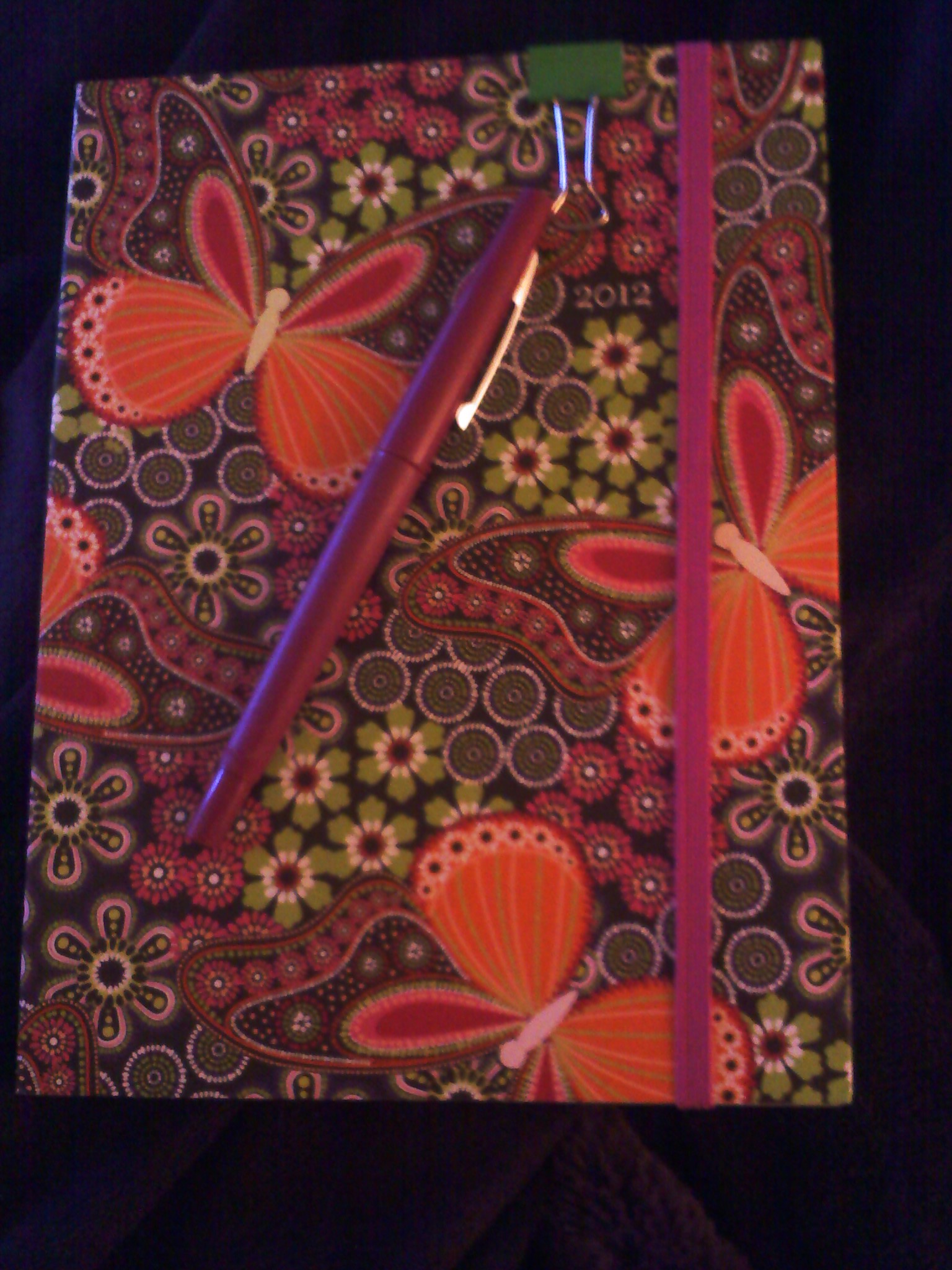
While I have transferred many of my daily activities to be technologically based (everything from keeping in touch via Skype/Face Time to reading nearly all of my books on my Nook), this organizational tidbit of my life is still firmly in the land of paper/pencil.  I love perusing the stores right after the new year, when everything is 50% off, picking out just the perfect planner to see me through the next twelve months. Color and pattern are at the top of the priority list, but design and construction are not to be forgotten. This year, the winner has a dark brown background on which are embossed pink and orange butterflies surrounded by spring green flowers. Both the elastic band to close the book as well as the font inside are a pretty raspberry pink color. This is the planner that will see me through the fanatical list-making that is sure to happen in the next few months; it will be packed and hauled to just about the opposite side of the Earth; hopefully it will utilized as my close companion in the transition to a new job once we get to Chengdu; and it will serve as a way to keep track of when all of our guests are coming and going from their trips to the Middle Kingdom. (Hint. Hint.)

After getting my colorful, sparkling new planner home, I immediately want to begin organizing life for the upcoming year. This means finding some pretty colored pens and filling the book with relevant birthdays, anniversaries and appointments that have already been set.  As many planners these days are 18-month ones, it also means that January doesn’t fall on the first page, but rather several months in, the booklet having started in July. This means I need to dig through my assortment of color-coordinated school supplies and find a matching butterfly clip (the winner is spring green) to hold the already used pages out of the way, clipping them to the front cover.  (I’ve been doing this for years, but only within the last couple did I realize that this wonderful technique is not one I dreamed up myself.  It took a bit to realize where I got it from, but once I did, I can’t believe I didn’t see it all along. I have vivid memories of sitting, after school, in my dad’s counselor’s office at Jefferson Junior High School.  When it was time to pack up to go home at the end of the day, as he gathered his things to go, one think that always got packed up was his dark blue Lifetouch daily planner.  I can clearly see the giant black and silver butterfly clip holding the used pages to the front of the planner itself.  While my planner and clip are definitely more fashionable than my dad’s ever were, apparently his sense of organization unconsciously rubbed off on my all those years ago!)

My love of calendars stems from two roots: first, my obsessive need to be organized (I call it prepared, Thad calls it bossy) and second, my love of all things fluffy and florally and girly.  There is little that combines those two wonderful concepts like a calendar, fresh out of its plastic wrap and ready to help me put a whole new year in its place!

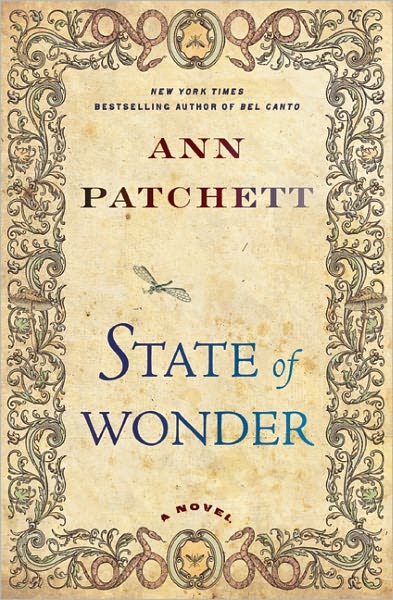
State of Wonder by Ann Patchett

State of Wonder by Ann Patchett

As with many of the books I read, I was first drawn to this novel by an online review I happened to stumble across. The premise of a lab-bound doctor venturing into the unknowns of the Amazon basin on behalf of a huge pharmaceutical company was one that contained the potential to go in so many directions, I just had to find out which overgrown jungle trail Patchett would follow.

State of Wonder is an interesting mix of a fictional adventure/travel genre and a more literary discussion of a large drug companies’ ethical responsibilities vs. its bottom line. The main character, Dr. Marina Singh is sent to Brazil on a double mission: first, to find the reclusive Dr. Swenson, who is supposed to be working on a game changing fertility drug, but refuses to enlighten her employers on its development and second, to find out just exactly how her predecessor, Anders Eckman,  in the previously mentioned mission died and what has become of his remains.

Once she arrives in Brazil and wheedles her way past the gatekeepers Dr. Swenson has employed to keep any and all curious outsiders from finding her and her research station, Dr. Singh discovers that nothing is quite the way it was presented to her back in Minnesota. The drug research, while happening and making huge progress, is not what her employing pharmaceutical company thinks it is, Dr. Swenson is pushing natural boundaries to a breaking point and there is more mystery to the demise of Eckman than anyone in the States knows.

I am always excited to open a new book. Sometimes the start of a new novel takes time to develop, slowly going through the machinations of time and place and character. Occasionally, I’ll happen upon a novel that, from the first paragraph, winds me tightly into its coils like a monstrous anaconda in the Amazon. For me, Patchett went all in and showed her hand on page six with when Eckman, an avid birder, is preparing for his trip to the wilds of South America by pouring over field guides of rainforest aviary. As he describes the reclusive Amazonian dwelling guira cuckoo and the plumage that bedecks its head, Patchett writes, “A person could wash out the inside of a pickle jar with such a bird.” After wiping away the tears that stemmed from laughing so hard at that line, there was no way I was going to be able to put down the book down until I had seen it through to the end.

For the thoughtful mixture of a travel adventure and the philosophical discussion of humanity’s ethical responsibilities towards one another earns Ann Patchett’s Sense of Wonder earns:

Eleven Times Three

While the day is just now arriving, my birthday celebration officially began several weeks ago, on New Year’s Eve, when while home for Christmas break I had the chance to share the festivities with my older sister, Melyssa, and my niece, Audrey, both of whom have end of December birthdays. Being the “big kids” out of the bunch, Melyssa and I deferred to the desires of the sprite-like Audrey, whose wishes included a very pink, very princess birthday party.

In grand fashion, we enjoyed the house swathed in Pepto-pink.  (While I am a total pink girl myself, my tastes run in the direction of raspberry more than cotton candy.) From balloons bedazzled with Disney princesses to a sparkly, pink-pearl embossed cake, it was as if we had fallen into monochromatic land. Colors no longer existed, just shades.

As the big 3-3 has finally arrived (years that are multiples of eleven seem a bit more grand than the others),  in honor of it here are, in a totally random order,  thirty-three things I’ve learned over the last three and a third decades:

  1. There is no appropriate place on a resume to put elementary school perfect attendance awards, but I am sure that the lack of missed days contributed to future job offers is some way, shape or form.
  2.  Not only is it okay, but it is brilliant to buy that cute pair of shoes (or perfect fitting pants or adorable top or cute necklace) in every color offered.
  3. Studying abroad in the Caribbean is definitely a good choice when the options are either northern Utah or Dominican beach in January.  Learning experiences aside, snow-capped mountains always lose to white sandy seashore.
  4. Icy Hot and sunburns should not be mixed. (A small fact I picked up on during the sojourn mentioned in #3.)
  5. Sometimes checking the “no preference” box is the best option. That little box is what landed Thad and me in rural China with Peace Corps for two years and we couldn’t have chosen a better site on our own.
  6. Being a picky eater is fine, as long as you can justify why you don’t eat certain foods.  Reasonable explanations may include “too pointy” (usually in reference to the ends of bananas), “too knobby” (mostly used for chicken strips that are strangely bumpy) and “looks too much like a trashcan” (always for tater tots!).
  7. Just because you already own three copies of a single book does not mean you shouldn’t buy another one when you find it on clearance table for a dollar at a library sale.  You can either shelve it with its compatriots or give it away to someone in need of a great read. There is no such thing as too many books.
  8. 8th graders are the world’s most fascinating species. On one hand, they are still kids, willing to do nearly anything for a sticker, and then on the other hand, in the exact same moment, they are sending texts that would make a madam blush.  (Just don’t combine the two halves or you will face a whole different terrifying predicament!)
  9. Soda pop out of a fountain machine is always the best. I think it has to do with the straw. The fizzy drink hierarchy goes: fountain, bottle, can.
  10. My experience tells me that old people can get away with nearly anything. With little repercussion they can speak their minds (or what is left of them.) They act with near impunity. No one corrects the geezers.  As I inch closer to those grand days myself, I am taking this opportunity to wield the old-folks’ license and do what I want.  No one, myself included, wants to read a list of thirty-three anything, so…enough!

Age has brought wisdom. It may not be not conventional wisdom, and is definitely not street smarts, but an acumen all of its own. The princess party is nothing more than a memory and another year of wisdom has been added to my mental file cabinet. Thirty and three has arrived.

This slideshow requires JavaScript.

The Sense of an Ending by Julian Barnes

As I continue to expand “In Search of the End of the Sidewalk,” I’ve decided to add another category to my musings. As a self-described uber-bibliophile, I readily admit to my love of reading, talking about and recommending books. When I was teaching, my 8th graders and colleagues were a perfect outlet for my need to share fabulous reading material, but now that I am without a classroom and have an ever-changing set of fellow students, I hope to use my blog to continue sharing and discussing great (and, at times, not so great) literature. These “Book Musings” will be short reviews (less summary oriented and more my thoughts)  of the books that are currently cycling through my Nook, along with a “Shell Rating.” Five shells will be awarded to the best of the best, with one shell being given to books that I was able to survive, but am utterly incapable of suggesting anyone else endure. With that introduction soundly delivered, here is my first Book Musing!

The Sense of an Ending by Julian Barnes

This novel made it onto my Nook as my book club’s January selection. As end of the year lists were compiled by any and all media outlets with any slight leaning towards literary aspirations, The Sense of an Ending made frequent appearances.  If others loved it, might we as well?

I have to admit, I finished this book well over a week ago, but put off writing this musing because I wasn’t sure what I thought of it. My first impression of this novel was one of bleakness.  This vibe isn’t only because suicide plays a hefty role in the storyline, but because the main character, Tony, as he looks back over his life and ponders the choices he has made and their subsequent consequences, doesn’t seem to have many positive times to cling to. While he isn’t overly downtrodden by these events, as an outsider, I had to feel a sense of defeat for him.  Our vision for life is that the good times ultimately outweigh the bad times, but for Tony, the best of the best and the worst of the worst hardly seemed to register on his radar. He seems content with utter mediocrity in his life.

The heart of the novel lies beyond the tangled web of Tony, his first real girlfriend, her mother and his best friend. Questioning the accuracy of our memories and the light in which we choose to recall events throughout our lives is really what the novel forces the reader to consider.  Tony is far from a reliable narrator, and yet, can we say that we are reliable narrators of our own lives? After telling the same story over and over to friends, to colleagues, at parties, are we really telling the reality of what happened or has it become warped and twisted into a new version of itself?  The short but dense novel coerces the reader into reminiscing about his/her own recollections and how dependable they may be.

While I was on the fence initially about this book, after some great discussion with the ladies at book club and thinking back over some of the really intriguing one-liners in the book, Julian Barnes’ The Sense of an Ending is awarded:


Wii-ning Advice

Much like the poultry population of southern China, our Oakwood population is experiencing its own culling process. Friends that we’ve made through Thad’s A-100 training class and language training are beginning to pack-out and leave for their respective assignments.  On one hand, this is great because the commencement of their tours means ours isn’t far behind, but on the other hand, it is a bit odd to not have the same people on the shuttle each morning and evening and to not have the same people chatting around the table at lunch each afternoon.

This week was the last week at FSI for two such people.  Ian and David both just dominated their end of course language tests and are now headed west to visit family before heading far, far east where Ian will begin his assignment in the Guangzhou consulate. Thad and Ian started Chinese classes together last July and have spent a large portion of each day together since then. David and I joined the party a bit later, but have also had our share of time on the fake-coyote ridden campus of FSI.

A bit of an impromptu going-away party convened last night to celebrate their impending departure and to wish them well in their new adventures. While I usually am not up for anything big on a Friday night, riding up the elevator five floors for a get-together is definitely doable! The evening’s docket included pizza, soda, chips and a bit of Wii.

This being my third Wii-experience (Wii-sperience?) in as many months, I have a few tidbits for my fellow players who also lack technological aptitude:

  1. Apparently, calling yourself a “video game player” is not appropriate lingo for those who are serious about their games. If you refer to yourself this way, it is equivalent to donning a sandwich board sign advertising your lack of video game skillz. (Spelling and pronouncing skills with a “z” may lead to a similar assumption, but I’m sticking with it!)
  2. Just because you are a decent driver in real life (no pullovers or tickets for this motor vehicle operator) does not mean those abilities will in any way translate to video game driving abilities. After coming in 11th and 12th consecutively, David jumped in to be my back seat driver.  In addition to giving me hints about upcoming turns and obstacles, his squeals when I careened into various gorges and ravines kept me on my feet. With him riding shotgun, I soon propelled my standing from the bottom of the pack to 2nd place!
  3. Don’t listen to your competitors-ever. Their advice should not be heeded. Towards the end of an intense Mario Party clashing, as I was about to purchase my third star, thereby putting me in the lead, I was debating whether or not it was in my best interest to allow Donkey Kong to shoot me out of his cannon (really, who wouldn’t want a ride in a cannon?!?), I hear something say “Yes!”  Thinking this advice was coming from someone in-the-know, I chose to take the cannon ride, which catapulted me not to the star as I thought it would, but rather to the Never-Neverland of Mario’s prehistoric jungle. There would be no star in my future, at least in that round.

As a thrice-experienced “gamer”(this, I am told, is the correct way to label yourself if you have wasted away hours of time on your sofa, moving your pixilated men and creatures in hopes of achieving virtual success), I feel that my past mistakes can be learning opportunities for those who follow in my technological footsteps.  While these tips may not allow you to be the ultimate winner of Mario Party (which I was last night, by the way!) but they will give you a leg-up on your fellow uninitiated video game players.

The coming months will see many more goodbyes, but mostly great ones, as it means everyone is finally heading out to their multitude of awesome posts, as well as the possibility of a few more virtual game nights. I doubt I will ever be good at goodbyes, but I will continue in my quest to achieve the gaming skills of a six year old!

This slideshow requires JavaScript.

The Lure of Sky Mall

It was with the best of intentions that I loaded my Chinese reader into my carry-on bag, determined to schlep it through multiple airports so that I could dutifully work the homework that I have neglected for the last week and a half. Carrying the rather large paperback meant my fruit snacks and Thad’s Combos had to be rearranged to save them from becoming balls of chewy goo and pizza-flavored crumbs, but if I were to get caught up on some of my classwork, the new packing arrangement would be well worth it.

I started the trip sticking with my study plan.  No sooner had I eaten my ritual pre-flight pancakes at the Boise Airport, than I dug my Chinese reader out of my paisley clad shoulder bag and picked up on chapter seven, where I left off yesterday. (I would have made it farther in the book yesterday, during my bonus-vacation day, but my focus was diverted by one tiny three-year old dancing around the living room singing “No king, no king, lalalalalala!” as she watched her newly acquired Lion King DVD yet again. It is pretty hard to concentrate on passages about percentages of Chinese people in the American workforce when a pack of laughing hyenas and a sprite of a child are available entertainment.)

So now, seated in the second row of a Southwest Airlines flight from Salt Lake City to Baltimore, enjoying my more than ample legroom and Plane Cookies (seriously, they are shaped like tiny airplanes!), I should once again pull out that never-ending mass of semi-decipherable characters and try to get through another chapter or two. I have the will-power to resist peering out the window, watching the fly-over states drift beneath us. I have the will-power to resist watching an episode or two of Sheldon’s antics and Penny’s marvelous outfits on The Big Bang Theory. I even have the will-power to resist the new book I recently downloaded to my Nook from the Arlington Public Library about women entrepreneurs trying to make their way under the banner of the Taliban in Afghanistan. What do I not have the will-power to resist? Sky Mall!

That’s right. Flying through the air in what is essentially a tin can filled with my fellow humanity, I have put off studying the mother tongue of the country that I will soon, once again, call home for two years, all in the name of browsing what has to be the world’s most eclectic, most random catalog to ever grace the seat-pockets of any form of transportation.

Just as my easily diverted attention span’s luck would have it, during our westward flight home for the holidays and the eastward one post-New Year’s, the Sky Mall magazines transitioned from the Late Winter 2011 edition to the Early Spring 2012 one, providing not only all the same useless fare in an updated format, but also some new and improved accompanying rubbish.

Rather than add to my dismally small reserve of recognizable Chinese characters, I have spent the last hour of my flight perusing such fabulous finds as the toilet seat that automatically raises and lowers. The accompanying blurb states that “Some men have a hard time remembering to put the toilet seat down after use.” Apparently, thirty seconds after a bathroom user walks away from the commode, the seat self-closes, “preventing germs and diseases from spreading.” While wanting to slow the spread of nasty germs is a valid undertaking, for me, the issue has less to do with microorganisms than it does with not wanting to wander in to the bathroom in the middle of the night, half awake, and end up not on the seat, but rather stuck in the bowl! Sadly, my Wi-Fi-less flight does not allow me access to skymall.com where I would find a video of this lovely product in action.

Sky Mall magazine contains solutions to such age-old problems as early balding (via a head covering that looks as though it could double as a means of contacting aliens) and bunions (via a plastic contraption that might possibly double as a means of torture). Through the 111 pages that make up the Early Spring 2012 edition of my favorite in-flight catalog, I’ve had the pleasure of being introduced to Tuddles the dog and his special bedding needs; I’ve been offered the chance to own my very own video screen microscope; and I’ve discovered my life just may not be complete without an eight foot tall pop-up banner for all my advertising needs.

Not to be alone in my time wasting, Thad also took a break from his even larger and heavier Chinese reader to explore the wonders of the Sky Mall world. He seemed to gravitate towards a strange looking plastic contraption that claims to use UV rays to disinfect shoes. This ground-breaking device avoids chemicals in its quest to kill 95% of foot bacteria. Again, if only I had internet access, I could be sitting here, enjoying a video view of the workings of the Sh-UV-ee Shoe Deodorizer. Oh, for want of the internet…

In just a few more hours, I’ll be back on terra firma, shuttling towards the mo-partment, contemplating tomorrow’s return to the Chinese classroom and seriously wishing I had used my flight time more wisely. I can already picture it, and yet, Sky Mall is still persuasively calling my name. It seems I will have to just consider the consequences of unfinished homework a problem for Future Michelle to tackle.

This slideshow requires JavaScript.