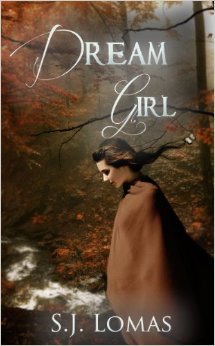
Dream Girl by S.J. Lomas

Dream Girl by S.J. Lomas

51G3zD-MQAL._SY344_BO1,204,203,200_


Dream Girl is the first in what will be a series of books by S.J. Lomas. As is the case with many inaugural books, much like TV show pilots, this narrative is very character focused, building the back stories of the characters who will reoccur in the following books, creating a strong foundation for future narratives.


While character-focused books often go a bit slower than action-oriented ones, Dream Girl doesn’t get bogged down by the scaffolding needed to create a series. Right away, readers connect with Christine, our good-girl protagonist who is drawn to Gabriel, the darker, mysterious boy who is worth a bit of extra time.  Not long after Christine meets Gabriel, through their part-time jobs at the local library, she experiences a terrifying incident where she is drawn into a dream world that she doesn’t understand and can’t break free of on her own. These jumps to another realm continue the more she gets involved with Gabriel, and it doesn’t take long for her to see that there is more to him than just a troubled young man.


Written with teenage girls in mind, the love story plot of the book is immediately obvious and soon twisted into a bit of a triangle, as the young man meant to help Gabriel and Christine break free from the danger of the dream world becomes an additional possible love interest for Christine.  Up until this point, I was pretty onboard with the narrative, but the turn towards a Twilight-esque love triangle left me a bit disappointed. I’d like to give teenage girls a bit more credit- having a strong female protagonist doesn’t require her to be attached at all times. Even though Gabriel is a major player in the book, I’m not sure many teenage boys would stick with this book to the end; the romance plays a little too heavily.


Love narrative aside, the book does a good job of creating a world in which the reader wants to continue. Sometimes at the end of a book that I know will be a series, I am happy to put it back on the shelf with no intention of ever picking up its counterparts. That can’t be said for this one. I’m hoping that the sequel to Dream Girl will see Christine move away from the need for a boyfriend and into a solid character on her own, but I’m also curious to see what happens to Gabriel, as the decision about what to do with his life was taken away from him and he is now forced into something that he can’t avoid. I’m hoping the characters continue to grow in their own rights and that the storyline is shored up in the next book, now that a strong foundation is in place.  S.J. Lomas’ Dream Girl isn’t totally engrossing, but it is interesting enough to have kept my attention and make me curious about what happens next, earning it:

books shellbooks shellbooks shell


Sisterland by Curtis Sittenfeld

Sisterland by Curtis Sittenfeld

 9781400068319_p0_v2_s260x420

I was initially drawn to the book because it centers on a (possible) earthquake and I have a bit of a history with those myself, but I didn’t expect the book to revolve so heavily around relationships and the ties that bind a family. The story took a decidedly different turn from what I had expected, but it was not an unpleasant journey.


Curtis Sittenfeld’s latest book weaves the tale of twin sisters, Daisy and Violet, who were born with the gift (curse?) of having premonitions of future events. (As the girls realize they have an ability not shared by all, they call their power their “senses,” not knowing how else to label it, as any discussion of their ability is quickly muted at home.) These shared senses are nearly all the two have in common as adults.  While Violet embraces her ability, dropping out of college after just a few weeks because Guardian (a spirit guide who came to her for the first time while she studied in her university library) told her she had a different path to take in life, uses her skills as a source of revenue, holding séances and readings, Daisy runs in the opposite direction from her abilities. After starting college under the guise of her middle name, Kate, and then taking her husband’s last name after marriage, she has effectively closed the door on her history as one of the twins with senses. No one can track her or immediately connect her with her outspoken sister.


A back story of a clinically depressed mother overwhelmed by life and school years besought with bullying and name-calling (the twins were well-known to be “witches)  helps the reader see why one sister might embrace the notoriety that would come with premonitions of the future while another would turn tail and run. Basing a book on the idea of extrasensory abilities has the potential to head towards comic book storylines, but Sittenfeld’s characters are well-rounded and deeply developed so the reader imagines them as real people and not people who belong in Lycra uni-tards on the big screen, saving the world through the destruction of evil.


The two women live near each other, and near their aging father, their relationship is strained when Violet publicly announces that she senses an earthquake will soon ravage their home state.  Kate is suddenly drawn back in to a world that she swore off after the birth of her first child.


Up until this point, I really enjoyed everything about the book. The strained, but loving, relationship of the family is one that is relatable to many readers and the plot flows well. But, I can’t walk away from this review without one minor grievance: Kate is a stay-at-home mom and is good friends with a stay-at-home dad up the street. (Conveniently, her husband works with his wife at a local college.) The problem lies in the cliché. While the two have been friends for years, suddenly their relationship jumps to a whole new level, once again playing into the idea that it is impossible for a man and woman to have a truly platonic friendship.  Plus, this bit of indiscretion on Kate’s part creates a whole new storyline as the consequences of her choice create far-reaching ripples, but ones that don’t entirely play out in the narrative before the books ends.


Curtis Sittenfeld’s newest book is well-written and even though it is based on extrasensory hunches, is mostly believable as realistic fiction. (I had to look the author up to realize that Curtis is a woman. As I read, I was surprised that a man could write the intricacies of the sisters’ relationship so accurately!) Even as I am annoyed with the ending of Sisterland, I think it is a story that would be enjoyed by many, falling firmly into what I would call the “beach read” category”, earning it:

books shellbooks shellbooks shell


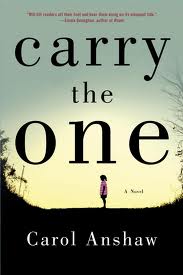
Carry the One by Carol Anshaw

Carry the One by Carol Anshaw

carry

Western-style burgers and pizza aren’t the only things Beijing has that our little (okay, not little, but non-connected) outpost of Chengdu lacks, although filling up on both this last weekend was a treat. No, we are also missing a true English-language bookstore, which means I’ve been deprived of shelves upon shelves of novels, memoirs and travel writing for months now. (Yes, I’ve got my Nook and do a good deal of book downloading on it, but there is something special about thumbing through a book off the “new releases” shelf or the “employee favorites” table that is lost in the translation to digital reading.) My trip to the capital this last weekend not only did some serious damage to my waistline (thank goodness for skirts with stretchy waists!), but also to my pocketbook (thank goodness for per diem!).

One of my treasures from this outing was Carol Anshaw’s release from last fall, Carry the One. (No worries my math-phobic friends. The title is in no way a reference to adding large numbers by hand!) In this newest novel by Anshaw, the reader is taken on a multi-decade tour of the lives of a group of friends who share a bond after all are present for a terrible disaster. While some are able to come to terms with what happened on that fateful night, not ever necessarily forgiving themselves for the pain that was caused, but creating lives of their own beyond the tragedy, others circle back to that night over and over, in a downward spiral that only ends in more pain.

Love is found and lost. Relationships grow and ebb. Careers are built and tumble down. But through it all, this core group of characters (friends is a bit of a stretch, especially as time goes on) are reunited over and over, always being reminded of the terrible bond they share.

I must admit that I wasn’t instantly drawn to the narrative of Carry the One. I found the ensemble cast hard to keep track of for the first few chapters and I wasn’t sure I would ever get them straight in my mind. But, not long after I considered the need to make a chart (thankfully I was able to contain myself and not get that crazy), the storylines diverged enough that each individual became unique and separate from the whole, while still being connected to the main tale. By the end of the book, I was definitely drawn to some characters and their personal struggles to deal with the shared tragedy, while I was disgusted at how others chose to profit from the pain of someone else. Creating such strong feelings about the players, whether positive or negative, is the mark of a great writer.

Like a wheel, with the central hub being the fateful night of the first chapter, each character spins off as a spoke, creating a life of their own, yet never being able to fully shake their shared nexus.  Carol Anshaw’s latest creation, Carry the One is a powerful narrative of pain and loss and the desire for redemption and healing, easily earning a solid:

books shellbooks shellbooks shellbooks shell

The Program by Suzanne Young

The Program by Suzanne Young

the program

Yes, another dystopian young adult novel book review from In Search of the End of the Sidewalk. I’m a sucker for them! All of the websites where I buy books or that I look at for book recommendations apparently have me pegged as an angst-ridden teenager because these types of books are always at the top of the “to read” lists and I never just click away to something else.

The Program is the first novel in a series by Suzanne Young, a newer (although not brand new, as she has a couple other books already published) writer who daylights as an English teacher. The book takes place in the not-so-distant future when an overuse of antidepressants is believed to have spawned an epidemic of suicides in the teenage population. There is no proof that the medication was the impetus, but as a generation of adults who were heavily medicated become parents of young adults, the rash of deaths is pushed upward of one in every four teens taking their own lives. As the country goes into panic mode over these cases, The Program is created to keep kids for ending it all.

Once a teenager is flagged for The Program, they are forced into a facility where their memories are taken away, one by one. The idea is that if the kids can’t remember the bad things, they won’t want to terminate themselves. The powers-that-be believe that the suicides are a plague and can spread from student to student, so as soon as one is infected, their friends are closely monitored for signs of negative changes and quickly flagged. This process leaves no room for true emotion or time to grieve over losses, as those difficult emotions are instantly interpreted as infection.

It is in this world that Sloane and her boyfriend James are trying to stick together and make it to their eighteenth birthdays, at which time they will be free of the threat of forced “treatment” through The Program.  As some of the people closed to them succumb to the infection or disappear into the blank-slate world of The Program, their ability to maintain facades of “normality” is challenged more and more frequently.

The premise of this novel is a good one and allows Young to explore some interesting areas of psychology, especially what makes someone themselves. If their memory has been wiped clean, are they still the same person as when they had a lifetime of memories? Or, how can one trust those around them when they have no background? Just because you were told someone was your friend, how do you know they really were? The chances for manipulation and abuse are rampant within these table rasa teens. These would be awesome discussions to have in a book group or classroom full of teenagers who already question who they are and what they want from life.

When I first downloaded this book, I didn’t realize that it was the first in a coming series of books, but it didn’t take long to figure out that the plot wasn’t going to come to a nice, complete ending by the final page. All along, it is setting the scene for future books, which I must admit is a bit of a downside. In theory, I don’t mind series (and I think they are great for reluctant readers who get caught up in with a tale and characters they love!), but when the book obviously feels like a set-up for what comes next, I must admit to being a bit disappointed. In the case of this novel, I think I may have liked it a bit better if it had been longer, but told a complete story, rather than stopping at what is clearly a jumping off point for book number two.

In the end, the series-format is the only thing that turned me off a bit to this slightly-futuristic novel. Suzanne Young’s exploration of self and memory is one that I found intriguing and created enough questions in my mind that I will definitely be downloading book two when it comes out, earning The Program a solid:

books shellbooks shellbooks shellbooks shell

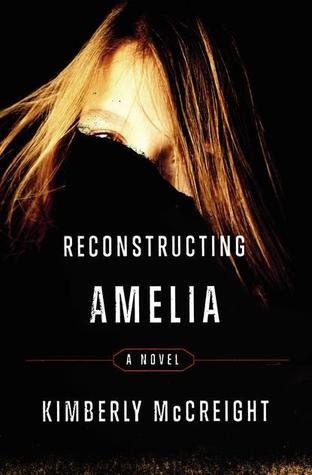
Reconstructing Amelia by Kimberly McCreight

Reconstructing Amelia by Kimberly McCreight

15776309

After avoiding it for months because it had become “too” popular, last winter I finally downloaded Gone Girl to read on the long flight from western China to Idaho. (I tend to get a little snotty about books that *everyone* says I must read.  When they become a cultural phenomenon, I get turned off by the saturation in the news and internet. It’s uppity and judgmental, I know. And yet, it’s how I roll.) But back to Gone Girl,I loved it! With that rambling introduction, this isn’t a review for Gone Girl by Gillian Flynn, but rather one that came up on a recommendation list I look at saying if I liked that one, I should try Reconstructing Amelia  by Kimberly McCreight. They were right!

Much like the suspense that kept me turning pages way too late at night with Flynn’s book, Reconstructing Amelia had me spellbound much longer that was prudent for the few days the book lasted. McCreight’s story starts with the suicide of Amelia, who jumped off the roof of her liberal, left-wing private school, and her mother’s arrival on the scene. But, it quickly jumps back in time, leading readers through the months prior to Amelia’s death, creating a picture of a teenage world much more complicated than her single, long-hour working lawyer of a mother would have liked to believe she lived in.

Told through Kate’s investigation of her daughter’s death (six weeks after Amelia’s death,  on the day she returns to work at her high-priced law firm, Kate receives a text message from a blocked number saying Amelia didn’t jump), the reader follows Amelia’s steps, and missteps, in those crucial months before she died. We not only get to have Amelia as a narrator, but, along with her grieving mother, we delve into her texts and emails (somewhere most parents don’t want to go), her relationships (both long-standing and newly-budding) and read past editions of a nasty online newsletter circulated anonymously at her school.

Several time throughout the book I thought I had pieced together the puzzle of why Amelia would take such a drastic measure, only to have the pieces shift and leave me looking at a whole new scene. McCreight does a wonderful job of giving readers enough information to keep them hooked, but not revealing the entire story until the final pages of the novel.

A tale of a young girl’s suicide may not seem like the book you want to rush home from work to curl up with on the couch, but Kimberly McCreight weaves a tale so intricate and twist-filled that I did just that- scurried home from work and into my pajamas so I could read a chapter or two before dinner and then another few before bed, easily earning Reconstructing Amelia: 

books shellbooks shellbooks shellbooks shellbooks shell


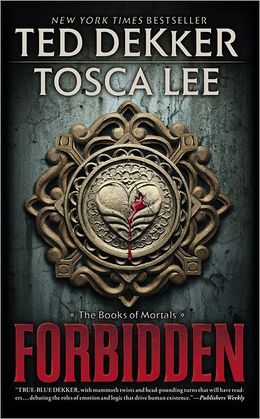
Forbidden by Ted Decker and Tosca Lee

Forbidden by Ted Decker and Tosca Lee

forbidden

Terrible.

So why even bother to write a review for In Search of the End of the Sidewalk? I’ve read tons of other books that would rank higher than this one. And yet, although it was terrible, it was still okay. Facing a fourteen hour flight from Los Angeles to Shanghai (and then several more hours to Chengdu), I was looking for something mindless, but something that would pull me in enough to make hours fly by without my noticing them. Forbidden did the trick.

Decker (with Lee) created a book that is smack in the middle of the genre I like to call DanBrown. (No spaces. It stands alone as a single noun.) We all know DanBrown as a genre. There’s mystery and intrigue. There are religious overtones. There’s a love story. There’s less than spectacular writing, but enough of a plot that the reader ignores the craftsmanship for the story.  Forbidden has all of the elements to some degree or another.

Forbidden tells the tale of a future society in which the world is ruled by a single government, emotionless, other than fear. All feelings have been wiped out, leaving only fear as a way those in charge to control the masses. As the time comes for a new sovereign to be placed in power, a remnant of those old emotions that were thought to be extinct, again finds a way in to the population. While only a small handful of citizens are able to experience the wider range of feelings, those who are touched realize that love is not only a beautiful thing, but it can also bring pain greater than any they could imagine.

The basic plot is there, but as a whole, Decker didn’t develop the society to make it believable. As I read, I wanted to know more of what it was like to live in a society void of feelings. The reader barely gets a glimpse at the world before the first character reverts to a state of feeling. Rather than focus so heavily on the royals of this period, I would love to have more set-up of the average people living without feeling. I would prefer a book that went in the direction of a dystopian 1984-type world than the DanBrown genre I got.

Maybe I am asking too much. To be fair, I bought this book off the mass paperback stand at an airport kiosk. I didn’t buy it for its literary appeal, but rather its ability to waste away a couple of in-flight hours. Which it did. So, while Ted Decker’s (and Tosca Lee’s) Forbidden earns a measly one shell on my rating system, I do give it slight props for helping pass the time at 30,000 feet.

books shell

The Paris Wife by Paula McLain

The Paris Wife by Paula McLain

Hemingway is a divisive figure in literature. Some people love his style and try hard to emulate his unique way of writing, while others are turned off by the seemingly mundane details included in each chapter.  But, whether you love the man or hate the man, Paula McLain’s The Paris Wife is a book worth picking up, as it shows an earlier side to the man who would change American literature forever.

Hadley robs the cradle when she marries Ernest, a man eight years younger than her. But, after living a life of coddling and seclusion, and one where she was staring old-maidhood in the face, Hemingway paints a picture of a future filled with adventure and society and excitement. Against the judgment of their families, the two marry and soon decide to move to Paris, where Hemingway can work on his craft in the midst of other artists. While they are portrayed as being deeply in love, I have to admit that the dialog expressing this love tended to be a bit over the top and stereotype-ridden. At one point Hadley says, “Did you ever think it could be like this?” I felt like I had been thrown into the cinematic debut of Nicholas Sparks’ latest romance.

Paris in the 1920s was a place where traditional marriage was no longer looked upon as sacred, at least the Paris of the Hemingway coterie. Within their circle of friends, extra-marital trysts were common and ignored. Apparently, if they were not openly discussed, they were not an issue. The Hemingways fare well for a while, but after the birth of their son, as pressure mounts on Ernest to become the published writer he has always dreamed of being, a woman Hadley considers her friend wedges her way in to their relationship, soon making a mess out of what had been so strong. The book actually begins with Hadley discussing the disintegration of her marriage, so there is no spoiler alert needed in saying that what started as roses and kisses and long letters morphed in to angry words and late-night fights and a parting of ways forever.

Getting an inside look at Hemingway’s early days is fascinating and was enough to have me hooked throughout the length of the novel. There were times where I thought that if the book had not been based upon a writer whom I enjoy reading and had not been as well-researched as it was, I would never have made it through as a simple novel. Hadley as a character is insufferable when it comes to motherhood. I couldn’t believe how many times she left her child with a nanny so that she could go on a ski-vacation in the Alps or attend the running of the bulls in Spain. The worst was when the boy had whopping cough and had to be quarantined, rather than stay with him through the difficult time, she called on the nanny to come and nurse him better so she could go out in the evening for drinks with their group. Maybe that was the norm for their set in Paris in the 20s, but it did not make her a sympathetic character.

While name-dropping is not normally looked upon as a social grace, in Paula McLain’s The Paris Wife it is a compelling aspect of the Hemingway-centered narrative. Cameos are made by Ezra Pound, F. Scott Fitzgerald, James Joyce and Gertrude Stein, just to name a few. Reading this book was like watching an ensemble cast movie, with all the top names of the day signing on to a single project. But unlike many of these Hollywood heavy-hitter filled movies where a lot of A-list names aren’t enough to satisfy the viewer, readers of this book walk away intrigued and ready to read more about each character. At times, both Hadley and Hemingway are hard to stomach, and the whole book leaves me feeling a bit more negative towards Hemingway as a person, the book is an entertaining read, both historical and literary points of view. McLain’s The Paris Wife earns:


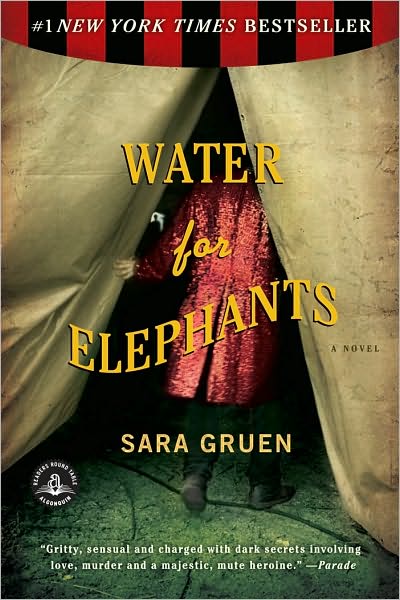
Water for Elephants by Sarah Gruen

Water for Elephants by Sara Gruen

I feel like a late-blooming middle schooler on this review. The new kid came to school, was a hit, so popular it made the A-team of actors/actresses in its movie form; all the while I was sitting on the bleachers, engrossed in pursuits that fully ignored the cool kid. Coming to Water for Elephants late, I was wary- it became too big, too popular and too commercial- was it really any good?

The answer is an unequivocal, yes!

If, like me, you ignored this book when it first came out (although judging from it sales, I may have been the only one) it is not too late to run away with the circus.

Water for Elephants is a beautifully written tale, told by Jacob Jankowski,  an old man (either ninety or ninety-three) sitting in a retirement home in the twilight of his life, watching a big top go up in the parking lot across the street, reminiscing about his days with a traveling circus. The story jumps from his present situation of declining mental capacity and depression to the beginning of the end of the heyday of the traveling menageries, where our narrator worked as a vet, fell in love with a performer and watched the demise of the Benzini Brothers Most Spectacular Show on Earth.

Jacob’s personal tragedy leads him away from the Ivy League school where he was about to graduate with a veterinarian’s degree and to the Benzini Brothers’ show, where he joins first the ranks of the working men, but soon is embroiled in a web of intrigue with the Marlena, her husband August, and the newest addition to the menagerie, Rosie, an Polish-understanding elephant.

What I loved about this book was the depth of the connections between characters. When Jacob’s world crumbled around him after the sudden death of his parents, his despair is palpable. When Marlena and August’s relationship comes to a tipping point, there is no denying the hurt and betrayal, but also the relief and freedom she feels after making her decision.  When Camel must be protected from Big Al’s ruthless “red-lighting” of unwanted workers, compassion and subterfuge take over.

Rosie, the circus elephant, is every bit as much a character in this book as Jacob, Marlena, August or Uncle Al. We feel her deep connections to the various human characters and her pain when she is treated treacherously and abusively. The wheels turning in her head are as obvious as if she were a person placed in similar circumstances. As the pain builds, there is no denying the emotional pain that goes in to her eventual resolution of the situation at hand.

Sarah Gruen’s novel’s sensational popularity is not unearned. It is a tale of romance and mystery, of the happiest place on Earth turned abusive and lethal, and of an old man reconnecting with his roots before it is too late.  As I read this tale, I was enraptured, just a like a child would be sitting next to the center ring under the big top, eating pink flossy cotton candy off of a paper stick and slurping lemonade from a plastic cup, and for this, the Water for Elephants earns:


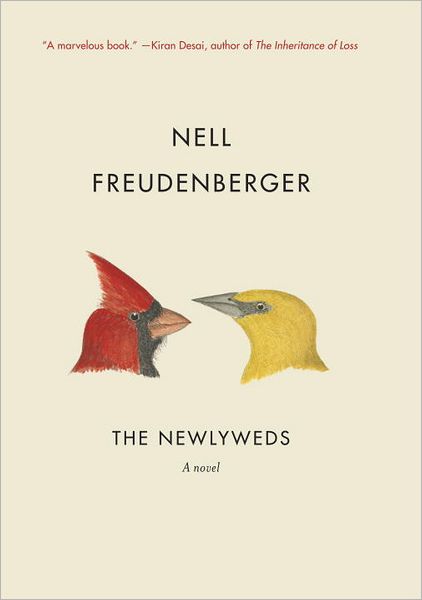
The Newlyweds by Nell Freudenberger

The Newlyweds by Nell Freudenberger

I love fiction set outside the United States, the more far-fetched the better, as it holds a window up to parts of the world that I may never get a chance to see and experience. Nell Freudenberger’s newest novel, The Newlyweds is a wonderful entanglement of two very opposite worlds- that of Amina, a Bangladeshi young woman and her new husband, George, an American who went looking for love online.

George and Amina  meet on AsianEuro.com, where he has gone in search of love to console a heartbreak he isn’t as over as he thinks he is and she is looking for love, or at least a connection, that will allow her and her parents to leave behind the life they have in Bangladesh and start over in what they imagine is the Land of Dreams- America. After an online courtship with just a few bumps, George flies to Bangladesh with an engagement ring in his pocket, to meet the woman with whom he has been exchanging emails filled with stories of who he is (although, Amina will soon learn that there are secrets left untold.)

With their engagement behind them and Amina’s successful application for a visa, she travels to the United States alone, to be married and start a life with George, knowing that she will apply for her parents to follow as soon as it is legally possible. She and George settle in to married life and get along fine, but between George’s past love affair and Amina’s future plans, there are certain aspects of themselves that they are each unwilling to share.

Having never been to Bangladesh, I can’t say how accurate the portrayal of the country is, but I was struck less by the poverty described in certain sections and more by the brutality employed, seemingly with impunity, by Amina’s distant family members who feel that her father has stolen from them. Between the attempt by one to burn her and her mother alive in their apartment to the acid thrown on her father in the market when she has come home to help her parents secure visas, the violence and lack of punishment for it is astounding. Bangladesh is made out to be rather lawless, especially when it comes to the villages. It seems like a terrifying place to live, let alone raise a family, and it is understandable why Amina and her mother have worked Amina’s entire life to find her a way out.

I love that this story is a realistic look at what marriage might be. In the US, we are conditioned to think love is the one and only basis for a happy marriage, but there are other ways to reach that same level of contentment in a relationship. George and Amina have some tough times and are forced to deal with a variety of difficult issues early on in their marriage, but that doesn’t mean they don’t work through them and create what could ultimately be a lifetime of happiness, despite their cultural differences. Nell Freudenberger’s beautifully written latest work, The Newlyweds, was outstanding and easily earns:


Mr g: A Novel About the Creation by Alan Lightman

Mr g: A Novel About the Creation by Alan Lightman

Science and religion have differing views on how our world came to be what it is today. Some argue that a giant explosion, long, long ago created the basis for the life that is now sustained by our planet, while others believe our existence is due to an omniscient, omnipotent power larger than we can imagine. Alan Lightman’s latest creation, Mr. g follows the creation of a universe and planet from their inception to their final destruction.

The title character, Mr. g, has been living in the Void with his aunt and uncle for time unlimited. There was nothing before him and nothing without him. Before deciding to create order in a small corner of the Void, time didn’t even exist, but he dwelt indefinitely in the nothingness.

Mr. g undertakes the creation of a galaxy by laying out some basic laws and then allowing those laws to dictate what happens with the matter within the realm. After a time, he decides to focus his attention and energies on a single planet- one he names Aalam- 104729. Over time, this world becomes inhabited by every more complex and complicated forms of life. Mr. g, at the request of Belhor, another roving being of the Void, stands back and doesn’t interfere with the burgeoning world. (Belhor, on the other hand, feels no such compunction on his own account, and meddles from time to time.)

Lightman’s background as a theoretical physicist and his adept writing skills allows him to create an intriguing novel based on a strong factual foundation. As the science of the creation of a universe unfolds, Lightman isn’t pushing for a choice between the Big Bang and Creation theories. Mr. g builds a galaxy in which both schools of thought sit neatly, side by side.

Beyond the science though, the writing is what really stood out to me. It is beautiful. Through his words, Lightman creates a spectacular scene of stars coming into being and burning out over millennia. I never imagined atoms and particles and bits and pieces that create life to be so astoundingly poetic. At one point, Mr. g’s aunt decides she wants a gift, something not from within the Void. Mr. g and his uncle create a dress for her out of the stars of another galaxy. I am not sure how Lightman pictured this dress in his mind, but in mine it is a spectacular frothy frock backlit by twinkling stars. The dress is Paris couture at its finest!

The premise of the novel is a unique one and as a reader, you must find a way to put yourself in the Void with Mr. g. Once that suspension of disbelief is allowed to take place, this book is like falling through space. There are wonders to be found on each page as Mr. g creates, watches over and eventually mourns the loss of his first universe. Alan Lightman’s novel Mr g: A Novel About the Creation is a masterful work of art, blending science and literature in a way that few fictional books are able to, thereby earning it: