State of Wonder by Ann Patchett

State of Wonder by Ann Patchett
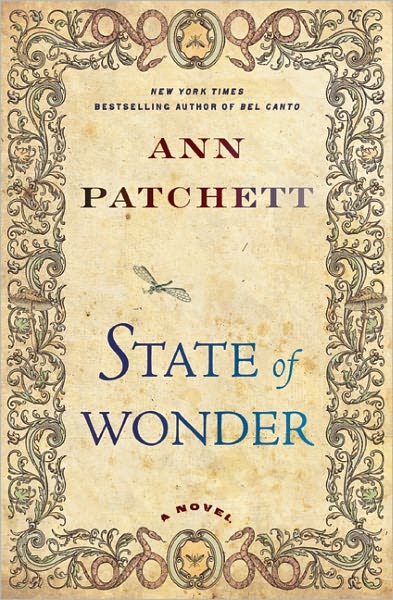
As with many of the books I read, I was first drawn to this novel by an online review I happened to stumble across. The premise of a lab-bound doctor venturing into the unknowns of the Amazon basin on behalf of a huge pharmaceutical company was one that contained the potential to go in so many directions, I just had to find out which overgrown jungle trail Patchett would follow.

State of Wonder is an interesting mix of a fictional adventure/travel genre and a more literary discussion of a large drug companies’ ethical responsibilities vs. its bottom line. The main character, Dr. Marina Singh is sent to Brazil on a double mission: first, to find the reclusive Dr. Swenson, who is supposed to be working on a game changing fertility drug, but refuses to enlighten her employers on its development and second, to find out just exactly how her predecessor, Anders Eckman,  in the previously mentioned mission died and what has become of his remains.

Once she arrives in Brazil and wheedles her way past the gatekeepers Dr. Swenson has employed to keep any and all curious outsiders from finding her and her research station, Dr. Singh discovers that nothing is quite the way it was presented to her back in Minnesota. The drug research, while happening and making huge progress, is not what her employing pharmaceutical company thinks it is, Dr. Swenson is pushing natural boundaries to a breaking point and there is more mystery to the demise of Eckman than anyone in the States knows.

I am always excited to open a new book. Sometimes the start of a new novel takes time to develop, slowly going through the machinations of time and place and character. Occasionally, I’ll happen upon a novel that, from the first paragraph, winds me tightly into its coils like a monstrous anaconda in the Amazon. For me, Patchett went all in and showed her hand on page six with when Eckman, an avid birder, is preparing for his trip to the wilds of South America by pouring over field guides of rainforest aviary. As he describes the reclusive Amazonian dwelling guira cuckoo and the plumage that bedecks its head, Patchett writes, “A person could wash out the inside of a pickle jar with such a bird.” After wiping away the tears that stemmed from laughing so hard at that line, there was no way I was going to be able to put down the book down until I had seen it through to the end.

For the thoughtful mixture of a travel adventure and the philosophical discussion of humanity’s ethical responsibilities towards one another earns Ann Patchett’s Sense of Wonder earns:

The Sense of an Ending by Julian Barnes

As I continue to expand “In Search of the End of the Sidewalk,” I’ve decided to add another category to my musings. As a self-described uber-bibliophile, I readily admit to my love of reading, talking about and recommending books. When I was teaching, my 8th graders and colleagues were a perfect outlet for my need to share fabulous reading material, but now that I am without a classroom and have an ever-changing set of fellow students, I hope to use my blog to continue sharing and discussing great (and, at times, not so great) literature. These “Book Musings” will be short reviews (less summary oriented and more my thoughts)  of the books that are currently cycling through my Nook, along with a “Shell Rating.” Five shells will be awarded to the best of the best, with one shell being given to books that I was able to survive, but am utterly incapable of suggesting anyone else endure. With that introduction soundly delivered, here is my first Book Musing!

The Sense of an Ending by Julian Barnes

This novel made it onto my Nook as my book club’s January selection. As end of the year lists were compiled by any and all media outlets with any slight leaning towards literary aspirations, The Sense of an Ending made frequent appearances.  If others loved it, might we as well?

I have to admit, I finished this book well over a week ago, but put off writing this musing because I wasn’t sure what I thought of it. My first impression of this novel was one of bleakness.  This vibe isn’t only because suicide plays a hefty role in the storyline, but because the main character, Tony, as he looks back over his life and ponders the choices he has made and their subsequent consequences, doesn’t seem to have many positive times to cling to. While he isn’t overly downtrodden by these events, as an outsider, I had to feel a sense of defeat for him.  Our vision for life is that the good times ultimately outweigh the bad times, but for Tony, the best of the best and the worst of the worst hardly seemed to register on his radar. He seems content with utter mediocrity in his life.

The heart of the novel lies beyond the tangled web of Tony, his first real girlfriend, her mother and his best friend. Questioning the accuracy of our memories and the light in which we choose to recall events throughout our lives is really what the novel forces the reader to consider.  Tony is far from a reliable narrator, and yet, can we say that we are reliable narrators of our own lives? After telling the same story over and over to friends, to colleagues, at parties, are we really telling the reality of what happened or has it become warped and twisted into a new version of itself?  The short but dense novel coerces the reader into reminiscing about his/her own recollections and how dependable they may be.

While I was on the fence initially about this book, after some great discussion with the ladies at book club and thinking back over some of the really intriguing one-liners in the book, Julian Barnes’ The Sense of an Ending is awarded: