Behind the Beautiful Forevers by Katherine Boo

Behind the Beautiful Forevers: Life, Death, and Hope in a Mumbai Undercity  by Katherine Boo
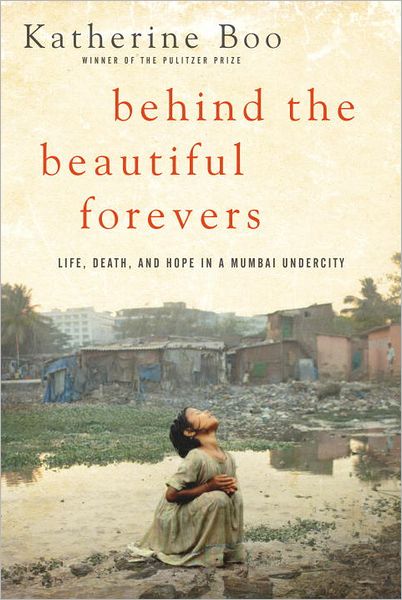
Behind the Beautiful Forevers is a powerful look at what a vast number of people face on a daily basis, just to make it through to see the following day. This book takes any romantic notion of poverty that may still exist in the reader’s mind and destroys it completely.

For the Indians living in the slums surrounding Mumbai’s international airport, nothing is easy, nothing is straightforward and nothing can be relied on. In Annawadi, difficulties are thrown at these people daily. Everything from finding enough recyclable trash in the heaps of garbage surrounding their lashed together sheet-metal homes to sell and make a little money to buy a bit of food for their families to contentious neighborhood relationships seen through the eyes of both caste and religious systems become battles that are waged and fought day after day after day.

Katherine Boo’s book follows a handful of characters, varying in age and background, through these difficulties. One family is dealing with false accusations after a jealous neighbor self-immolates and then, before dying, blames her suicide on a family that was starting to prosper. The husband, as well as a son and a daughter, are imprisoned on these charges, as the mother has to navigate the corrupt judicial system of the Indian government. One woman decides the only way she can improve her situation is by becoming the slumlord, but to achieve this goal she must push aside any inklings of empathy or concern for others. Slumlord-ing is a dog-eat-dog world and she is set on becoming the only dog left standing. Another young lady decides that eating rat poison is the only way to achieve the freedom she desperately desires. And the parade of desperate people forced to make desperate choices continues.

Boo’s book is the epitome of narrative non-fiction. Her story is told so well, with so much detail, that for the first few chapters, I was actually a bit confused about what genre I was reading. I thought for sure I had seen in the summary of the book that it was non-fiction, but some of the characters are so outrageous and the setting is so destitute that I thought I must have misinterpreted what I had seen, that this must be created entirely from her imagination. The writing flows like that of a fictional story, with touching dialog, detailed descriptions and a voice that is usually associated with storytelling.  This book rips off any rose-colored glasses through which the reader may still view poverty, throwing them into the heaps of garbage that Abdul and his friends are forced to dig through each day, just to earn enough rupees to keep their families afloat. There is no romanticism in Boo’s tale, but rather a stark, unblinking look at how many of the world’s unfortunate are forced to scrape and scrabble their entire lives, just for the chance to maybe make their kids’ or even their kids’ kids’ lives just a bit better. Katherine Boo’s  Behind the Beautiful Forevers earns:

Bed by David Whitehouse

Bed by David Whitehouse

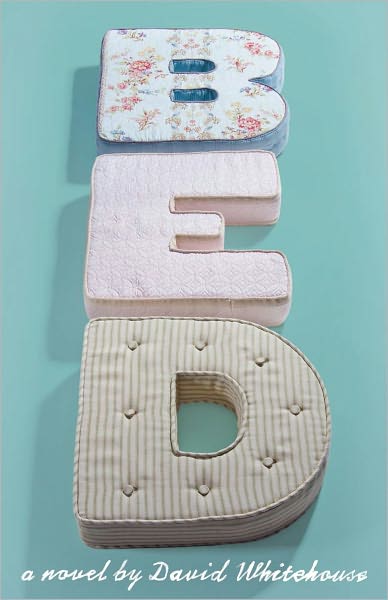
Any book that, on page one, includes the sentence, “He was an enormous meat duvet” is a winner in my opinion. I need to go no further than that initial few paragraphs to know I am hooked!

Bed is the tale of an obese, bed-ridden man named Malcolm, who weighs it at over one hundred stone. (For all of us living on the rebellious side of the Pond, one stone is equal to fourteen pounds.) While Mal is the central focus of the story, the narration is given by his younger brother, who, like all of the characters in the book, has been drawn into Mal’s orbit, unable to break away from the strong gravitational pull his lifestyle choices have created.

This book could easily have veered into the realm of mockery and disdain for a person who has made the conscious choice to never again leave his bed, but instead, the heart of the story lies in pondering what exactly it means to love another human. Each of the characters feel love for others, but the way that emotion is expressed (or hidden) varies widely, as do the results of that love.

Mal decides on his twenty-fifth birthday that he doesn’t want all the “ing’s” life has to offer. He doesn’t want to be a part of marrying, buying, working, parenting, etc. The view he holds of his future is one in which he is expected to follow in the footsteps of the generation before, just plodding along until death finally comes for him. Rather than partake of those unwanted “ing’s” for several more decades, he resigns himself to his bed, and, as it turns out, his food.

While some parents would be horrified by this turn of events (I highly doubt mine would be thrilled if I were to move back in full-time), Mal’s mother sees her only purpose in life as caring for others. She cared for her mother until disease took her away. She cared for her husband and family for years. Once her two boys are grown, she was at a loss as to who she really was, until Mal moves back in that is. Now, with Mal ensconced in his childhood room, his mother can devote her time and energy to his constant care, which becomes a huge task as he grows larger and larger, loosing mobility and the means to complete even simple personal hygiene tasks on his own.

Mal’s father, younger brother and girlfriend are also forced into lives that are dictated by Mal. All seem to have lost the ability to break the chains that connect them to this aging anchor of a human being. While physical escape (to the attic, to a tent in the yard, to America even) is attempted, all are soon sucked back into the vortex of Mal’s needs- “selfish obesity,” rather than just morbid obesity, as it is referred to at one point in the novel.

Each character is connected to others through unique relationships, yet the binding tie throughout the book is the question of whether these relationships are healthy. All are love. There is no doubt about the emotion behind the ties that keep them together, but it seems that love on its own may not always be enough for a healthy relationship to exist. Love pushes each character to do the things s/he does, but the results of those choices aren’t always the best for that individual in the long run, nor are they pointing people in positive directions. Whitehouse does a great job of taking an emotion usually associated with affirmative and progressive interactions and casts it in a light where the reader is forced to look again. Is there something a bit malevolent lurking in the shadows of the family’s love for one another?

The tale is an odd one, I must admit. A book about a man weighing in at over a half ton is not something I would normally gravitate towards, but the dust cover was intriguing enough to make me want to know where the story was going to lead. The writing of this book is great!  The descriptions are superbly written,  not only of Mal’s condition and the physical toll it take on his body, but of how each family member struggles to make a place for themselves in world shrinking as Mal’s corporal domination continues. David Whitehead’s Bed earns:


Message from an Unknown Chinese Mother: Stories of Loss and Love by Xinran

Message from an Unknown Chinese Mother: Stories of Loss and Love by Xinran

It seems that most Americans know someone who has adopted a baby from overseas (and by “know” I don’t mean read about Angelina Jolie’s growing menagerie in the weekly tabloids), many of those being baby girls from China. There is endless speculation about why the adoption rates coming out of China were so large for so long (they’ve fallen off precipitously in the last few years).  Most of what we hear is the Western media’s take on the situation, based on a variety of both reliable and unreliable sources. While at times this media coverage is accurate, often it portrays the birth mothers as unfeeling, selfish and backward in their cultural beliefs. These are easy sentiments to propagate, as they serve to make the adopting families feel a sense of superiority to the birth mothers forced to make terrible choices. In reality, I worry that all such speculation does is create a more deeply ingrained stereotype of the Chinese people and their culture.   Xinran attempt, and succeeds, in putting human faces on those mothers. While we may still have a hard time culturally identifying with the women and the choices they make, they are no longer faceless foreigners, just abiding by cultural dictates, but instead real mothers facing a dilemma and pain that is unknowable to many.

Message from an Unknown Chinese Mother is a rare opportunity for us to glimpse the other side of the adoption story.  This book is not a single story of one woman who gave up her baby, but rather a series of tales from a variety of women, spanning the entire spectrum from uneducated countryside to highly educated city women. Through the stories of these women, we are allowed a glimpse into a world that requires mothers to make difficult choices, to weigh their own emotion versus what is best for their child. None of the stories are easy to read, but all are worthwhile.

One of the things that I really liked about this book was the way Xinran was able to mesh the adopting mothers’ points of view with those of the birth mothers. While the focus of the collection is on the Chinese mothers, she doesn’t neglect the wonderful families in other countries who have opened their homes and their hearts to these young girls. There is no finger-pointing or name-calling, but rather a true desire to help the world, and especially those Chinese girls who have been adopted, understand what their biological mothers were faced with and why the decision to give the baby up for adoption may have been made.

The book sways the reader on a pendulum of emotion. At times tears and frustration and anger directed at the historical dictates, strict government officials and mothers unready to fight their current situation are at the forefront of the reader’s psyche, followed shortly by awe and inspiration at another group of women who dedicated their lives to improving the lives of the young Chinese who could not care for themselves.

The writing itself isn’t of the highest caliber, lacking a sense of flow from sentence to sentence and paragraph to paragraph, but the story told is important enough to outweigh the book’s literary shortcomings. (Part of this disconnect may be connected with the fact that this is a translation from Chinese. The smoothness that we are used to as readers of English may just be a different style than a non-fiction book of this type would display when written in Mandarin.) This book would be a beautiful gift for anyone who has adopted a Chinese baby or for the girls themselves when they are old enough to start questions what may have caused their mothers to have made such a painful choice. Xinran’s Message from an Unknown Chinese Mother earns:


Habibi by Craig Thompson

Habibi by Craig Thompson

Outstanding!

I feel as though I could wrap of this review with just that one word. Habibi is one of the best books I’ve read in a long time. Josh (friend, librarian and book recommender-extraordinaire) told me about this book last fall, at which point I went directly to the Arlington Library homepage and put it on hold, to be shipped to my local library branch.  It took about a month for the book to become available, which just happened to fall during the time I was exploring Anne of Green Gable’s red cliffs on Prince Edward Island. That meant the book was shipped back to its home branch, with me never laying eyes on it.  I actually forgot about it for a long time, until I recently got another email from Josh, asking what I thought of the book.  Well, my first thought was “Crap!” as I had totally let it slip my mind. Back to the Arlington website I went, this time being sure to bundle up and trek over there as soon as I received the email notice saying that my selection had arrived.

It was worth the wait! (Twice.)

Habibi is the unconventional love story of Habibi and Zam. Neither of their lives follow traditional paths. Habibi is sold as a child bride, whose husband is soon murdered and she is sold into slavery. With a bit of wit and luck, she escapes her captors, but not alone. She takes with her a baby boy who has been abandoned by his mother. Together, the two of them live on a deserted boat that serves as both a physical and mental oasis for the pair. Habibi does whatever she must to provide for her young charge, nurturing him and providing a home for him.

Habibi and Zam aren’t living in a vacuum. As they mature, the age span that seemed so immense in their childhoods quickly evaporates. Habibi doesn’t recognize that an alteration is taking place and is shocked when Zam is suddenly not the little boy he used to be.  The unfortunate circumstances of their lives pull them apart from one another for years, at which time they individually go through huge physical and psychological transformations.  When their worlds suddenly collide again, they are no longer the people they used to be. Their childhood love still exists, but to repackage it into an adult love takes more out of them than they may have to offer.

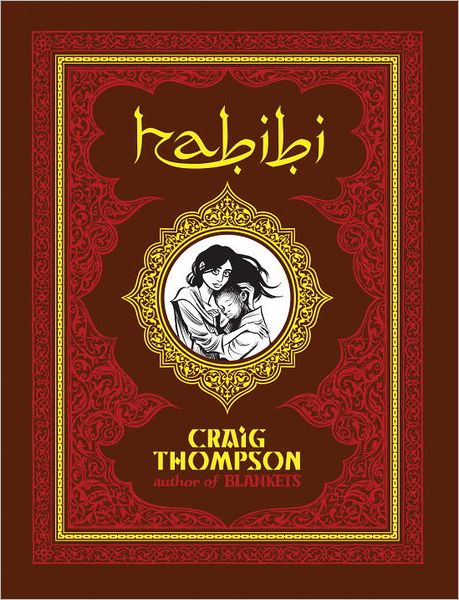
The story told by Thompson is a stunning one, and would stand strongly on its own, but he couples it with an amazing artistic ability, turning a powerful tale into a magnificent work of art. Graphic novels are often overlooked as nothing more than long comic books; I know this attitude was prevalent among some of my fellow English teachers. I would challenge any of them to read this work and then see if they don’t reevaluate their former stance.

Habibi is the graphic novel genre at its finest.  The artwork not only supports the storyline, but it creates one of its own. Details add to the tale, providing information that words wouldn’t do justice. Thompson employs devices that may be easily overlooked by a causal reader, but add an incredible depth to the work as a whole. For instance, through the pattern and color of the margins of a given page, the reader can tell which of the many storylines is being told. This allows the story to jump between characters and settings with no written segue, just the visual one provided through the graphics.

This novel is beautiful- both the writing and the illustrations. I was hooked from the very first page, doing little other than reading from the time I cracked the front cover until the time I stared at the final page, wishing for more. I was drawn in by every aspect of this book and am thrilled to see a graphic novel reach this level of sophistication and splendor. Craig Thompson’s novel Habibi easily earns:

Damned by Chuck Palahniuk

Damned by Chuck Palahniuk

Dear Chuck, are you there? It’s me, Michelle.  I’ve just finished your newest publication. I want to tell you that I enjoyed the sarcasm and wit of your novel, but worry that you are relying on gratuitous sexual images to draw in more readers. Your writing can stand on its own without that. Stick with your eccentric characters- it is your strong suit as a writer.

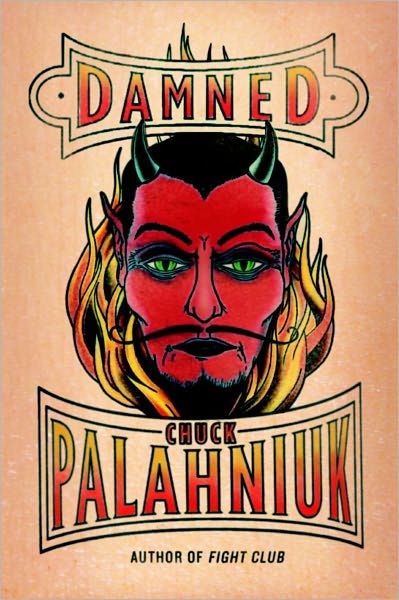
Chuck Palahniuk continues to push boundaries with his latest novel, Damned. The story revolves around Madison, a thirteen year old girl who must navigate her way through the social and cultural norms that make up Hell.  She comes from a life of privilege, her mother being a movie star and her father a wealthy investor. When death arrives unexpectedly, her homes all over the globe are replaced by an existence in Hell, where she is surrounded by mountains of finger and toe nail clippings, demons who can be bribed with candy and a job as a telemarketing market researcher. (I actually had this job for about eight months when I was in college. I got really good at asking people about the chips and cracks in their windshields and how people felt about a variety of political candidates. It really was hellish!)

Palahniuk is not known for treading gently over possibly touchy topics and he doesn’t attempt to garner such a reputation with Damned. Everything from the personal pleasure of mythical demons to where aborted babies end up is within the limits of his writing.  Witty and sarcastic and slightly sacrilegious can all be entertaining parts of a story, but when too much of the foundation is laid with them, the story itself gets to be a bit shaky.

Maddy and her fellow underworld dwellers are treasure troves when it comes to characters. They are all young, dead and energetic. As Maddy begins to explore who she is in death, it forces her to look back on who she was in life and where she lost her concept of freewill along the way. As the tale was wrapping up, I felt like I was just getting to a point with her where she was coming alive. (Terrible pun. I’m sorry.) Rather than dwelling on trying to be edgy, I would love to have seen Madison and the other characters progress through their personal transformations more thoroughly.

The book is definitely not for the easily offended. Once the reader gets past a bit of the vileness,  Hell fills itself out as a place not of fire and brimstone but of bats and insects and dethroned gods, it becomes an amusing place where most of us are slated to spend eternity. If you’ve ever left a bathroom without washing your hands, count yourself in. If you have exceeded the limit for how many times you’ve honked your car horn, you also have a one way pass. (This pretty much condemns all drivers in China.) It doesn’t take much for your soul to be condemned to working as an eternal telemarketer.

Gut-turning descriptions of Hell’s scenery aside, the book attempts to take an interesting look at what the afterlife might hold in store for the majority of Earth’s inhabitants.  The wit and sarcasm and satire are appreciated, but at times just seem to be trying too hard. Chuck Palahniuk’s Damned earns:  

Swamplandia! by Karen Russell

Swamplandia! by Karen Russell

I don’t know. That is my initial response after reading Karen Russell’s Swamplandia! As a contender on many of the “Best of 2011” book lists, I initially thought that this novel would be a homerun, but it just goes to show how much subjectivity there is in the world of writing.

The book follows two main storylines: that of Ava Bigtree, a young girl who works at her family’s failing alligator-wrestling theme park and Kiwi Bigtree, Ava’s older brother who wants nothing more than to escape that same park and make a way for himself on the mainland. While these two characters serve as the baseline for the tale, they are filled out by Chief (the father), Hilola (the dead mother), Osceola (the other sister) and the Seths (the alligators.)

Ava’s story, while told with the mindset of a young adolescent, is written in beautiful prose. The elegant language, which seems a bit at odds with this rough and tumble tomboy of a character, allows the reader a more refined glance into the world which Ava inhabits than would be possible if it were told in the actual words of a kid. Through Ava’s eyes, we see her world crumble to pieces. After cancer takes her mother, the axis around which the whole family revolves and the park’s main attraction, nothing is the same. It is as if without the stabilizing force of Hilola, the family and business disintegrate into their individual parts, rather than continue to function as whole entities. It is in this confusion that Ossie begins dating ghosts and Kiwi escapes for what he imagines will be a better life on the mainland. At the same time, Chief disappears, leaving Ava, the youngest, as the sole guardian of Swamplandia!

Kiwi is the other character whose storyline is closely followed. The writing in his chapters was extremely different from that of Ava’s. It didn’t display the smoothness and insight that hers did. Rather, Kiwi’s story is rather disjointed and halting, mirroring the life he is trying to create for himself outside his family’s island. Kiwi considers himself well-educated (it is a self-provided education, coming from extensive reading, but without any feedback or discussion with others, making his full of random facts, but without utility behind the knowledge.) His attempts to fit in with the mainland kids and their way of life are uncomfortable to read. It is hard to imagine him ever fitting in in this new world, but as the book goes on and profanity spews from his mouth more and more readily, you realize that a metamorphosis is taking place. Eventually I felt as if Kiwi no longer held a place in either realm, making him an outsider with both his family and his new friends.

The part of the novel that I struggled with the most was Ossie and her ghostly relationships. As I read, I didn’t know whether my mind should wander towards the possibility that she was mentally unstable or whether Russell was going to take this into the realm of fantasy. I’m not good at the whole suspension of disbelief, so as Ossie and her dead fiancé head for the underworld, tailed by Ava and her Dante-esque guide, the Birdman, I just couldn’t decide how I should be interpreting the direction the story was headed. During these sections of the novel, I had a hard time enjoying the graceful writing and unique plot because I couldn’t take my focus off where this was all going. I kept trying to figure out what kind of twist would make this all possible in a novel that is otherwise set in a realistic realm.

Taking away the oddness of a search for the underworld off the coastline of the southern United States, this book had a touching core. The idea that the loss of the one person who holds a family together can make everything unravel is a painful one, but also one that plays out in reality on a regular basis.  Without Hilola to draw in the tourists, the alligator theme park is doomed for disaster. Without Hilola to draw together the array of personalities making up the Bigtree family, the family falls apart, with each individual drifting in his and her own direction. While we never hear directly from Hilola, as she is dead before the first page of the book, she is the character around which all the choices of the book revolve.

My original “I don’t know” still stands. There were parts of debut novel that I really loved and was drawn in by, but there were also parts that were just too contrived and weird for me to accept as a reader. I can see why some people loved this book, but for me, it falls into the category of being interesting, but not something I am likely to pick up and reread at any point. Karen Russell’s Swamplandia! earns:


Scored by Lauren McLaughlin

Scored by Lauren McLaughlin

We live in a world where, in many cases, numbers dictate who we are. It starts in kindergarten when IQ tests are administered. Travelling through grade school, those numbers become how many words per minute the child can read and how accurately a Mad Minute math test can be completed. Heading into middle school and high school, the focus shifts to percentage scores and GPAs defined to the hundredth of a point. Throughout the years of schooling, throw in mandatory state testing as required by No Child Left Behind, and a shot or two at ACT and SAT scores. Add all of those numbers up and what you get is a judgment on most any kid in America.

Looking at society from this point of view, Lauren McLaughlin’s Scored really isn’t far-fetched at all. In this young adult novel (Another one, I know! I promise a review on a different genre soon.) ScoreCorp, a national company has found a way to utilize the ubiquitous cameras monitoring Americans on a daily basis to create a scoring system for adolescents.  Families are not required to enroll their students in the program, and a few of the wealthy families are privileged enough to not have to, but for most families in the not-so-distant future Massachusetts clamming community, the Score is the only chance their kids have at any semblance of upward mobility. With a high enough score, students are given automatic scholarships to college, which puts an education and future in reach of kids who would otherwise be left with whatever service-industry job they can cling to in the economically depressed region in which they live.

Imani, the protagonist of the novel, has always strived to keep her score above the scholarship line. She works hard, follows all of the rules and hopes that will be enough to earn her a scholarship to study marine biology. When the monthly score reports are posted and she drops from the mid-90’s to the 60’s, she realizes that her friendship with Cady is the problem. With only a month before final scores are posted and lifetime trajectories are set in stone, Imani knows she must do something to get her score back to its previous standing.

When the opportunity to enter a scholarship essay contest is presented by a teacher, Imani thinks she may have solved all of her problems- until the teachers says she must write about why the Score is bad for society. Imani believes whole-heartedly in the score and the opportunities it affords those without monetary advantages. To write against the score is to write against everything she believes in.

Eventually, Imani is forced to turn to Diego, a wealthy, unscored classmate whose lawyer mother is famous for fighting legal battles against ScoreCorp, for help. Their relationship isn’t one of friendship, but of mutual need, as he too is entering the contest, but must write about how the Score has been beneficial to society.

The premise of Scored is one that should resonate with many young adults.  Feeling constantly monitored and judged is a pretty universal part of being a teenager in America. The book has a strong foundation and delves fairly deeply into both sides of the argument towards a true meritocracy system. I appreciated the references to 1984  and Brave New World (hoping that maybe a teenager or two goes to the library and picks them up out of curiosity), as well as the snarky comment early in the book  aimed at No Child Left Behind. The place where McLaughlin’s novel falls short is the unnecessary love story propagated by the relationship between Imani and Diego. I was disappointed that their intellectual connections weren’t allowed to stand on their own, but rather had to morph into romance.  It would have been great to have strong female and male characters that were able to stand on their own as individuals and not need a bit of Cupid’s arrow thrown in at the end.

This young adult novel was a quick read, weighing in at just 160 pages. The story moves quickly, but has a depth uncharacteristic to such a short book.  It can be read as just another dystopian novel, enjoyed and set aside without another glance. On the other hand, it would also make a great classroom novel. I can just imagine some of the great discussions that students could have about how society stratifies itself now and whether the world envisioned in the book is a step forward or a step backward.  Lauren McLaughlin’s Scored earns:

Nanjing Requiem by Ha Jin

Nanjing Requiem by Ha Jin

Ha Jin’s latest novel, Nanjing Requiem, released last fall, takes on the huge challenge of setting a novel during the Japanese invasion and occupation of China’s Nanjing City. It is not an easy task to write a
book with a foundation based in the torture and slaughter of thousands of civilians, but that is the challenge Jin has set up for himself with this new book.

Jin tells the story of the fall of Nanjing,  opening  with the heartbreaking tale of Ban, a young boy who serves as an errand-runner for the Western –funded and run Jingli College, who was whisked away by Japanese soldiers and forced to do their bidding, fearing for his life if he didn’t cooperate.  After this initial chapter, the rest of the book (with one other short exception at the end) is narrated by Anling, a Chinese woman who works for the college. While she is the primary story-teller, the roles of the foreign citizens are the focus of much of the novel.

Nanjing’s citizens were cruelly treated when the Japanese army overthrew the Chinese government there, as the invading army’s officers allowed their soldiers to run wild, abandoning any sense of
decency and humanity. Countless women, of all ages, were raped and killed. Men were forced to watch their relatives’ endure these heinous acts and then they themselves were slaughtered.  Jin doesn’t shy away from the realities of what occurred in city in the late 1930’s. Because of this brutally honest look at those atrocities, Nanjing Requiem can be difficult to read. His writing relays the stark realities of the horrors committed, making the book, at times, painful to endure. It is not a leisurely book, written for the feint-of-heart.

With the focus on the deeds of the foreigners living in Nanjing, I was disappointed that Ha Jin didn’t focus more on the positive aspects of Chinese culture and traditions.  Oftentimes, the Chinese women (other than the main narrator herself) are made out to be petty and squabbling and wholly selfish. I would love to have seen him incorporate more Chinese women who sacrificed for the cause of helping others.  The characters, both Chinese and foreign, were pretty flatly drawn, making it hard to connect with them while reading the novel.

Nanjing Requiem, while dealing with a terrible period in Chinese history, really focuses on the roles that foreigners played in saving thousands of people from certain death. These characters, mostly American missionaries, put their lives on the line for the people of the country in which they live. They show a basic humanity and dignity which is a direct foil to that characterization of the Japanese forces. With this said, the writing lacks the emotion one would expect from such a horrific event. The writing  is sufficient. It describes scenes, it fleshes out characters, it has a clear beginning, middle and end. What it doesn’t do is move the reader to tears or even a conjure of a great amount of anger. If I had not read several other books about the occurrences in Nanjing (I would specifically recommend The Rape of Nanking: The Forgotten Holocaust of World War II by Iris Chang), I don’t think the absolute travesty of the situation would have been clear. In several places, Jin provides clear descriptions of varies horrors, and yet they come across as nothing more than flatly written fiction.

Overall, this book fell short of what it could have been. I am disappointed that a book with the potential of this one didn’t create more of an emotional reaction. When I initially started this novel, I
thought I was going to love it, but around the halfway mark I realized that it was going to fall squarely in the “okay” category. Ha Jin’s Nanjing Requiem earns:

The Scorch Trials (Maze Runner #2) by James Dashner

The Scorch Trials  ( Maze Runner #2)  by James Dashner

Not only am I a sucker for the dystopian literature genre, but combine that with a young adult series and you’ve got me hooked!  After reading the first of James Dashner’s newest series, The Maze Runner, I couldn’t wait to get my hands on the second.  The first book ends with nothing less than the epitome of a cliffhanger that leaves the reader clinging to the side of the mountain, scrambling and clambering to keep a hold on the ledge until book two shows up!  Well, book two showed up two days ago and I instantly morphed into a mountain goat, doing nothing but climb that rocky ledge as the story continued, forgoing both homework and housework to find out what lies around each turn of the page.

In this second book, Thomas is back, along with his allies from The Glade. Their rescue and relief at the end of the first novel is short-lived and they are soon placed in the middle of another experiment run by the shady group called WICKED. This time, rather than being in the confined and controlled spaces of a maze, the group is given a final destination, promised “safe haven” upon arrival at that point and told they have two weeks to get from point A to point B.

Of course, completing this task was not a mere matter of sticking out their thumbs and hitching a ride the one hundred miles, but rather a painful, and for some, deadly, trek across the burned wasteland left behind after sun flares destroyed everything on earth between the Tropic of Capricorn and the Tropic of Cancer.

Along the way, the motley assembly of adolescents faces obstacles that are unimaginable, even after what they went through in the Glade. But worse than the deformed humans suffering the ravages of the Flare (Cranks), the mind games that WICKED plays on the kids leaves them in a position where no one knows who to trust, no one knows who is working for the mystery agency or even which side is good and which is evil. More than once, messages are relayed saying the “WICKED is good.” But is it? Throughout the book, the basic tenants of their individual personalities, their beliefs and their friendships are suddenly called into question.

Like many series, the first book, The Maze Runner, sets a high bar, as it creates a new world, populated with interesting characters and unique situations. Subsequent books have to keep up the energy and excitement of the first, but at the same time somehow deepen the conflict and relationships within its pages.  In this trilogy, the follow up, The Scorch Trials, does an admirable job living up to the expectations.   I couldn’t stop turning pages, eager to find out what was to become of this group of hardy survivors and the manipulative government agency that controls them.  As I wait for the third and final installment in this trilogy, again clinging to the edge of the cliff I was tossed over by the end of book two, James Dashner’s The Scorch Trials earns:

The Magician’s Elephant by Kate DiCamillo

The Magician’s Elephant by Kate DiCamillo

While the length and the pictures in this book give it a decidedly upper elementary school feel , the fact that it is written by Kate DiCamillo, the author of Because of Winn-Dixie was all the recommendation I needed to originally pick it up. (By pick it up, I mean download it from my local library. Oh technology these days…) I am glad that I didn’t let this book’s outward appearance deter me. It can be easily read by younger readers, who will enjoy the fantastical story of a fortuneteller’s prediction that an elephant will reunite a young orphan boy and the sister he believes is dead, but there is so much more to the book than that.

The main character in the story, a young man named Peter. Peter is an orphan, his father having been killed in war and his mother having died during childbirth. He is raised by a man who was a solider alongside his father, but raised is probably not an accurate verb. He is being trained, tutored and school (although not well) in the ways of soldiers.  One day, while in town on errands, Peter spends his only coin at the booth of a fortuneteller.  This woman tells him that an elephant will help reunite him with his sister. This prophecy evokes many emotions, confusion being a primary one, as Peter has always been told his baby sister never breathed a breath of air, but was stillborn. On top of that, he lives in a small eastern European town, far, far away from the lands where elephants dwell.

Days later, once again in the town market, Peter overhears some adults talking about how a magician conjured an elephant the previous night at the opera house. With the world “elephant” tickling his ears, he realizes that it is possible that the soothsayer’s divination is true, meaning his guardian has lied to him all these years about his younger sister.

Peter realizes that “What if?” and “Why not?” are questions that he should have been asking all along.  These become a bit of magic in his own life, pushing him and others to follow the words of the woman in the marketplace, to allow an elephant to reunite his small family.  The characters that get on board with Peter and his belief are compensated with all manner of rewards ranging from finding a true family to returning home to the less visible, but most important one- forgiveness.

The setting of this book very much has a fairy tale, Christmastime feel to it. Winter has descended on the small market town and the chill in the air lends a sense of the story being both of this world, but not quite a part of  the day to day world in which we all live. An elephant falls from the sky, a magician is jailed and a young boy has the chance to find his long lost sister. All possible, but none probable.

The fairy tale setting adds to the readability of this book for younger students, but it also adds an air of mystery for those of us who have torn a few more pages off of the calendar.  The book checks in with fewer than 100 pages, but those pages kept me transfixed in this other world of winter wonderland beauty and elephant-astic fantasy. Kate DiCamillo’s The Magician’s Elephant earns: