Chomp by Carl Hiaasen

Chomp by Carl Hiaasen

“Mickey Cray had been out of work ever since a dead iguana fell from a palm tree and hit him on the head.” If that opening line doesn’t catch your attention and leave you with dozens of questions, I can’t begin to imagine what is going on in your brain.  As it turns out, the iguana froze to death during a cold snap in southern Florida, turning it into a giant reptilian ice club, effectively giving Mickey one heck of a concussion.

Hiaasen’s latest young adult book takes us on an adventure into the Florida Everglades, where the Cray family lives and works as animal wranglers. Mickey, the father, relates better to his beasts than he does to human beings, while Wahoo (much like Sodapop and Ponyboy of The Outsiders fame,  that is his real name) does a much better job bridging those worlds. When Expedition Wild!, a hit reality TV series based on wilderness survival shows up and wants the wrangling expertise of the Crays, the alligators, parrots, snakes, monkeys and raccoons are the least harmful of the creatures involved.

When it comes to TV, reality isn’t quite real. The star of the series, Derek Badger, appears on the show to be a rugged outdoorsman who can survive any situation Mother Nature can throw at him. As it turns out, he is a rather pudgy, dessert-loving whiner who doesn’t do his own stunts, doesn’t have the sense of an empty coin purse and is only saved through the graces of the editing studio.

When Derek decides he is going to “go wild”  for this episode of his show, things quickly spiral out of control. From encounters with angry snakes and scared bats to a drunk man with a gun (which is a whole separate plot of its own), Badger soon realizes that he isn’t Mr. Outdoors, but clings to his desire to be the star of the series, thus earning him a huge pay raise in his next salary negotiations.  Clinging to that hope, he attempts some crazy stunts, but will it be enough?

Fans of Hiaasen’s previous young adult novels, such as Flush and Hoot, will love this one as well. There is action and adventure as they characters wade through the Everglades, but unlike Expedition Wild, there is also a good dose of reality, as the subplots deal with an alcoholic and abusive father, a family on the brink of losing their home and a look at what constitutes “reality.” The book comes in at just under 200 pages, so it is just the right length for young readers.  I’d give this book an instant two thumbs up, but in honor of Wahoo and his run-in with Alice, the resident alligator, I’ll stick with one thumb and one nub up, which translates to Carl Hiaasen’s Chomp earning:

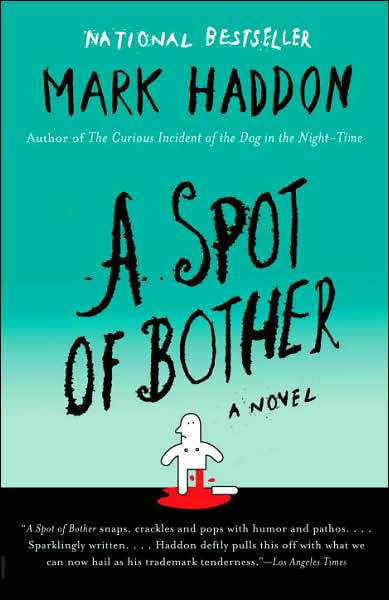
A Spot of Bother by Mark Haddon

A Spot of Bother by Mark Haddon

When I saw this book on the shelf of a used bookstore out in Alexandria last weekend, I knew instantly I had to have it. Several years ago I read and loved The Curious Incident of the Dog in the Night-Time, but for some reason never looked into other books by Haddon. I couldn’t wait to dive into this newest novel. (Okay, it was published in 2006, but it is new to me since I had no idea it existed!) I was expecting something similar to The Curious Incident of the Dog in the Night-Time, but found A Spot of Bother to stand entirely on its own.

George Hall, our protagonist, is just settling into retirement when he finds a spot of dry, diseased feeling skin on his hip. He immediately decides he has skin cancer and goes into a downward spiral, filled with panic attacks and self-destructive behavior. The fact that his family seems to be coming apart at the seams only adds to his stress, which increase the panic attacks. His daughter announces her marriage to a man that her parents don’t particularly care for and one that, while she appreciates him, she isn’t sure she loves. Their son’s boyfriend leaves him, saying he doesn’t know how to be in a real relationship. If that wasn’t enough drama, George’s wife has been sleeping with one of his former colleagues.  All of this drops into George’s lap as he thinks he has discovered he is dying.

As the wedding draws nearer, George’s depression spirals out of control. He is convinced he is dying, that his wife doesn’t love him and that he has made a mess of his entire life. The at-home surgery, self-medicating through codeine and alcohol and then abundant use of doctor prescribed Valium aren’t helping things.

I felt guilty laughing while George’s life seems to unravel, but Haddon’s telling of the tale weaves such a dark comedy that I couldn’t help but chuckle at times. At one point, on the day of Katie’s wedding, George takes off in an attempt to not have to be involved in the nuptials. He is found hiding in a ditch (he makes the excuse that he went for a walk, tripped and turned an ankle) and must return home. On his way home he remembers he has a stash of Valium that should get him through the day. With this thought being the only one in mind, he takes off at a full sprint back to the house, startling those who were watching him limp along the road just seconds before. As the family is in full-panic mode, thinking they’ve lost George, he goes zipping by the kitchen window at mach5 speed. The imagine of this slightly paunchy, bedraggled man flying by the kitchen window on the morning of a wedding just makes me laugh each time I imagine it. With writing like that, George’s predicament seems a little less serious and allows the reader to see the absurd and ridiculous side of even the most trying events.

The hardest part of this book for me was its British-ness. There were a few times I had to stop and look up what a word or phrase meant. When George goes to the surgery to see his doctor, I had to keep reminding myself that it was the hospital, not an operation that he was going in for. And, boy oh boy, was there a lot of tea drinking. Regardless of the situation, good or bad, tea was always the first thing offered. (Which I would think was far-fetched, but know from first-hand experience that tea really is a go-to for the British. After making a rather speedy exit from my apartment building during the Sichuan earthquake, I was sitting on the ground with a British teacher, with the earth still moving below us. As we watched landslides on the surrounding hills, she looked at me and said, “I could really go for a cup of tea right about now!”)

While this book was not at all what I expected, it was still enjoyable. I liked the dark comedy and the way the reader gets to peer into the lives of a family that looks “normal” on the outside, but in reality is scrambling to hold everything together. Mark Haddon’s A Spot of Bother earns:

Arcade Archives

I’m not much of a video game player. It’s not just the shoot-‘em-up games I don’t like, it is pretty much all of them. Even the interactive Wii games, while they are fun for a few minutes, quickly bore me and I decide I would rather just go read my book. I’ve chronicled my uncoordinated video-game playing experiences on In Search of the End of the Sidewalk before, in both “Wii-kends are for  Playing” and “Wii-ning Advice.” (Apparently, the Wii doesn’t make me more athletic or coordinated, but it does fill me with puns.)

Here’s the thing though– add in the possibility of winning tickets and suddenly, I am all about the games! Over Christmas break, when Thad and I were home in Idaho, we went out one night with plans to go bowling. Well, the alley was crammed and we were put on a waiting list and given ten dollars of tokens for each person to play with in the arcade while we bided our time. (The bowling alley even gave us one of those cute little buzzers used by restaurants! Since when did bowling allies go from being filled with smoke and mullets to being brightly lit and jamming to pop-music?)

Free tokens? The possibility of tickets? Trading those tickets in for worthless crap at the arcade store? Yes! Yes! And definitely yes!

That night in December, I believe I came away with a purple plastic articulated snake toy that if you wiggle it just right, it looks like it is slithering on its own. Oh yeah, and a bag full of fruit flavored Tootsie-Rolls. Not bad for killing time before scoring an incredibly low total in a few games of bowling. (I blame the score on the massive number of fruity candies I ate between each turn.)

Last night, I was again offered the chance to get my arcade on.  When we moved to Washington DC last summer, I had cable for the first time in my life. Needless to say, for about two weeks, while Thad went to work each day, I kept up with the Kardashians and learned how to stage my home for sales showings. (If only I could make that happen from the other side of the country! I still have a lovely home in Nampa on the market, rock bottom priced, if anyone is interested!) During those few weeks of cable-coma, I saw several commercials for what appeared to be Chuck E. Cheese, but for adults. Awesome.

We’ve been talking about going for a year now, but with our time quickly coming to an end and John and Lulu leaving in less than a month, we figured it was now or never. So, along with John and Erin, the six of us met up for an evening of mediocre food and fabulous games. I knew it was going to be a good time when Thad excused himself from the table to go wash his hands, was gone an inordinately long time, finally returning with a grin, saying “I found the game room.”

As an avid Skee-ball fan, that is normally where I would take up position, but the Skee-balls games at Dave and Buster’s have a terrible return when it comes to tickets. At the arcade, it is all about the ticket collection. Thad racked up good numbers playing the world’s largest version of Fruit Ninja. (Granted, he and John Park have been practicing for that moment on their iPads for months. I’ve sat through numerous lunchtime challenges for such lofty rewards as a Mountain Dew or a York Peppermint Patty.)

The evening included a lot of Fruit Ninja, a basketball competition, Erin braving the Dance Dance Revolution machine, John T. driving a big-rig, a bit of electronic jump roping, more than one game of Let’s Make a Deal, Wheel of Fortune and The Price is Right, as well as some bass fishing and a bit more Skee-ball.

As the helpful wife that I am, I collected all of our tickets first in my bag, soon transferring them to one of the high quality cardboard cups provided by D&B’s. I figured by gathering the earnings after each game, I not only consolidated what we needed to haul around, but also essentially co-opted the gains. What’s yours is mine, right? (I’d say Thad was surprised, but this is the financial model we’ve been living under for the last year, so he is used to it. He goes to work and earns a paycheck; I stay home and spend said paycheck.)

With our credits run dry (we all chose dinner deals that included a $10 Dave and Buster’s play card), it wasn’t quite time to call it a night. First, we had to hit up the arcade shopping center.  Between us, Thad and I grossed 665 tickets. (Rather than run the tickets through a machine, or count them by hand the way we used to at POJOs when I was a kid, the tickets went on a scale, which weighed them and provided a total count. I have to say, I think it was really 666, but that number apparently freaked out the kid behind the counter, so we were left one ticket short when they were put on our card.) My hands wrapped around a ticket card with nearly the same net worth as Satan, I scanned the store for what I could afford. Thad was disappointed that the quesadilla maker was far, far out of our range. Instead, we settled for a Velcro-handed monkey (which I eventually up-traded with John Park for his stuffed Domo, as I have thing for adorable monsters) and four big mystery flavored Laffy Taffys.

So, Domo in hand and a mouth full of pink and green flavored taffy (yes, I know those are colors and not flavors, but at the same time, aren’t they flavors? You totally know what I am talking about when I say pink and green flavored, so I think it counts!), it was time to take our sugar-high selves home.

I imagine it will be quite a while before I hit up another arcade, but with my new Domo-buddy by my side, I think it is time to go to China.

This slideshow requires JavaScript.

The Unconquered: In Search of the Amazon’s Last Uncontacted Tribes by Scott Wallace

The Unconquered: In Search of the Amazon’s Last Uncontacted Tribes by Scott Wallace

Having grown up with towering stacks of the iconic yellow covered National Geographic just one room down the hallway from my bedroom, I spent hours poring over the shiny photographs bound within their golden spines. Often, those pictures were of peoples and places I could only dream of, imagining what life must be like in the wilds of the Amazon or the plains of the Serengeti.  As a reporter for that very same geographical society, Scott Wallace was given the rare opportunity to venture into that jungle world, skirting the edges of tribes that had yet to be contacted by the outside world. The results of his journey are chronicled in The Unconquered.

Wallace joins Sydney Possuelo, a Brazilian who has devoted his life to protecting the “indios bravos” of the Amazon, on his trek into the rainforest in an attempt to map the borders of a group known as the “flecheiros.” Possuelo is dedicated to the preservation of these tribes who have had little to no contact with the world beyond their own, but his single-minded devotion comes at the expense of his fellow trekkers. He rules with an iron fist while in the jungle, which both serves to keep his motley band of travelers safe, while at the same time alienating them from him as a leader.

While telling the tale of his easy boat trip up the Amazon, his arduous trek through the forest and the difficult process of building canoes to return to civilization, Wallace also gives us an insight into the competing factions when it comes to the issue of what to do with these previously uncontacted tribes. White man (defined by Possuelo as all non-natives) brings with him innumerable diseases that kill quickly. He brings a way of life so foreign to the natives that even once introduced to it, they are rarely able to assimilate to a point of upward mobility. On the other hand, keeping medical and technological advances from these people in hopes of them retaining their current way of life could be a construed as inhumane and condescending, as those decisions may not be within the rights of the Brazilians.

Becoming friends (or at least companions) with men from several different native tribes, coming close to disaster (if not death) on several occasions and being just feet away from members of a tribe not previously seen by outsiders are just a few of the experiences Wallace has on during his time in the Amazon.  The travel must have been difficult, but we rarely hear details about the day-to-day conditions. The focus of the book is definitely on the native tribes and their precarious situation, but a bit more description of the demanding hikes, the overwhelming flora and fauna, as well as his personal thoughts on the whole subject would be appreciated.

By the end of the book, we have seen Possuelo at his best and his worst. We come to see that the fight over tribal lands (taking up 11% if Brazil’s landmass, but harboring only 1% of the population) as being not only a huge gray area, but a battle with no end in sight. This ambiguity is reflected in what we learn of Wallace as a person. He attempts to inject himself into the narrative, talking about his sons and life in the US, but by the end of the book, we are left no knowing what came of several personal predicaments. This lack of a solid ending for both the natives and the author himself leaves us feeling unease about what the future holds, but anything more packaged would feel false and contrite.  The National Geographic photographs from my childhood came to life at the hands of Scott Wallace in The Unconquered: In Search of the Amazon’s Last Uncontacted Tribes, which earns:


Building A Mystery (or Resume as the Case May Be)

As a fan of all things pop-rock, I can’t help but think of Sarah McLachlan’s 1997 hit “Building a Mystery” as I pour over my resume this evening. (Yes, I’m a sucker for pop music. I don’t need quality music, just fun music. If the song has a good beat and a catchy chorus, it wins a not-so-coveted spot on my MP3 player. In fact, the music collection on my player is so horrible, it is embarrassing. This winter, I was having a baby shower at the mo-partment and couldn’t get our internet-TV’s Pandora application to work. Thad had run away, hoping to avoid all things baby, so I had to call him for advice. When he couldn’t fix it via our phone conversation- probably because I had no idea what he was talking about with his technical cord names- he suggested I just plug my Walkman into the TV and play that as background music. Uh, no! I don’t need everyone to know that my shuffle mode goes from Britney Spears to Shaggy to The Black-Eyed Peas, with a little Ricky Martin and Beyonce thrown in there. Needless to say, that baby shower was music-less and my horrible taste in music remained between me and my player.)

But back to Sarah McLachlan and my resume. In what way could music from the mid-nineties and a curriculum vitae turn into a viable Venn Diagram? It isn’t as far-fetched as you might think, because the last time I had to make a resume and prepare for a job interview was in 2000. That’s right. I haven’t had to go through the job-search process in twelve years. Needless to say, making my resume feels like building a mystery.

I taught in Marsing for nine years, covering everything from normal English and reading classes, to electives in poetry and creative writing. Basically, if it was English-y, I was there! But, the jobs I am applying for are not traditional teaching positions. While both have education-related elements to them, they are not ones that will require me to stand in front of thirty eighth graders and get them to love “Annabel Lee” as much as I do, or care that “a lot” is ALWAYS two words! (Seriously, people! You would never write “alittle” or “abit,” so why “alot”??? ) This has meant taking stock of my skills and finding ways that those abilities can translate to new positions.  Again, Sarah MaLachlan puts it well when she sings, “Building a mystery/And choosing so carefully.”  I know I have the skills for these positions; it is just a matter of selling myself on paper (and interviews) so that I am given the chance to show my awesomeness!

My year of self-selected retirement has been great. I’ve gotten to do things that I wouldn’t necessarily have done in Idaho, like motorcycle classes and a field trip to the morgue, but it is time to get back in the saddle again and have a real job.  I am hoping that by the time we board the plane for the oh-so-long flight to China, that carefully crafted resume will have landed me a job, just waiting there for my plane to touch down.

(PS- While I may not live in a church and sleep with voodoo dolls, I do wear sandals in the snow, so maybe the song applies to my life in more ways than one!)

Jasper Jones by Craig Silvey

Jasper Jones by Craig Silvey

Jasper Jones, Craig Silvey’s latest young adult novel, charts the journey of a teenage boy losing the naivety of his youth as he discovers the world around him, and especially the people, don’t fall into the neat frames he has created for each one. This is a definitely a book about growing up, but Charlie, the protagonist, is forced into maturity when confronted with the death (murder? suicide?) of Laura, the teenage daughter of a leading town politician.

This book is a bit of an enigma to me. The book is beautifully written and tells a captivating, if devastating story, but it seems to build on its own foundation in weird ways and at odd intervals. There were times where I thought I had a feel for the setting and characters, only to have the world I created in my head shattered by a new piece of background information. For example, I was probably a third of the way into the book before I realized that it was set in the 1960’s, while the Vietnam War was raging in Southeast Asia.  The fact that it is set in Australia also probably should have been apparent to me soon, but a name like Corrigan just drew to mind an English town, rather than one on the other side of the world. These two facts combined, once they were clear to me, fashioned an entirely different landscape than I had previously imagined. (It’s the difference between rainy, overcast days versus sunshine and heat or trails made by rabbits and rodents versus those created by kangaroos and wallabies.)

Once I had the setting straight I my mind, it was the plot that took a bit of mind-warping reconciliation. When Charlie is asked to help bury a dead girl at the bottom of a lake, he does so without hesitation, but then must keep the events of the evening a secret, as he continues on with his summer holiday. This foundation is horrifying, and yet it leads to a story even more devastating. The deceased is already gone, so while the actions are awful, they don’t change her fate. Instead, other fates are revealed as Charlie and Jasper go in search of her murderer.  The weeks following Laura’s death reveal new relationships, as well as see the destruction of existing ones.

But what are the characters doing when they are not deeply involved in the mystery of Laura’s death? Cricket. Lots and lots of cricket. This game of Down Under is one that baffles me. There are wickets and bats and runs and bowls and all sorts of doodads that are foreign to any sports understanding I may hold. While this made a great addition to the Australian setting, it was an aspect of the book I found hard to follow. (This is especially true when it came to the climactic game where Charlie’s best friend finally gets his shot and cricket stardom, which is narrated, in detail, along the course of several pages.)

For a tale based upon death and the subsequent destruction that plays out in the tragedy’s aftermath, I have to say that this is a really good book. It feels strange to like something so much, when the basis of it is so dark, but as the characters come alive throughout the story, I can’t help but feel  their pain as the rose colored glasses of childhood are removed and they discover that the world isn’t quite as kind as they had once believed. Craig Silvey’s Jasper Jones , a powerful young adult novel aimed at mature teens, that takes a powerful look at growing up, tough choices and the inevitable consequences of those decisions, earns:

Brave Dragons: A Chinese Basketball Team, an American Coach, and Two Cultures Clashing by Jim Yardley

Brave Dragons: A Chinese Basketball Team, an American Coach, and Two Cultures Clashing by Jim Yardley

Professional basketball and Chinese history and culture are not topics commonly lumped together, but Jim Yardley takes on the challenge in Brave Dragons. I originally picked this book looking for a new take on China, which I got, but I do have to say that I wasn’t expected to be quite so overwhelmed with basketball. (Okay, to be fair, the cover sporting a basketball jersey should have given me a clue that the book would be heavy on the sports, but I looked right past that to the awesome font that also adorns the cover.)

Right off the bat, I must admit that this was not the book for me, but I definitely would have bought it and put it on the shelf of my classroom. There is a strong market for this book. I am not that market. I had some hoop-obsessed students who would have devoured this book, which is filled with the jargon of the game, court-side wheelings and dealings and an insider’s look at what a budding professional basketball league looks like.

Yardley, after a handful of setbacks in is NBA coaching career in the US, is offered the position of head coach of the Shangxi Dragons, a bottom of the barrel Chinese professional team based in Taiyuan, part of the northern coal country in China. He goes there, having no previous experience living abroad, expecting to take full-coaching responsibilities (with the help of a translator) and with a hope of improving the team’s horrible record. Yardley quickly learns that not only is China physically on the other side of the world from his home in Washington state, but that the mental shift needed for this new lifestyle and job is nearly as large.

I love that Yardley took his story off the hardwood, trying to dig into the culture of China to understand what factors might be playing into the decisions being made by his players and his front office. He includes tidbits about the country’s history, about their sports training programs and a view into where the nation might be headed. Like with many things in China, the Chinese Basketball Association (CBA) is built on layers of bureaucracy and an ever-present need to “save face.” I had to laugh to myself as Yardley learned to navigate the world of appearances versus reality that becomes so confusing when the concept of “face saving” rears its sometimes befuddling head.

Having read extensively about Chinese history and lived the culture on a daily basis, at times I felt like the book took too cursory of a glance at some of these aspects, maybe playing up the ones Westerners would find odd in an attempt to draw readers into the story. For those unfamiliar with the Middle Kingdom, the book is a great starting place. As a teacher, I would have proffered it to the students who I knew had a love of the game and then hoped it would spark a wider interest in the world. This book is perfectly suited to do that- start with a topic that is familiar and of interest to a wide population and through the medium, introduce an entire new area of exploration to the reader.

Basketball isn’t my thing. China is (kinda’) my thing. Combine them and I end up on the fence about ranking this book. Would I recommend it to others? Yes! There are definitely some of my students who will be getting emails about it. Would I read it again? No. I like the idea, but it was just too detailed when it came to that large orange ball with the black stripes that tall guys (and gals) bounce up and down a hardwood floor and attempt to get in that woven basket hanging from a round, metal hoop. With that said, Jim Yardley’s Brave Dragons: A Chinese Basketball Team, an American Coach, and Two Cultures Clashing earns:


From Adios to Zbogom

You may not know this about me, but I am a bit of a book nerd.  I will read nearly anything. While I was a fairly early adopter of the e-book format, owning both an original Nook and a Nook Color, print books will always hold a dear spot in my heart. Even as I am snuggled up under the covers of my king-sized bed, reading page after digital page by the glow of the Nook Color, a tug of nostalgia the yesteryear of print rests on my soul. Not so many years ago (okay, probably more years than I would like to admit) I was also snuggled up under the covers, this time of my white, frilly daybed, with a flashlight and whichever book was on the top of my library loan pile.

There is something about the smell of a new print book, the weight of it, the way the pages are cut, whether the cover is shiny or matte, how the pages sounds as I flip through them that can’t be replicated on an e-reader. It is for this reason, I was a bit sadden to read an article last week about how Encyclopaedia Britannica will no longer create print version of their series, but rather all copies with be digital. (http://www.latimes.com/business/technology/la-fi-tn-encyclopaedia-britannica-goes-digital-only-20120313,0,2517276.story)

Again, I have nothing against e-books, as a matter of fact, the majority of what I read now is in that format. It isn’t the technological progression that makes me stop in my tracks, but rather the memories of being a child with a set of encyclopedias that I could skim through, searching topics by whatever whim crossed my mind. The idea that generations of kids won’t be able to pick a random letter of the alphabet and spend an hour learning about platypuses, Peru and pentagons rather than taking their required afternoon nap is disheartening. Logically, I know that they will be able to do the same thing online, maybe even hitting more diverse topics though the help of a “random” button or digging deeper into a single subject through hyperlinks and multi-media offerings.

But, it just isn’t the same.

Those reddish-brown books with their gilded gold letters lined up on the second from bottom shelf were my first glimpse into the world of vultures, Venezuela and viruses. (The bottom shelf was reserved for stacks of the innumerable copies of the National Geographic, which also provided hours of entertainment, more through the photography from all over the world than the technical articles that were too difficult for a 4th grader to understand.) Our encyclopedia set literally contained the world from A-Z and provided the basis of many an elementary school report.

The positive outcomes of the digitalization of encyclopedias far outweigh the longings of my nostalgia. Hopefully this new format will make the reference’s sources more readily available to families of a variety of incomes (I actually have no idea how my family came to own the set we did), make searching for specific topics easier and allow the companies to expand not only the number of articles, but the lengths as well. (It used to drive me nuts when I found a super interesting topic, like jaguar or Jamaica or Jackson, Stonewall, only to find a mere three or four paragraphs about it. In the pre-internet era, I was stuck with those few columns of sparse information until the next trip to the library, where I could find a more suitable supply of facts to fill-in the gaps of ol’ Britannica.)

So, it is with not with a crocodile tear, but a more gecko-sized one, that I bid adieu to the hardbound copies of Encyclopaedia Britannica and embrace the next generation of factual summarization.  You served me well during those sanity-saving (for my parents) afternoon naps.  From anteater to zebra, Antarctica to Zimbabwe and Adams, John to Zorro, I’ll miss you Encyclopaedia Britannica.

This slideshow requires JavaScript.

Mr g: A Novel About the Creation by Alan Lightman

Mr g: A Novel About the Creation by Alan Lightman

Science and religion have differing views on how our world came to be what it is today. Some argue that a giant explosion, long, long ago created the basis for the life that is now sustained by our planet, while others believe our existence is due to an omniscient, omnipotent power larger than we can imagine. Alan Lightman’s latest creation, Mr. g follows the creation of a universe and planet from their inception to their final destruction.

The title character, Mr. g, has been living in the Void with his aunt and uncle for time unlimited. There was nothing before him and nothing without him. Before deciding to create order in a small corner of the Void, time didn’t even exist, but he dwelt indefinitely in the nothingness.

Mr. g undertakes the creation of a galaxy by laying out some basic laws and then allowing those laws to dictate what happens with the matter within the realm. After a time, he decides to focus his attention and energies on a single planet- one he names Aalam- 104729. Over time, this world becomes inhabited by every more complex and complicated forms of life. Mr. g, at the request of Belhor, another roving being of the Void, stands back and doesn’t interfere with the burgeoning world. (Belhor, on the other hand, feels no such compunction on his own account, and meddles from time to time.)

Lightman’s background as a theoretical physicist and his adept writing skills allows him to create an intriguing novel based on a strong factual foundation. As the science of the creation of a universe unfolds, Lightman isn’t pushing for a choice between the Big Bang and Creation theories. Mr. g builds a galaxy in which both schools of thought sit neatly, side by side.

Beyond the science though, the writing is what really stood out to me. It is beautiful. Through his words, Lightman creates a spectacular scene of stars coming into being and burning out over millennia. I never imagined atoms and particles and bits and pieces that create life to be so astoundingly poetic. At one point, Mr. g’s aunt decides she wants a gift, something not from within the Void. Mr. g and his uncle create a dress for her out of the stars of another galaxy. I am not sure how Lightman pictured this dress in his mind, but in mine it is a spectacular frothy frock backlit by twinkling stars. The dress is Paris couture at its finest!

The premise of the novel is a unique one and as a reader, you must find a way to put yourself in the Void with Mr. g. Once that suspension of disbelief is allowed to take place, this book is like falling through space. There are wonders to be found on each page as Mr. g creates, watches over and eventually mourns the loss of his first universe. Alan Lightman’s novel Mr g: A Novel About the Creation is a masterful work of art, blending science and literature in a way that few fictional books are able to, thereby earning it:


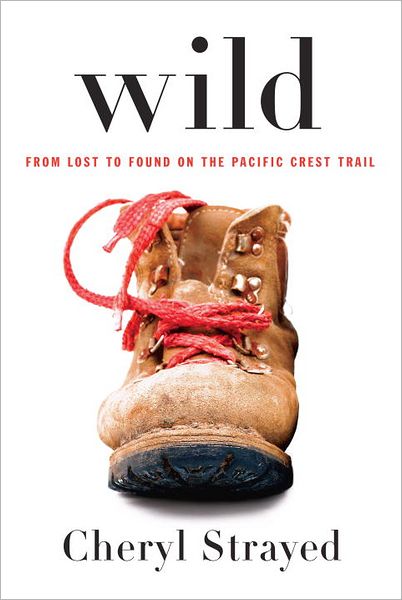
Wild: From Lost to Found on the Pacific Crest Trail by Cheryl Strayed

Wild: From Lost to Found on the Pacific Crest Trail by Cheryl Strayed

Think of Sporty Spice. Now, think of something that is her exact opposite, maybe Klutzy Spice. That is me. I have no athletic ability at all. I may actually suck athletic ability away people standing near me. I’m like a sportiness black hole. And yet, I found Cheryl Strayed’s new book Wild: From Lost to Found on the Pacific Crest Trail captivating and entrancing.

Strayed, as a young lady in her early 20’s, fell into an emotional abyss when her mother (a non-smoker) was diagnosed with lung cancer and given less than a year to live. That year-long prognosis was soon destroyed, when the disease took its toll faster than anyone could have imagined, killing her mom in a mere forty-nine days. Without their mother to hold the family together, she and her sibling and their step-father fell out of touch, and Strayed fell off the edge of a psychological canyon. Giving in to her every whim, she cheated on her husband, began a not-so-casual relationship with heroin and spent four years wandering without a purpose.

When a book about the Pacific Crest Trail nearly fell into her lap, she decided that a solo hike of one hundred days, from California to the border of Oregon and Washington, was what she needed to get her life back in order. After just a few short months of planning and preparation, she embarked upon a journey that would shatter her physically, but one in which she would reclaim her emotional stability.

As a non-athlete, non-hiker, I was worried that I would find little to relate to when I first picked up this book. (By picked up, I, of course, mean downloaded.) My lack of outdoorsy-ness took little away from the story. I may not know how to pitch a tent or build a fire, but I definitely understand how losing a treasured family member could make one unravel.  I love that Strayed was hiking on the west coast, through parks and towns that I’ve driven through on various occasions. Picturing the west coast and its mountains brought a little bit of home here to me on the east coast.

Strayed is witty and amusing as she tells of her triumphs and failures along the trail. Whether it is a discussion of how her hiking boot went tumbling off the side of a mountain or waking up covered in tiny frogs, I couldn’t help but laugh a little and continue to root for her in this gargantuan undertaking. The instant connections she had with her fellow hikers, each walking the trail for their own varied reasons, was enduring. I can imagine it would be pretty natural for one to feel a quick companionship with others who embarked on a similar colossal journey. These made-from-the-trail relationships go a long way in helping Strayed pull herself back together, piecing back not who she was before her mother’s death, but who she will be and can be as she goes forward after her time on the trail ends.

I may never attempt to walk the physical journey that Strayed did and heaven forbid I ever have to endure the emotional one she traversed, but this memoir made both overwhelming situations seem within the realm of possibility and both seem overcome-able. Cheryl Strayed’s newest publication Wild: From Lost to Found on the Pacific Crest Trail is both entertaining and heart-wrenching, and is definitely a must-read for this year. This book earns: