Visiting Chengdu’s Very Own SUPER-lative

Travel by superlatives- it is the way to go. As we’ve wandered the world, sometimes with just backpacks filled with the essentials and other times with shipments of all our worldly goods, we’ve always loved seeking to the biggest, the longest, and the farthest of all our destinations. In Cambodia we visited the world’s largest religious monument – Angkor Wat.  In Argentina we slowly made our way across Avenida 9 de Julio, the world’s widest avenue. (It took several changes of the light to make it from one sidewalk to the next, but luckily the city has built-in pit stops in the center!) And don’t forget our own American superlatives such as General Sherman, the world’s largest single tree, in the Redwood forest or the world’s largest museum complex- the Smithsonian.

But, when it comes to “-ests” of the world, don’t count out China. After all, it is home to more people than any other country on Earth. The Chinese government loves its superlative sites.  We’ve been to Urumqi- the city in the world farthest from an ocean, Le Shan- home of the world’s largest sitting Buddha, and of course, the Great Wall- the world’s longest fortification.  (Oh, and don’t forget our visit to the Macau Tower a few years ago, where Thad and John T. decided it was a good idea to bungee jump off of what was then the world’s highest bungee point.) Heck, just this week China took home another superlative title, although this one a bit less pride-inducing- Chinese airports are the most delayed of any in the world. With less than 19% of Beijing’s flights leaving on time, the record is dismal, but not at all surprising to those of us who depend on those Air China flights through the capital to get in and out of the country.

Chengdu, not wanting to be left in the superlative dust, just premiered their own “-est” attraction. On June 28, the doors officially opened on the world’s largest building-The Global Center.

It is massive!

Some of us have lovingly given it the nickname The Death Star, as it is nearly as big as George Lucas’ moon-sized space station.

With a Facebook feed full of links to online articles about the city’s newest addition from friends and family, what choice did I have but to venture and out see this incredible structure for myself?

Saturday morning was the day! Thad and I took the subway out there, meaning we got to enjoy the panic that is a line change at Tianfu Square. (No matter the time of day or the time span between trains, people get off one line and sprint to the other. I was nearly trampled by a tiny woman fully decked out in neon and sporting three-inch heels as I made my way up the stairs between lines, only to stand next to her for five minutes as we all waited for the blue line train to arrive.) The metro system has a stop directly below the Global Center, making our initial scouting trip to the building an easy one.

After rising from the subway tunnel like a Morlock, into the midday brightness (not sunshine, as I’ve not metro-ed myself to the countryside), and blindly blinked as my eyes adjusted to glare of the orb from above, I looked up to see a colossal building, covered in glass, with each corner flipped up like a wave, echoing the traditional Chinese architecture seen on Buddhist temples throughout the country.

I’ll give you this Chengdu- it is impressive!

Making a beeline across the scorching hot, white tile that makes up the courtyard in front of the Center, we initially tried to enter through a giant door that we soon realized went the office spaces in the upper regions of the building, so we skittered on down the square until we found the revolving doors that breezed us on into the mall section of this city-sized creation. Inside, we were greeted with an expanse of marble (looking?) flooring, buffed to a high shine that would make even the most demanding butler proud.  Choosing between the never-ending escalator that went directly to the fourth floor or a visit to the indoor water park, we opted to start at the latter. I couldn’t wait to see the park that boasts daily sunrises and sunsets on the world’s largest LED screen.

Off to the far side of the Death Sta…er, Global Center, we go!

As we made our way through the amateur photographers camping inside the front doors with cameras that weigh nearly as much as I do propped on hefty tripods, it didn’t take long to realize that while the building was open, it wasn’t OPEN. We passed storefront after storefront advertising what *would* be there in the near future. There will be a Lotte’s Department Store; there will be an H&M; there will be a bookstore (fingers crossed on that one!); there will be an IMAX theater.

But what IS there? A Toys ‘R Us and an overpriced Vietnamese restaurant. Oh yes, there are also a lot of exposed wires sticking out of the glossy marble floor and more than one puddle of standing water on upper floors of the expansive shopping center.

After passing “coming soon” signs in the display windows of nearly every store in the building, we reached the indoor water park- which looked amazing! The Rainbow Bright colored slides twisted and turned from huge heights, the spiraling tube-rides beckoned in reds and purples and the sandy beach was just waiting have the wave pool crash over it in set intervals that would make Old Faithful green with jealously.

Theoretically, the park looks fantastic! But, my realistic side says I’ll never spend a day there, clad in my polka-dot swimsuit, enjoying water world fun on a chilly late autumn afternoon. It looked bright and shiny and new on Saturday, but once the doors open and the masses arrive, all splendors will soon fade away as toddlers without diapers turn the beach into a giant litter box and a culture with infinitesimal personal space bubbles takes up every square inch of play space.

One of my favorite parts of the not-yet-open water park was not in the recreation area at all, but rather on the outskirts where cabanas will be home to a variety of snack stands and souvenir stores. One little restaurant advertised itself as having all manner of casseroles available. Because, what doesn’t say “a day at the beach” like a nice, creamy casserole?

In its quest for a superlative of its own, Chengdu has gone above and beyond in the world of architecture. The city has created a building like no other. (Seriously. No other.) As its galactic destiny comes to fruition over the coming months, I plan to make another trek out there to see it is all its glory. I probably won’t be buying much and I definitely won’t be swimming, but I will go wander the lustrous marble floors and enjoy knowing I’ve added yet another superlative to my own travels.

This slideshow requires JavaScript.

A bit about the Global Center (aka: Chengdu’s very own Death Star):

— 6 times the size of the Pentagon

— 500m x 400m, and 122m tall at its highest point

— 400,000 sq. meters of retail space, 800,000 sq. meters of office space

— 2 Intercontinental hotels are supposed to open, with about 450,000 sq. meters of hotel space, and over 1,000 rooms

— The Ocean Park area occupies 250,000 sq. meters, with more than 400m of “ocean coast line,” and  5,000 sq. meters of man-made sand

— LED screen that measures 150m x 40m, the world’s largest

Touched by Kim Firmston

Touched  by Kim Firmston 

17198540

If you’re like me and always scroll to the bottom of a book review to see what “ranking” it received before going back through and reading the review itself, let me warn you that this one is a bit deceptive. Don’t give up on this book just because I didn’t love it.  Touched  by Kim Firmston is the kind of book I would buy for my classroom in a heartbeat even though on a personal level I didn’t love it. You see, as a middle school teacher, I often ran into 8th graders who were reluctant to pick up a book. For a variety of reasons, reading wasn’t fun for them- it was work and no one wants more work. This book is written for those who may shy away from books because their reading level doesn’t match their interest level when it comes to many of the options on the library shelves.

Touched is about Ethan, a high school student with amazing computer skills. When Ethan feels like his dad isn’t paying him enough attention, he decides to use his electronic aptitude to make his dad sit up and notice him. Ethan hacks into his school’s central computer system, installing a virus that he is sure will catch his father’s attention, since his dad works in electronic security. But it doesn’t because his father is too preoccupied with Ethan’s step-sister’s meltdown.

Haley is a few years younger than Ethan, and they used to be close, but lately she’s been rebelling, focusing all the family’s attention on her. As she focuses inwards, Ethan pushes harder to be noticed, but in trying to impress his dad he starts sabotaging his relationships at school. With things spiraling out of control at school, Ethan’s home life matches it negative step by negative step.

Then, accusations of molestation emerge. Ethan is left without a support network of friends and wondering who to trust.

This book isn’t going to win any prizes for complex storylines and writing, but that is partially the point. For a student who struggles with reading, this book is perfect! It has an engaging plot, filled with computers and robots and family drama, but is written in a straightforward way, with lower-level vocabulary, that makes it accessible to upper grade readers with lower grade reading levels. Plus, at just over 100 pages long, it isn’t intimidating to pick up. (Many of my middle schoolers, including the good readers, didn’t judge books by the covers so much as they judged them by the width of their spines!)

Computer hacking and robot building are not things that I often sit around contemplating, so my personal rating of this book is going to be much lower than if I were giving you a teacher recommendation. For my classroom, I would buy multiple copies of this book and hand them out like candy to my reluctant readers-both boys and girls, as it fits both teenage audiences well! But, because this is blog is my personal review of books and not one based on me wearing my “teacher hat,”  Kim Firmston’s Touched earns:

books shellbooks shell


More Mobius Strip than Line Segment

Often, life is depicted as a horizontal line, starting at birth and proceeding on a linear course. History teachers love timelines, as they lay out events in an easily understandable chronological order. Epic battles are waged, empires rise and fall, great men and women leave their various marks, science and technology march forward and the knowledge of the world expands while the physical distance seems to shrink, all on these straight edges. (In school, I loved color coding my timelines. Pink could represent births and deaths, purple could be starts and ends to wars, green could mark social milestones, etc. History, while so cruel at times, can be so pretty!)

And yet, the older I get, the more time seems to fold back on itself, rather than running along smoothly from point A to point B. These folds tend to be minor, yet they pop up again and again. (Imagine them to be the crow’s feet around the eyes of the cosmic world. Inconsequential, but here to stay.)

For example, I remember sitting in my 8th grade geography class, wondering why Mr. Shake thought we needed to know the countries and capitals of the world. We’re from Idaho, after all! As we studied each region, we were given a quiz over those political designations; I hated studying for those tests. As a thirteen year old, I thought it was utter rubbish. I recall having a particularly difficult time on the “Americas” unit test. Yes, there are some freebies in there- Guatemala City is the capital of Guatemala, Panama City is the capital of Panama and Belize City is the capital of Belize. (Or so it was! When I wanted to push for a Caribbean post as being high on Thad’s most recent Foreign Service bid list this spring, I quickly realized Belize up and moved their capital to Belmopan.  That’ll throw a monkey wrench in the globe-makers plans!) But not all of those Latin and South American countries make it so easy on 8th graders. For the life of me, I could not keep Haiti and the Dominican Republic straight. How was I to know which got the tiny part of the island and which took the lion’s share of land? And their capitals? I still remember memorizing that by knowing the Dominican Republic matched is capital- both having two words, leaving Haiti and Port-a-Prince as the “other.”

Fold.

Jump ahead six years to my sophomore year of college and suddenly, there is no doubt in my mind which part of Hispaniola was Spanish-speaking and which went the French route. Why? Because I was boarding a plane to spend winter semester in the Spanish-speaking half of what seemed like the other side of the world to my junior high self. Suddenly, Mr. Shake’s geography class wasn’t a bunch of busy work! (Although, much like with my color-coded timelines, I also enjoyed coloring the maps we created for each region of the world. The hardest part was that no two touching countries could be the same color, meaning he wanted us to stick with basic [read: boring] color choices- red, green, yellow, orange, etc.  Really though, I wanted to do all of Africa in various shades of pink and purple- maroon, raspberry, grape, violet, orchid, magenta. I could easily come up with enough hues to fill in all fifty-four nations without ever having two of the same shade touch. But no. Primary and secondary colors it was.)

Fold.

And then there was sixth grade. (I’ve debated back and forth in my head for a week now about whether this was sixth or seventh grade. I really can’t decide!) I joined an after school team called OMSI that would enter the spring competition in northern Idaho. I know there were different sections, possibly some math and science related options, but I quickly signed up for the humanities-based project, as even then letters always made me happier than numbers. Our project for the competition was to write and act out a play about the final days of Pompeii. I am sure there were very specific rules about timing and major points that had to be touched upon, but decades (what?! really!?) later, those escape me. What I do remember is donning a bed sheet-toga and a head of perfectly curled spiral ringlets. That year, I read every book in the Wilson Middle School library about Pompeii and volcanoes and Greek history. I was obsessed with those photos that show the casts made by bodies buried in ash as people fled to the sea.

Fold.

Now, a few more years down the road (it’s best not to give an actual count this far out!), I’m about to experience another cosmic crow’s feet event. Yesterday, Thad booked plane tickets for our anniversary trip- to Italy and Greece! We’ll be spending just under two weeks touring Rome, the Vatican, Florence and Athens. And of course, no inaugural trip to the Boot would be complete without spending a day wandering the ruins of Pompeii. (I’m guessing bed sheet togas and heavily hair-sprayed ringlets are discouraged.)

Fold.

Straight lines are easy to draw and give a good glimpse into a given era, but in reality, life is more Mobius strip than line segment.

Fold.

Fold.

Fold.

God Bless…Porcupines

Summer is upon us in Chengdu. While my friends and family back in Idaho are broiling in the 110 degree dry heat, watching wild fires pop all around them, I am facing a very different kind of summer heat- one heavy with humidity. As I sit on my balcony enjoying a relatively clear Chengdu day, it is 90 degrees with 60% humidity. (Weather.com helpfully tells me this means it “feels like” 96 degrees outside. I’d like to think that there is a specific formula used to calculate the “feels like” temperature, but my trust in weathermen is pretty minimal. I’m guessing they just send the unpaid intern outside for fifteen minutes and then ask him to guesstimate the temperature. Whatever he says becomes the official “feels like” for that time period.)

A week of July 4th celebrations has come and gone. After two official events, both taking place at red, white and blue bedecked hotel ballrooms, I rounded out the festivities by hosting a pizza and pool party at the consulate. All were fun, but I must admit to having a twinge of homesickness for Independence Day porcupines.

Yes, you read that right. Porcupines.

You see, when I’m in Idaho for the holiday, my day usually consists of sitting on a curb in the tiny logging town of Council, Idaho, munching on my first (of many!) Idaho Spud of the day, watching a parade consisting mostly of summer baseball teams and four-wheelers. Each four-wheeler carries a few things: two teenagers looking supremely proud of themselves, a cage with a porcupine inside and a homemade sign announcing that critter’s name for the day. As I watch the procession of pokey-haired animals pass me by, I calculate the odds each one has of winning that day’s events. There’s a fine balance to be struck between rooting for the little guy who is adorable, but squirrely and cheering on the massive but pragmatic one who just wants to get across the finish line.

Yes, again, you read that correctly. The finish line.

You see, once these critters make their ceremonious way through town, they are taken to the high school football field, where they line up against one another to race for the glory that is the blue ribbon of the Council Porcupine Race.

For those of you not familiar with a porcupine race (although I can’t imagine who wouldn’t be!), it goes down like this: a team of two (usually teenagers) uses a broom and a trash can to coax their porcupine from one end of the straight-away track to the finish line on the other side. There can be no scooting or hitting of the animal with either the broom or the can. There are usually a few qualifying heats, rounded out by the finals, where the winning porcupine takes the proverbial checked flag.

Without fail, each year at least one spiky contestant makes a break for freedom, scurrying under the less-than-useful orange tarp used to delineate the field of play, scattering the hordes of people who’ve come from such far reaching places as Meadows and the fancier New Meadows to take in the show.  These escapees are usually quickly cornered, as porcupines aren’t known for their endurance, but rarely make a showing when it comes to handing out the prizes.

Oh yes, there are prizes.

You see, after the parade but before the races, the wheeling and dealing takes place. Each porcupine is auctioned off to the highest bidder. (Hence, the need to parade them through town.) All of the paid money goes into a single pile, with the winning “owner” and team taking a percentage of the earnings. We’re talking serious business here, as a porcupine can be sold for $100 or more, and with ten to twelve entrants, there’s a sizable pot at stake. There’s no choosing black or red for this gamble. It’s all about which tree-dwelling, night-loving creature will stumble over the finish line first.

This, my dear reader(s?) is how I grew up celebrating the most patriotic of holidays.

America- the land of the free and the home of the brave…and the birth place of the porcupine race. God  bless America!

This slideshow requires JavaScript.

Gong Bao and Ji Ding Wish You a Very Merry Independence Day

As a loyal reader of this blog, I am sure you remember when I added two tiny turtles to the Ross family during an outing to People’s Park last fall . (Click here to jog your memory.)  And of course, I am sure you also reflect back (with great delight, of course!) on their move to a new home right before Chinese New Year. (Click here for that fabulous tale.)

Well, those little turtles are quickly growing and seem to flourish in their new home- to the extent that they now send me greeting cards!

On Wednesday morning, as I sat at my desk trying to organize the list of overdue 4th of July party RSVPs that were piling up in my inbox, I came upon a different type of email- one from Gong Bao and Ji Ding’s new caretaker. As I head out the door to host our community Independence Day pool/pizza party, I’d just like to share this holiday greeting with you.

Enjoy!

hi there

Welcome China 19s!

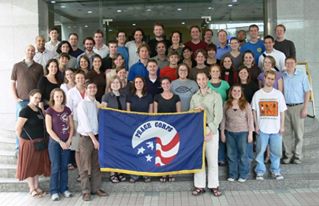
They’re here! China’s newest crop of Peace Corps Volunteers has arrived. They touched down in Chengdu on Sunday night and I am sure are already swimming through the cultural shock that instant submersion in the Middle Kingdom delivers. The numerically monikered China 19s are currently seventy strong and will hopefully retain those ranks as they face the long-haul training that is PST.

With the new volunteers in town and excited to begin their journeys, I can’t help but think back to July 1, 2006 when Thad and I were in the same position. He had diligently listened to Pimsler’s Mandarin CDs in his truck on the way to and from work for the semester leading up to our departure, but I had no such mini-foundation in the Chinese language. (I had a similar commute time, but chose to use it less productively- singing along to radio hits like Daniel Powter’s “Bad Day” and “Who Says You Can’t Go Home” by the ever-fabulous Bon Jovi.) I hit the ground without a “ni hao” or a “duo shao qian” in my proverbial pocket. We arrived in the city late at night, were handed an envelope of living expense money to get us through the summer (money that, at the time, looked like it belonged in a Monopoly box at a yard sale) and a scheduled that left no room for jet lag. Welcome to Peace Corps training!

Little did we know that we were embarking on an adventure that would include not only working with fabulous students from some of the most rural parts of the country and the making of life-long travel buddies and friends, but one that would reshape our future career paths, creating opportunities that we would never have had if we had stayed home in Idaho, just following the status quo.

But here we are, seven years later…

(Has it really been that long since China 12s began their immersion into the world of hotpot, mouth-numbing lajiao peppers and Sichuan-hua?)

That envelope of money of varying sizes no longer looks like it came from a little man with a monocle.  Rather, it has become my norm. Red bills in an envelope for the ayi, a green one if I’m having lunch at a Western restaurant, blue ones for the cab drivers or purple for a soda from a noodle alley shop. Each brightly colored bill is an easy transaction, while those monochromatic green ones from home require constant mental conversion to RMB.

I don’t get up each morning to fill a white board with Poe or The Outsiders or poetry activities for my 8th grade reading classes (although I miss that immensely!). I now pop out of bed to head to the consulate where I get the pot of coffee brewing and spend my days planning community activities, keeping everyone connected to schools and local events, all while working to maintain strong morale at a post far from many western comforts.

So, welcome China 19s. We are excited to have you in the country and thrilled that you are joining the legacy that is Peace Corps China. It will change your life. For me, my service was just the beginning of exploring new sidewalks (many of which you will find to be slicker than snot when wet or littered with what we lovingly refer to as “brick bombs” after a good Chengdu rain); it was a new direction, but one that I wouldn’t change for all the cheese and peanut butter in America.

Welcome.  And good luck!

China 12s!

China 12s!


Pancakes are Essential to International Travel

Head to any children’s section of a bookstore and you will find a whole series of books about what happens when you give fictional animals their sincerest desires. If you give a pig a pancake, there is a whole series of events that unfold because of that one generous gesture. Pig loves his pancake, but needs syrup and then gets messy and eventually needs a bath, with bubbles, of course. As the story goes along, a thread connects everything back to the initial request of pancakes. Ever wonder what would happen if that thread were suddenly cut and the Rube Goldberg machine that is Pig’s life wasn’t able to continue?

While I am not normally a superstitious person, I do have a newfound respect for a travel ritual that I seem to have taken for granted- early morning pancakes. Little did I know, just like Pig, those pancakes are the start to a series of events, which in my case lead to auspicious air travel. You see, as I was getting ready to depart Idaho this last weekend, I made the horrible mistake of eating Lucky Charms (the real thing- not even generic Marshmallow Maties!) at my parents’ house before heading out to the airport. With my belly full of fun-shaped bits of sugar and cat-food-like wheat crunchies, I had no desire to drop by the BOI McDonald’s for some flapjacks. Poor choice! I’ve stopped at that McDonald’s before every early morning flight for years, but the gods of the sky didn’t like being bypassed this time.

All went well for the first leg of my trip, lulling me into a false sense of security. My plane from Boise made the flight to San Francisco with nary a bump. On the ground at SFO, I faced the nerve-wracking to-upgrade-or-not-to-upgrade (see here for that story!), but otherwise had what I thought was an uneventful layover.

But I was wrong. It was in SFO that my problems began.

You see, after skipping the McDonald’s pancakes in Boise, I decided that I really did need to indulge in my preflight ritual, one that I can’t pander to in China since Chinese McDonald’s don’t serve pancakes. (What is that about?! They have hamburgers with mashed potatoes on them and serve cups of corn as an alternative to fries, but they can’t whip out some carb goodness first thing in the morning?) I didn’t see Ronald on the international terminal map anywhere, but the King was present, so about ten minutes before ten, I got in line to have it my way. The line was long. Too long. As I chatted with the woman in front of me, I tried to mask the horrified look on my face as I watched the worker slide the lunch menu overtop of the breakfast one, signaling the official end to breakfast at Burger King. I was just one spot away from ordering! Hoping the clerk would have pity on my poor self, I stayed in line and when it was my turn to order, tried to sneak in a breakfast platter, but was rejected faster than a Ginobili-shot in game seven of the NBA championships. Not wanting anything lunch-y at ten in the morning, I despondently wandered away from the counter, mumbling about how having it my way means pancakes at 10:02AM.

A giant M&M cookie later, I sat on the floor of SFO, blogging about my epic window-seat decision, not really thinking about the long-term repercussions of my flapjack-less travel. Things didn’t start to go bad until after I boarded the flight, when we inexplicably sat on the tarmac for an hour. (Maybe they got the message about needing to stock toilet paper on the ten-hour flight, unlike the United flight from London the day before, where cocktail napkins became TP out of necessity.)  Knowing I had a mere hour layover in Narita, my mental wheels starting turning as I leaned against the wall next to my economy class window seat. I may not be a math-person (words are SO much cooler than numbers!) but it didn’t take a lot of calculation to know that an hour layover minus an hour delay meant I would probably not be seeing my bed Sunday night.

Oh, how right I was!

Even with a United representative waiting at the gate for me and the four other passengers connecting to Chengdu, we didn’t get through security in time to make the China flight.

But alas, it wasn’t all doom and gloom. Much like when the adorable Corduroy was stuck in the department store overnight, my evening became an adventure of its own. (I’m full of picture book references today! Usually my age-genre for literary allusions leans a bit more middle school.  If I could find an online degree program that focused on YA literature, I’d be signed up and taking classes in a heartbeat!)  After getting a hotel room voucher from United, through a series of trial and error (translation: pointing and gesturing) I found my way to the shuttle that would deliver me to my evening abode.

With nearly a negative amount of Japanese and no experience in the culture, I stumbled my way through checking into my hotel room, which turned out to be the perfect fit for a travel-weary, connection-missing solo flyer. (The math on the negative Japanese works out like this- all of my long-term Asia experience is in China which is, in many ways, polar opposite of Japan. That makes my starting point below neutral.)  Since my luggage was stuck at the airport overnight, I was delighted to see that my tiny (not capsule-room tiny, but petite nonetheless) was equipped with an array of soap, shampoo and conditioner, as well as a toothbrush and toothpaste. Plus, it came with jammies! That’s right. I had anticipated a night of sleeping in my jeans and tank top, but was thrilled to find a men’s dress-shirt style button-down night shirt folded up on the double bed. It was like something out of a storybook! . (Maybe this is what precipitated today’s picture book heavy post.)   Add on to that amazingly high-speed internet that was perfect for a Skype call home and vouchers for the Japanese buffet on the first floor and my unexpected layover turned out to be a tiny travel adventure in and of itself.

I am going to market a new book in the If You Give A _______ A ________ series called If You Don’t Give Michelle a Pancake. It will be non-fiction and tell the tale of a weary traveler who disregarded her own travel rituals and ended up stuck in Narita overnight because she didn’t stop for some imitation maple syrup covered pancakes grilled up by cranky teenagers working at the world’s most ubiquitous fast food chain. But, it will also include her grand (if short) adventures in a new land.

Lessons will be taught.

Lessons were learned.

This slideshow requires JavaScript.

Mere Moments to Decide My Fate

Sometimes in life we are all forced to make some big choices, knowing that the path we choose will dictate our futures, for better or for worse. At nineteen, I decided to get married, which may not seem to be the most prudent decision, but one that fifteen years later I can attest worked out just fine. Or a couple of years after that we decided to sell our home and cars and give away our adorable pot-bellied pig for a two-year stint at Peace Corps Volunteers in western China. Then there was that little choice a few years ago to walk away from my teaching career to become the terribly monikered “trailing spouse” of a US Foreign Service Officer. None of these choices was made lightly or without a good deal of research, but we don’t always have the luxury of time to think through the big ones; sometimes they are thrown at us and we are given mere moments to determine our future.

This is exactly what happened to me today. My back, bum and possibly sanity depended on a single spur of the moment decision. Standing at the United counter at SFO I had to make an on-the-spot determination that would have long-lasting (at least ten hours!) consequences: window seat in economy class or upgrade (for $140) to a middle seat in “economy plus.” Oh the pressure! There’s no time for pro/con charts, no time for color-coding and organizing information about each option, no time to assess the possible consequences of each choice on an individual basis.

Standing 5’10”, those extra six inches of legroom are tempting. But, with an extra suitcase returning with me from America, (filled with nacho cheese, hot sauce, a couple pairs of shoes and a book or two) spending more money wasn’t wasn’t inviting at all.

What’s a girl to do?

Quickly, I mentally rushed through my options as the gate attendant looked at me expectantly. Window to lean my head on for ten hours but with my knees crushed against the seat in front of me that will be unceremoniously kicked back at the first opportunity or half a foot of extra space, but stuck in an uncomfortable middle-man situation that may or may not result in actual access to the arm rests? (My personal rule is that the middle-man always gets the “shared” armrest as a tiny consolation prize for taking one for the team. Sadly, not everyone recognizes this simple karmatic alignment of air travel.)

“Ma’am, which seat would you like?”

Window! I’ll go window!

As I now sit on the floor of SFO charging my laptop before the trans-Pacific flight to Narita, I am left to question my decision. Will my back and bum make me regret not having extra space to curl my legs up in front of me mid-flight? Will I actually be able to sleep for an hour or two, propped against the wall of the plane? These are the consequences that can only be determined with time, when I unfold myself from that crammed economy seat ten hours hence.

She may not have proposed marriage or posited the possibility of moving to the other side of the world, but the United gate attendant did force a major decision with no time to really consider the good and bad of each possible option. Okay, I’ll admit that in the big scheme of things this doesn’t even qualify as a minor decision, but with nothing else to occupy my mind during my four-hour layover, I’ve had a lot of time to ponder the possible repercussions of the choice.

Window it is. Now, only time will tell…

Garden of Stones by Sophie Littlefield

Garden of Stones by Sophie Littlefield

garden of stones

World War II gets a lot of attention in high school history books and on TV documentaries, but oftentimes while the sacrifices of American soldiers are the center point of these discussions, a darker tale is swept under the rug- that of internment camps on our own soil, built to hold our own citizens. The Japanese camps of the early 1940s are too often skimmed over in the discussion of the US’ role in the war, not giving fair play time to those who suffered and lost while never leaving their home country. Sophie Littlefield’s latest book, Garden of Stones, shines a light on this difficult time in American history, weaving a tale that links the pain of several generations.

As Garden of Stones jumps between the Patty’s pending wedding in the late 1970s and the dissolution of that same family in the early 1940s, Littlefield tells Lucy’s story- the middle woman in a three-generation tale. Lucy was just a teenager when the US government decided it would be prudent to gather up all Americans of Japanese ancestry and send them to holding camps, fearful that these people would work with the Japanese military against the US. Lucy was still reeling from the sudden loss of her father when she and her mother were shipped to Mazanar in California. While Lucy found the transition easier than her mother, falling into a part-time job as a delivery girl and meeting Jessie, who would be her first true love, her mother, Miyako, finds no such solace. As a beautiful woman, she is instantly noticed by the officers who ran the camp and soon forced to provide favors for these men, in hopes of keeping her maturing, and beautiful, daughter away from their prying eyes and filthy hands.

Soon though, Patty sees the darker side of the camp, as she realizes that not only her mother, but also Jessie, are taken advantage of in ways that would be unheard of in her life before the war came to American soil. This sudden loss of naivety starts the ball rolling on a series of events that will transform not only her own life, but those of her mother and Jessie as well.

Garden of Stones doesn’t condone the choices and subsequent actions of its various struggling characters, but it does shine a light on their backgrounds, allowing the reader to see beyond the face value of what appears to be heartless maiming of a child or cold-blooded murder. There is more to each character than meets the eye and as readers, we are privy to those histories and stories.

My one complaint with this book is that the multi-generational ensemble cast creates such a huge tale to tell that individual’s stories often don’t go as deep as I would like. There were several characters introduced, who by the end of the novel, I still want to know more about. Stories that need to be told are left open-ended, in what seem to be unintentional cliffhangers.

Sophie Littlefield’s latest work isn’t always easy to read, on an emotional level, but it does tell the tale of a time too often forgotten, and does so in a way that made me really consider just how large a swath of gray area can exist when it comes to the choices people make, earning it:

books shellbooks shellbooks shell

Guest Blog– Notes from the Field: Chengdu, China

I’ve been MIA for the last week,  hiding out in Idaho on a little vacation from Sichuan. But, I’ve not been totally unproductive when it comes to blogging.

Last week I submitted a guest blog to The New Diplomat’s Wife.  

Check out a few thoughts on Chengdu at: http://www.thenewdiplomatswife.com/2013/06/notes-from-field-chengdu-china.html

550683_786783408104_309474182_n

Idaho vacation time