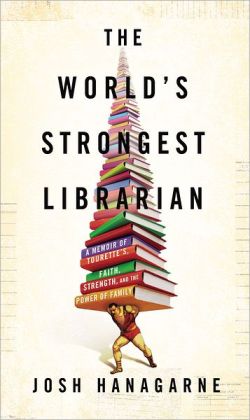
The World’s Strongest Librarian: A Memoir of Tourette’s, Faith, Strength, and the Power of Family by Josh Hanagarne
The World’s Strongest Librarian: A Memoir of Tourette’s, Faith, Strength, and the Power of Family by Josh Hanagarne

9781592407873_p0_v2_s260x420

Being either a weightlifter or a librarian are not two commonly checked boxes in the “what do you do?” category of any survey, but finding someone who could honestly check both would be nearly impossible. Or so you would think. Josh Hanagarne, though, assigns himself not only  those two monikers, but he’ll also add in being Mormon and having Tourette’s to the jumble of labels that make him who he is.


It’s an odd premise for a book, I will admit, but Hanagarne does an excellent job weaving his story, giving the reader not only an in-depth look at where he has been, but an truthful assessment of where he is as those different roles ebb and tide in his life throughout the years.


There is much to appreciate about The World’s Strongest Librarian, but its real strengths (forgive the word choice!) lie in its honesty and fairness.  Not only does Hanagarne talk frankly about the trials that come along with dealing with constant physical and vocal tics, but he also gives a heartbreaking account of his fear of passing those same challenges on to any future children and the guilt that comes along with that possibility. On an even more personal level, Hanagarne gives readers a glimpse into the world of the LDS church and what it means to be raised Mormon. While he is honest about his current indifference to organized religion, it was nice to see a book give the church a fair shake, taking a pretty neutral stance on many of the teachings. Often, what is written about the church is either pushed by zealotry, either in favor or opposition to the religion. It was interesting to see so many of the stories from the Book of Mormon told in a modern way, emphasizing aspects of the church that are rarely a part of public discussions. As he deals with his own faith (or lack of) he doesn’t disparage the church/culture in which he was raised.


By starting off each chapter with a story or two from the inner workings of a large public library, I found myself drawn to both Hanagarne’s current situation, as well as learning to understand what created the person he is today.  I enjoyed reading about the odd patrons that walk through the doors of their institution on any given day, as well as felt pangs of nostalgia for when I had easy access public libraries whenever I felt the need to wander the stacks in search of a new book (or two, or three).


As someone with zero (or less!) interest in weightlifting, I must admit to having trudged through a few pages here and there when Hanagarne gets into the details of kettle bells vs. traditional free weights or the specifics of training. But, the occasional skimming of a paragraph here or there didn’t take away from the overall story one bit.


But, by far, my favorite part of The World’s Strongest Librarian, is the abundance of literary references throughout. I love how Hanagarne wraps up so much of his personal story with the writings of other authors! Not only did his true “librarian-ness” shine through at these times, but it gave me a whole new reading list.


Josh Hanagarne’s The World’s Strongest Librarian: A Memoir of Tourette’s, Faith, Strength, and the Power of Family was a great weekend read and one I would recommend to people who are checking a variety of different boxes in their own lives. His story is one that, while seemingly catered to a very niche audience, is actually a tale of personal growth and the overcoming of obstacles, which ultimately makes it applicable to us all. This book easily earns:

books shellbooks shellbooks shellbooks shell


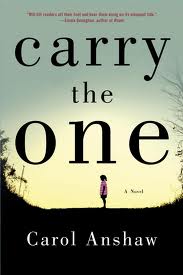
Carry the One by Carol Anshaw

Carry the One by Carol Anshaw

carry

Western-style burgers and pizza aren’t the only things Beijing has that our little (okay, not little, but non-connected) outpost of Chengdu lacks, although filling up on both this last weekend was a treat. No, we are also missing a true English-language bookstore, which means I’ve been deprived of shelves upon shelves of novels, memoirs and travel writing for months now. (Yes, I’ve got my Nook and do a good deal of book downloading on it, but there is something special about thumbing through a book off the “new releases” shelf or the “employee favorites” table that is lost in the translation to digital reading.) My trip to the capital this last weekend not only did some serious damage to my waistline (thank goodness for skirts with stretchy waists!), but also to my pocketbook (thank goodness for per diem!).

One of my treasures from this outing was Carol Anshaw’s release from last fall, Carry the One. (No worries my math-phobic friends. The title is in no way a reference to adding large numbers by hand!) In this newest novel by Anshaw, the reader is taken on a multi-decade tour of the lives of a group of friends who share a bond after all are present for a terrible disaster. While some are able to come to terms with what happened on that fateful night, not ever necessarily forgiving themselves for the pain that was caused, but creating lives of their own beyond the tragedy, others circle back to that night over and over, in a downward spiral that only ends in more pain.

Love is found and lost. Relationships grow and ebb. Careers are built and tumble down. But through it all, this core group of characters (friends is a bit of a stretch, especially as time goes on) are reunited over and over, always being reminded of the terrible bond they share.

I must admit that I wasn’t instantly drawn to the narrative of Carry the One. I found the ensemble cast hard to keep track of for the first few chapters and I wasn’t sure I would ever get them straight in my mind. But, not long after I considered the need to make a chart (thankfully I was able to contain myself and not get that crazy), the storylines diverged enough that each individual became unique and separate from the whole, while still being connected to the main tale. By the end of the book, I was definitely drawn to some characters and their personal struggles to deal with the shared tragedy, while I was disgusted at how others chose to profit from the pain of someone else. Creating such strong feelings about the players, whether positive or negative, is the mark of a great writer.

Like a wheel, with the central hub being the fateful night of the first chapter, each character spins off as a spoke, creating a life of their own, yet never being able to fully shake their shared nexus.  Carol Anshaw’s latest creation, Carry the One is a powerful narrative of pain and loss and the desire for redemption and healing, easily earning a solid:

books shellbooks shellbooks shellbooks shell

The Ugly One by Leanne Statland Ellis

The Ugly One by Leanne Statland Ellis

the ugly one

The young adult book genre has expanded rapidly over the last decade, creating reading niches for a variety of teenage interests, from the currently ubiquitous choices that include vampires and werewolves to the popular dystopian series. But, one of my favorite growing topics in the world of YA literature is cultural/travel fiction. I think it is outstanding when kids sitting in their suburban American homes can open and book and be suddenly transported to Southeast Asia, South Africa or South America. Leanne Statland Ellis’ soon-to-be-released book does just that- taking readers on a journey to Peru and the thriving Incan civilization.

Names are an important part of this tale, with the narrator going by several different ones, depending on who is addressing her. (Tale is a fitting label for this book, as it reads like a mystical tale from the ancient oral traditions, tying the reader up in the story as pages fly by.) She is called by her given name, Micay, by her loving older sister, but mocked as The Ugly One by a young bully in her village. As her story progresses, she gains other monikers, more fitting to her changing situation, but at heart, she remains the same strong young woman.

Micay’s name isn’t the only morphing element of the book, as her role within her small mountainous village is challenged and set on a new path by a stranger from the jungles below. While she initially doesn’t believe she is destined for great things, those around her see a potential that, with the right help, she is capable of achieving.

A great middle-level book is one that not only entertains, but draws on universal themes that open larger dialogs, which is an area this book excels. From the tale of the bully and his painful words to the difficult decision of when it is right to put one’s personal desires before those of the community, The Ugly One provides a great deal of fodder for thought and discussion.

The reading level of The Ugly One is not particularly difficult, making the book easily accessible to a wide range of middle school readers, although some might struggle with the occasional unfamiliar Incan word. Luckily, there is a great glossary at the back of the book, which not only helps the reader follow the narrative, but as a teacher, I love having yet another chance to introduce students to references sections in different types of literature.

The one place I felt letdown by this book was at the very ending. As the narrative is wrapping up and the reader gets a glimpse into what the future holds for the main characters, I felt that one young man who played a critical role in the story is left out of the story. I was really hoping to get at least a hint as to whether sharing a moment of understanding with Micay is enough to change this boy’s outlook or if his attitude is too deeply engrained to transform into something more positive.

Overall, Leanne Statland Ellis’  The Ugly One is a great read for students, drawing them out of themselves and into another time and another culture, earning the book:

books shellbooks shellbooks shellbooks shell

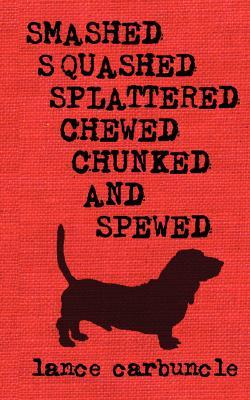
Smashed, Squashed, Splattered, Chewed, Chunked and Spewed by Lance Carbuncle

Smashed, Squashed, Splattered, Chewed, Chunked and Spewed by Lance Carbuncle

smashed

Who wouldn’t want to pick up a book titled Smashed, Squashed, Splattered, Chewed, Chunked and Spewed? With an eye-catching moniker like that, the reader must know they are in for a wild ride, which is an assumption that plays out correctly. Lance Carbuncle, in his debut novel, aims for the crazy-land target and hits it dead on. There is so much going on in this book that it is at hard times to keep track of the trajectory, and yet, the narrative always circles back to a thirty-five year old basement dweller and his creatively named basset hound, Idjit Galoot.

From dreams of a runaway talking dog to an exploding sombrero, this book is just meanders down wacky lane from start to finish. It is definitely not a good pick for those who are easily offended, as it doesn’t take many chapters to encounter possible necrophilia, poop in freezer bags and enough drinking and pot to keep  college freshman entertained for a month. But, if such adventures don’t turn you off, this book is darkly comedic and entertaining.

I have to admit that Idjit Galoot quickly became a major selling point for me. I don’t think I would have stuck with the book to the end without the odd little basset hound whose existence creates the whole purpose for this ridiculous quest.

While I have friends who might love the crazy wanderings of this verbosely titled book, but in the end, it wasn’t the tale for me. I appreciate dark humor and can giggle at crude jokes as much as the next guy, but it was just too out there for me. I think the point I really got lost was after the hurricane hit south Florida and the follows some bayou-dwelling taxidermists and their hunt for the skunk-apes.

Lance Carbuncle’s first publication, Smashed, Squashed, Splattered, Chewed, Chunked and Spewed, is definitely a niche novel that will win a following among a certain segment of the reading population, but I won’t be the one pushing it on my friends. The over the top vulgar humor and preposterous storyline, while appealing to some, just pushed the tale beyond entertaining for me, earning it a mere:

books shellbooks shell

The Program by Suzanne Young

The Program by Suzanne Young

the program

Yes, another dystopian young adult novel book review from In Search of the End of the Sidewalk. I’m a sucker for them! All of the websites where I buy books or that I look at for book recommendations apparently have me pegged as an angst-ridden teenager because these types of books are always at the top of the “to read” lists and I never just click away to something else.

The Program is the first novel in a series by Suzanne Young, a newer (although not brand new, as she has a couple other books already published) writer who daylights as an English teacher. The book takes place in the not-so-distant future when an overuse of antidepressants is believed to have spawned an epidemic of suicides in the teenage population. There is no proof that the medication was the impetus, but as a generation of adults who were heavily medicated become parents of young adults, the rash of deaths is pushed upward of one in every four teens taking their own lives. As the country goes into panic mode over these cases, The Program is created to keep kids for ending it all.

Once a teenager is flagged for The Program, they are forced into a facility where their memories are taken away, one by one. The idea is that if the kids can’t remember the bad things, they won’t want to terminate themselves. The powers-that-be believe that the suicides are a plague and can spread from student to student, so as soon as one is infected, their friends are closely monitored for signs of negative changes and quickly flagged. This process leaves no room for true emotion or time to grieve over losses, as those difficult emotions are instantly interpreted as infection.

It is in this world that Sloane and her boyfriend James are trying to stick together and make it to their eighteenth birthdays, at which time they will be free of the threat of forced “treatment” through The Program.  As some of the people closed to them succumb to the infection or disappear into the blank-slate world of The Program, their ability to maintain facades of “normality” is challenged more and more frequently.

The premise of this novel is a good one and allows Young to explore some interesting areas of psychology, especially what makes someone themselves. If their memory has been wiped clean, are they still the same person as when they had a lifetime of memories? Or, how can one trust those around them when they have no background? Just because you were told someone was your friend, how do you know they really were? The chances for manipulation and abuse are rampant within these table rasa teens. These would be awesome discussions to have in a book group or classroom full of teenagers who already question who they are and what they want from life.

When I first downloaded this book, I didn’t realize that it was the first in a coming series of books, but it didn’t take long to figure out that the plot wasn’t going to come to a nice, complete ending by the final page. All along, it is setting the scene for future books, which I must admit is a bit of a downside. In theory, I don’t mind series (and I think they are great for reluctant readers who get caught up in with a tale and characters they love!), but when the book obviously feels like a set-up for what comes next, I must admit to being a bit disappointed. In the case of this novel, I think I may have liked it a bit better if it had been longer, but told a complete story, rather than stopping at what is clearly a jumping off point for book number two.

In the end, the series-format is the only thing that turned me off a bit to this slightly-futuristic novel. Suzanne Young’s exploration of self and memory is one that I found intriguing and created enough questions in my mind that I will definitely be downloading book two when it comes out, earning The Program a solid:

books shellbooks shellbooks shellbooks shell

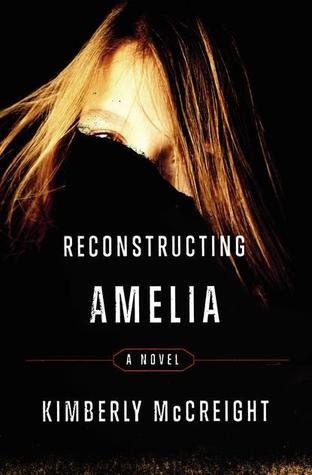
Reconstructing Amelia by Kimberly McCreight

Reconstructing Amelia by Kimberly McCreight

15776309

After avoiding it for months because it had become “too” popular, last winter I finally downloaded Gone Girl to read on the long flight from western China to Idaho. (I tend to get a little snotty about books that *everyone* says I must read.  When they become a cultural phenomenon, I get turned off by the saturation in the news and internet. It’s uppity and judgmental, I know. And yet, it’s how I roll.) But back to Gone Girl,I loved it! With that rambling introduction, this isn’t a review for Gone Girl by Gillian Flynn, but rather one that came up on a recommendation list I look at saying if I liked that one, I should try Reconstructing Amelia  by Kimberly McCreight. They were right!

Much like the suspense that kept me turning pages way too late at night with Flynn’s book, Reconstructing Amelia had me spellbound much longer that was prudent for the few days the book lasted. McCreight’s story starts with the suicide of Amelia, who jumped off the roof of her liberal, left-wing private school, and her mother’s arrival on the scene. But, it quickly jumps back in time, leading readers through the months prior to Amelia’s death, creating a picture of a teenage world much more complicated than her single, long-hour working lawyer of a mother would have liked to believe she lived in.

Told through Kate’s investigation of her daughter’s death (six weeks after Amelia’s death,  on the day she returns to work at her high-priced law firm, Kate receives a text message from a blocked number saying Amelia didn’t jump), the reader follows Amelia’s steps, and missteps, in those crucial months before she died. We not only get to have Amelia as a narrator, but, along with her grieving mother, we delve into her texts and emails (somewhere most parents don’t want to go), her relationships (both long-standing and newly-budding) and read past editions of a nasty online newsletter circulated anonymously at her school.

Several time throughout the book I thought I had pieced together the puzzle of why Amelia would take such a drastic measure, only to have the pieces shift and leave me looking at a whole new scene. McCreight does a wonderful job of giving readers enough information to keep them hooked, but not revealing the entire story until the final pages of the novel.

A tale of a young girl’s suicide may not seem like the book you want to rush home from work to curl up with on the couch, but Kimberly McCreight weaves a tale so intricate and twist-filled that I did just that- scurried home from work and into my pajamas so I could read a chapter or two before dinner and then another few before bed, easily earning Reconstructing Amelia: 

books shellbooks shellbooks shellbooks shellbooks shell


Silver Orphan: A Social Novel by Martine Lacombe

Silver Orphan: A Social Novel by Martine Lacombe

silver orphan

With our population of Baby Boomers growing ever-older and the social norms of the following generations creating a society with less room for these aging Americans, many communities in the US face a looming crisis of how to adequately care for the shifting demographics of their populations. This trend of seeing elderly folks without next of kin willing/able to provide such support has created an ever-enlarging segment of our population, dubbed “silver orphans” by sociologists. This emerging predicament forms the basis for Martine Lacombe’s first novel, Silver Orphan: A Social Novel.

While I’m not sure why Lacombe chose to include “A Social Novel” as a part of her title, as there are currently many authors attempting to address social issues through their fiction, I do appreciate her tackling a problem that is just emerging within our society. Recently, many authors have undertaken writing about tough issues such as bullying and school violence, but Lacombe comes out ahead of the crowd, bringing to light a problem that isn’t making the bold-faced headlines yet, but will be soon.

Brooke Blake is immediately introduced to the reader as the lead character (I hesitate to call her protagonist, as her personality is off-putting enough to not want to use “pro” anywhere near her name), whose life quickly becomes interwoven with Frank, an octogenarian who needs some support. This is the first place that I struggled a bit with the story-telling, as after a rather lengthy introduction to Brooke as a high-paid pharmaceutical rep with shoes that cost more than I make in a day and a cold demeanor meant to put all in their place, I had a hard time suspending believe enough to imagine that she would actually pull over for a random hitchhiker, then not only take him home, but become a part of his life. The idea of someone coming into Frank’s life to be a support and then push his story beyond his death is a great outline for a story, but I just don’t find Brooke believable in this role. The jump from her character in the first ten pages to her character just thirty pages later is too far for me.

Beyond the far-fetched connection of these two characters, the other aspect of Silver Orphan that I struggled with was the sometimes halting dialog. When Lacombe is telling the story from the narrator’s point of view, the writing is smooth and, at times, even poetic, but once she is forced to put words into the mouths of characters, something in the flow is lost.

The multi-layered settings of the book create one of the high points of the novel, as Lacombe braids together stories from the current time, the recent past, the WWII era and the height of the Italian immigration. History that is often glossed over by textbooks is uncovered throughout the book, making the novel a mini-social studies class, thanks to Frank’s genealogy. There are times that the historical references seem a bit forced (I have to admit to still being confused about why the tale of Orson Well’s War of the Worlds is included), but this novel could find a place as a companion novel in a high school history classroom.

Without giving the ending away, I did feel like it came a bit out of left-field and has me closing the book with some lingering questions, not about the main plot line of the book, but about new twists that were introduced on the final page.  I am finding it hard to assign a final score to this book, as the novel was given to me for free in return for a book review, but there are revisions I think the story needs to go through before it is great. (My hesitation comes from the fact that I would love to be more active in the review of book galley copies, but my first one is not overflowing with praise, which may turn off other authors.) Martine Lacombe’s soon-to-be-published first novel is just that- a first novel. It is a great start for a young author and I am excited to see what social issues she will tackle in her next book. This book isn’t going to fall into my top 10 of 2013 list, but I like where Lacombe is headed with her writing and will definitely be watching and waiting for her sophomore publication! Silver Orphan: A Social Novel by Martine Lacombe earns:

books shellbooks shell
 

Is a Ravens Win “But A Dream Within A Dream”?

The Big Game is finally here. After months of weekly fashion shows by all of the teams in the league (and maybe a bit of ball running/throwing/kicking to make the NFL look like something other than a club for boys with cute outfits vying for rings each winter), it has come down to two options for Mr. NFL. We’ve got the 49ers who will be sporting red and gold ensembles tomorrow morning (game time is 7:30AM for those of us residing in the Middle Kingdom) and the Ravens who will wear a darker scheme of purple and black.

(Looking back over the season, the regular game day uniforms were pretty similar to last year, but when it came time for throwbacks, there were some major missteps! I still can’t believe the Steelers took the field looking like giant bumblebees this fall.  Horizontal stripes aren’t easy for most people to pull off, but put them on a 300 pound linebacker and the results aren’t pretty. Give them some antennae and a few Spanish phrases and they could be stand-ins for Bumblebee Man from the Simpsons. And don’t even get me started on the throwbacks donned by the Buccaneers this season. Just a hint boys: Sherbet-hued outfits will intimidate no one. And regardless of how you feel about the breast cancer awareness pink requirement during October, I would officially like to excuse the Redskins and the Chiefs from next year’s forced “we heart boobies” trend. There is just no way the red/yellow of their normal uniforms can come anywhere near looking good with a splash of bright pink. Let them off the hook, for the sake of all of our eyes.)

While my Idaho roots may make readers think I would lean towards supporting the 49ers, I can’t do that, for several reasons. First, those outfits are hideous. They look like they are stuck in the 80s. If the Super Bowl was based purely on uniform design (which I wish it were), they’d lose before the coin was even tossed.

But, their terrible threads are not the only reason they aren’t getting my vote. How can I not tell the tale of my heart and root on the Ravens? You’d have to chain me to a catacomb’s wall to keep me from cheering on Baltimore’s team tomorrow morning. The wings seraphs of heaven covet the playing abilities of Ray Lewis and Joe Flacco.  Will San Francisco take home the Lombardi trophy tomorrow morning? “Quoth the raven, ‘Nevermore.’”

He was a literary master and he has an NFL team named after him. There is no other team to root for. Evermore!

To prepare for the early morning match-up, my day has been spent getting ready for the Super Bowl party I will host at the consulate. With freshly painted purple and black fingernails, I’ve peeled about a million mandarin oranges, which are a perfect for the continental breakfast spread I have ready to go in the morning. (Rather than noshing on nachos, pizza, chicken wings and beer, we’ll be celebrating with muffins, cinnamon rolls, fruit and coffee. That’s what happens when kickoff is before the opening of business on a work day.) I ran to the store to get extra juice, worried that the four boxes I schlepped back to the compound after lunch on Friday would not be enough, and got some baby bananas to supplement the peeled miniature oranges.

Sadly, we won’t get to watch the overpriced Super Bowl commercials, as we’ll be watching the game live on an AFN (Armed Forces Network) feed, which doesn’t allow for commercials.  While all of America is watching a baby Clydesdale grow up and make his owner proud (and getting to take a shot at naming him) and a confusing VW commercial that implies driving one will give you a carefree Caribbean outlook and a stereotypical Jamaican accent (neither of which I got in the several years I drove a VW Bug), we’ll be sipping coffee as the military reminds us about such uplifting topics as PTSD, suicide and the pitfalls of only paying the minimum balance on our credit cards.

Knowing that winter is going to be cut short thanks to Punxsutawney not seeing his shadow this weekend, those of us in Chengdu will be enjoying some early morning pigskin play action and hoping for a bit of sunshine to break through the haze. Oh yeah, and rooting on an American literary legend’s team.

GO RAVENS!

MWF Seeking BFF: My Yearlong Search for a New Best Friend by Rachel Bertsche

MWF Seeking BFF: My Yearlong Search for a New Best Friend by Rachel Bertsche

Friendship is a tricky thing. When you are young, it is all about who lives in your neighborhood or who is in your class at school. Kids, for the most part, are good at finding connections within those preset groups. One you get in to middle school and high school, friendships are much more chosen. Kids look outside the few houses surrounding theirs or their homeroom and seek out kids in the school with similar interests or backgrounds. And by college, while your dorm mate might be your BFF for the first few weeks, you quickly find others who are studying the same things, involved in the same activities or hanging at the same places as you do. Your friendship net is able to cast much wider than ever before.  But, by the time we get to be adults, it seems like we lose a bit of our ability to automatically connect the way we did as kids. It can make finding friends, especially close ones, tough to do.

That’s the premise that Rachel Bertsche started with in MWF Seeking BFF. She was new to Chicago and looking for girl friends. She had a wonderful husband, but wanted the chit-chat, reruns of Glee and mani/pedi dates for which a husband just doesn’t cut it. With the need for new girl friends, Bertsche went on a year-long quest to add to her friend Rolodex. She committed to “date” fifty-two girls over the course of the year, hoping to make some genuine connections along the way.

When I first picked up MWF Seeking BFF, I thought I was in for another blogger turned memoirist book. (I have to admit, I love this up and coming genre.  There is something to be said for someone who gains a huge following online and then is able to translate it on the printed page.) And the book is a memoir, but it is more than that. There is a touch of self-help thrown in and a whole lot of research on friendships, along with the humor and storytelling that I prize in these types of books.

Initially I was very turned off by the research included in the book. To me, “memoir” doesn’t scream quotation citation and reference checks. And, to be honest, Bertsche’s use of the research is a little choppy at times. There were moments, mostly early in the book, that I felt like I was reading the world’s longest 8th grade research paper. (Believe me, I’ve read enough of those to know what I am talking about.) The transitions from her story to the quotes by scientists and sociologists were not always the smoothest. It felt like she was told her had to have a certain number of citations, and by golly, she was going to get them.

But, once I got used to this rather unique writing style, I really tuned in to the book and enjoyed it. Rachel Bertsche is just a few years younger than I am, and having recently moved to the other side of the world, (with many more such moves in my future) I get where she is coming from. At 30-something, it isn’t easy to leave behind your BFFs and make new friends, to basically start over in the friend department.  I found her discussion of different levels of friends to be spot-on and her tales of breaking the ice with new person after new person sounded rather familiar to me.

This book was originally recommended to me by one of the members of my book club in Washington DC (and fellow blogger in the world of Foreign Service- you can check out her adventures in Mexico City here), and would have been the *perfect* read for a book club. After finishing it, I am super disappointed that we didn’t get to read it together and talk about the struggles of friendship as an adult. MWF Seeking BFF: My Year Long Search for a New Best Friend by Rachel Bertsche was a fascinating book, in which I saw a lot of my current situation reflected, which earns it a very strong:

The Paris Wife by Paula McLain

The Paris Wife by Paula McLain

Hemingway is a divisive figure in literature. Some people love his style and try hard to emulate his unique way of writing, while others are turned off by the seemingly mundane details included in each chapter.  But, whether you love the man or hate the man, Paula McLain’s The Paris Wife is a book worth picking up, as it shows an earlier side to the man who would change American literature forever.

Hadley robs the cradle when she marries Ernest, a man eight years younger than her. But, after living a life of coddling and seclusion, and one where she was staring old-maidhood in the face, Hemingway paints a picture of a future filled with adventure and society and excitement. Against the judgment of their families, the two marry and soon decide to move to Paris, where Hemingway can work on his craft in the midst of other artists. While they are portrayed as being deeply in love, I have to admit that the dialog expressing this love tended to be a bit over the top and stereotype-ridden. At one point Hadley says, “Did you ever think it could be like this?” I felt like I had been thrown into the cinematic debut of Nicholas Sparks’ latest romance.

Paris in the 1920s was a place where traditional marriage was no longer looked upon as sacred, at least the Paris of the Hemingway coterie. Within their circle of friends, extra-marital trysts were common and ignored. Apparently, if they were not openly discussed, they were not an issue. The Hemingways fare well for a while, but after the birth of their son, as pressure mounts on Ernest to become the published writer he has always dreamed of being, a woman Hadley considers her friend wedges her way in to their relationship, soon making a mess out of what had been so strong. The book actually begins with Hadley discussing the disintegration of her marriage, so there is no spoiler alert needed in saying that what started as roses and kisses and long letters morphed in to angry words and late-night fights and a parting of ways forever.

Getting an inside look at Hemingway’s early days is fascinating and was enough to have me hooked throughout the length of the novel. There were times where I thought that if the book had not been based upon a writer whom I enjoy reading and had not been as well-researched as it was, I would never have made it through as a simple novel. Hadley as a character is insufferable when it comes to motherhood. I couldn’t believe how many times she left her child with a nanny so that she could go on a ski-vacation in the Alps or attend the running of the bulls in Spain. The worst was when the boy had whopping cough and had to be quarantined, rather than stay with him through the difficult time, she called on the nanny to come and nurse him better so she could go out in the evening for drinks with their group. Maybe that was the norm for their set in Paris in the 20s, but it did not make her a sympathetic character.

While name-dropping is not normally looked upon as a social grace, in Paula McLain’s The Paris Wife it is a compelling aspect of the Hemingway-centered narrative. Cameos are made by Ezra Pound, F. Scott Fitzgerald, James Joyce and Gertrude Stein, just to name a few. Reading this book was like watching an ensemble cast movie, with all the top names of the day signing on to a single project. But unlike many of these Hollywood heavy-hitter filled movies where a lot of A-list names aren’t enough to satisfy the viewer, readers of this book walk away intrigued and ready to read more about each character. At times, both Hadley and Hemingway are hard to stomach, and the whole book leaves me feeling a bit more negative towards Hemingway as a person, the book is an entertaining read, both historical and literary points of view. McLain’s The Paris Wife earns: