Escape from Camp 14 by Blaine Harden

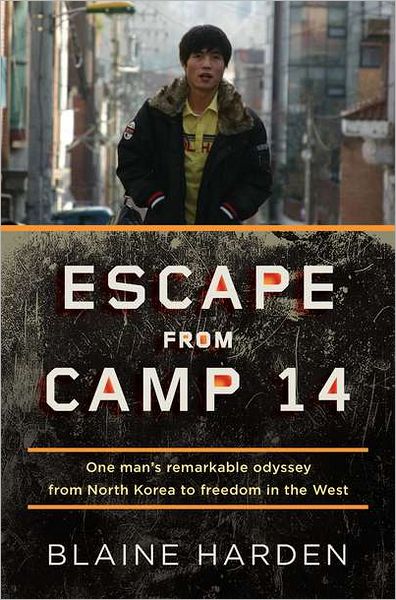
Escape from Camp 14: One Man’s Remarkable Odyssey from North Korea to Freedom in the West by Blaine Harden

Since the death of the North Korea’s Dear Leader last year, the isolated country has popped back up on the radar of the American public, who previously had mostly written it off as unimportant or nominal when it came to world politics. With Kim Jong-il’s passing, and the subsequent handoff of power to his son, a bit of attention has refocused on the Korean peninsula; examinations of the political manipulation and terror that are widespread are starting to be taken seriously. It is in this perfectly suited climate that Blaine Harden’s powerful book Escape from Camp 14 has been published.

Escape from Camp 14 is the tale of Shin Dong-hyuk, the only known North Korean prisoner to have been born in a prison camp and escape the country. While thousands of other North Koreans have made the treacherous trip across the northern border, into an unwelcoming China and eventually on to South Korea, where they are granted citizenship, Shin did so with very little knowledge of the world outside the fences of his camp.

Shin’s childhood was marred by starvation, torture and a constant feeling of fear. Trust, love and friendship are words that meant nothing within the walls of Camp 14. It isn’t until he is thrown into an underground jail for crimes he didn’t commit that he starts to know that there are other countries outside of his own, that there is another way of life than he has always known. Once that light bulb begins to shine, however dimly, in his mind, he can’t let it go.

There have been other books written by survivors of not only the North Korean prison system, but those strong souls who made it through the concentration camps of World War II and other horrible circumstances around the world. For me though, Shin’s story stands out amongst the memoirs for a couple of reasons. First, while many people who endure the horrors of war or oppressive governments knew a different lifestyle before, knew the meaning of love and trust and family, Shin was born into Hell. From the very beginning, he was just another mouth to feed, another form of competition for the already meager rations provided to those living in the camp. He didn’t have memories of better times to sustain him. Camp life was the only life he had ever known.  Second, Harden doesn’t whitewash the tale to make it more comfortable for the reader.  I appreciate that Shin’s story stands as it is. There were times when I was reading the book that I became really frustrated with Shin and the decisions he was making. Like many North Korean defectors, Shin has a very hard time assimilating to a world not ruled by guards. A fictional tale of escape would have the protagonist go through some growing pains and then settle in to a life of freedom and live happily ever after. Shin’s story doesn’t end with a happily ever after, at least not yet, but that is the reality of his (and probably many others’) situation. It is uncomfortable for the reader, but there is no easy answer to how to deal with the psychological turmoil he wakes up to each day.

This recently published book shines a spotlight on a country that has been in the news, but often in a way that mocks it slightly. Its past leaders have been eccentrics who seem clownish to the outside world, but behind the giant glasses and stiffly combed hair are men who allow their countrymen to be beaten, tortured, and to starve and die while the leaders enjoy vacation homes by the sea. While the story can be frustrating to read on an emotional level, it is well-told and serves an eye-opening account of the realities of life behind the electrified, barbed-wire topped fences of North Korea’s prison camps. Blaine Harden’s Escape from Camp 14 earns:


Girl Walks into a Bar by Rachel Dratch

Girl Walks into a Bar by Rachel Dratch

It appears that lately I’ve had a thing for the ladies of comedy. A few weeks ago I read (and reviewed) Mindy Kaling’s new book, then last week I bought Tina Fey’s Bossy Pants (which is currently in a box on the slow boat to China) and then today I finished (somewhere 30,000 feet above the flyover states) Rachel Dratch’s new release. I haven’t read Fey’s book, but I do have to admit right up front that between of Kaling’s and Dratch’s books, Kaling wins without a doubt.

Now, that doesn’t mean I didn’t enjoy Girl Walks into a Bar, there were parts that made me laugh and parts that made me reflect on my own choices in life. I definitely agree with Dratch on her views of baby showers, (I mean, how many tiny pairs of pants can one oooh and ahhh over in the space of a single afternoon?)but overall I think the vast difference in where we are in life makes the book fall outside my range of interest.

Dratch focuses a lot on the fact that she became a mother for the first time at the age of forty-four. She had always wanted kids, but didn’t want to be a single mother and Mr. Right hadn’t found his way in to her life yet. Her world is turned upside down when, well past the time she thought she would have to worry about birth control, she finds out she is pregnant. The father is a man she had been seeing long-distance for several months, but one with whom there was no set commitment.

Before getting to the pregnancy, Dratch does detail the horrors of her dating life. I couldn’t help but laugh at how many crazies came her way over the years. From the married man who flirted like there wasn’t a wife and two kids at home to the one who casually asked her if she ever wondered what human flesh tasted like, she definitely got her fill of the New York dating scene.

The book references Saturday Night Live and its cast and host of characters pretty regularly, so that may be a draw for some. While I went through a period when I watched it most weekends, it has been a few years since I could be counted on to know the recurring skits. (Even when I was watching often, it was pretty much only for the digital shorts and Weekend Update. The rest was pretty hit or miss for me.)

Girl Walks into a Bar was a quick read and I am sure it will be popular with mothers who feel the pain/excitement/horror/joy/fear/blessing of an unexpected pregnancy, but this just wasn’t the queen of comedy book I had hoped for.  (Fingers crossed that Tina Fey’s book will fall into the Mindy Kaling category and not the Rachel Dratch one… ) With that said, it was the perfect book for a cross-country airplane ride- easy to read and short chapters that don’t require excessive amounts of concentration.  Overall, Rachel Dratch’s Girl Walks into a Bar earns:

From the Memoirs of a Non-Enemy Combatant by Alex Gilvarry

From the Memoirs of a Non-Enemy Combatant by Alex Gilvarry

What do you get when you mix the New York fashion scene with alQaeda? You get a darkly humorous novel that delves into the paranoia that gripped the US in the months and years following 9/11. From the Memoirs of a Non-Enemy Combatant is just that, as it follows Boyet Hernandez, a Filipino designer who has come to New York to make a name for himself and his clothing line (B)oy.

Boy runs into problems immediately upon arrival in the US. He has big dreams and talent to back them up, but not the funding. Just as he imagines he may never have the backing he needs to make the clothing line he has envisioned, a chance encounter with a neighbor changes his world. What Boy is too naïve to realize is that this new benefactor, with an apartment full of fertilizer, may not be funding his clothing line out of sheer love for his design aesthetic. Boy doesn’t see that he is being used as a front for much more sinister works.

We learn of Boy’s New York exploits as he writes about them from his tiny cell in No Man’s Land, (ie: Guantanamo Bay) where he is being held and interrogated, without having been arrested and without access to a lawyer. On yellow legal pad after yellow legal pad, Boy walks his interrogator (and us) through those early days in the United States. We see how much he loves the US, how entirely focused he is on clothing design and how he was too self-absorbed to realize what was going on around him.

Boyet is a likeable protagonist. He is embroiled in a mess well-beyond his understanding, and yet he tries to make sense of it by pulling forth his own renderings of history, philosophy and literature, usually butchering these references beyond belief. (The footnotes throughout the tale help sort out the points he is trying to make.) My favorite of these ill-guided attempts at allusion is when he tries to make a connection to the works of 19th century Russian author Fyodor Dostoyevsky, saying he particularly liked the one about the idiot, if only he could remember the title!  This just puts a stamp on Boyet’s incredible nativity and innocence as he is being accused of the heinous and horrible acts.

I really like that this book breaks out of the conventional novel box. I like that it is Boyet’s own “confession,” written while held captive, bookended by a prologue and afterward by a reporter wishing to make the story known. This organization pushes the reader to imagine how such unwarranted detentions were (and still are) possible in a country where we say we prize freedom and the rule of law, but we are so afraid of terrorists getting the upper hand that those sentiments can be easily swept under the carpet in the name of protecting the homeland.  Boy’s story is a fictional one, but it does force the reader to stop and consider how close to reality certain aspects may be treading.

A unique style, coupled with a tale that weaves fashion and ethics together earns Alex Gilvarry’s novel From the Memoirs of a Non-Enemy Combatant:

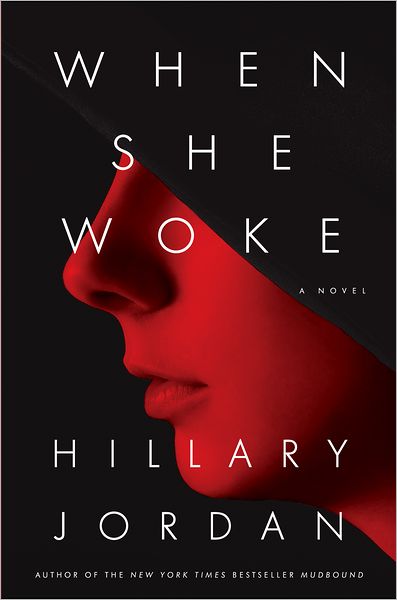
When She Woke by Hillary Jordan

When She Woke by Hillary Jordan

When She Woke falls firmly in the young adult literature genre, but within that realm, its home is on the older end of young adults. The writing style and vocabulary are by no means out of reach of middle school students, but the themes and content definitely require a bit more mature reader.  I was drawn into the novel from the very start, loving the obvious references to The Scarlet Letter. (The allusions, both apparent and those that are a bit more concealed, were strong enough to make me want to go reread Nathaniel Hawthorne’s magnum opus.)

The problem became, while I was intrigued and captivated by the first half of the novel, that level of enthusiasm wasn’t sustained throughout the second half.  While the beginning of the book introduces a series of ethical and moral dilemmas, ranging from tangled relationships and a woman’s right to decide what to do with her own body  to how criminals should be punished, the second half devolves into a mere love-story.

In the not so distant from now future, Hannah Payne is raised within the boundaries of a strict, religious family. The only world she knows of is the one her parents allow her to see. That is, until she falls in love with the preacher of the mega-church her family attends- the married preacher of the mega-church her family attends. When he returns her affections (and more!) and she becomes pregnant, she knows she can’t reveal the identity of the baby’s father, so rather than having the child, she decides it is best for all involved to have an abortion. In this future, abortion is illegal, punishable by a many years long sentence. (Prisons had become too pricey for the government to run, so other than the very worst of criminals, the punished are injected a virus that turns their skin a bright color- red for murderers- that identifies them as a felon. They are then released back into the public, where they must find a way to survive the ongoing hatred meted out to them by the state’s citizens.)

Hannah, now a “red,” must find a way to survive her term of coloration. After a failed attempt through a halfway-type house, she decides to make a run for the Canadian border, where she will be protected. It is at the point that the higher-minded discussion of women’s rights and unduly harsh punishment drop by the wayside and the story becomes a mere romance.

Maybe Jordan decided that the issues were just too big and too overwhelming to tackle in a young adult book. (Although, if she felt that way, I am not sure why she started down the path to begin with. Why not make it an adult novel and see those subjects through? Or if it was YA that she really wanted to create, why not choose a single subject and do it justice?) Whatever happened, I was sorely disappointed when Hannah’s storyline became more about seeing the man who would have been the father of her child rather than the societal problems that were the foundations of the novel.

I really struggled with how many shells to award this book, but because I would give the first half a solid four and the second half a generous two, I am going to split the difference. Hillary Jordan’s book When She Woke earns:

The Obsidian Blade (The Klaatu Diskos #1) by Pete Hautman

The Obsidian Blade (The Klaatu Diskos #1) by Pete Hautman

I’ve never been a huge science fiction fan, leaning more towards dystopian literature when I’m in the mood for something outside mainstream fiction, but over the years I’ve run across a few that I really love. Anything by Ray Bradbury is a winner in my book, as is the Ender’s Game series.  When I got my hands on the first book of Pete Hautman’s new series, I thought maybe I’d be discovering another standout in the genre.

It wasn’t.

The Obsidian Blade starts out in what seems to be a fairly current time period in a small Midwestern town called Hopewell. Tucker is the son of a local preacher who, while fixing the roof one day, disappears, only to reappear later, with a young girl, obviously not familiar with their time period,  in tow. Reverend Feye (interesting name choice, as “fe” means faith in Spanish) returns changed, saying he no longer believes in God. Soon after this odd occurrence, Tucker’s mother starts to behave strangely, exhibiting symptoms that doctors diagnose as Autism, but she’d never struggled with the disease before. Things quickly spiral out of control and soon Tucker’s parents disappear (presumably into the same time-warping disko on their roof that his father entered previously). From here, the book goes all over the place.

Tucker’s uncle, whom he has never met, comes to take care of him, but soon they have both entered a different disko that is atop Uncle Kosh’s barn roof in a town several hours away. They are transported to the top of the World Trade Center on September 11, 2001. (What?!) Anyway, after making their escape, Tucker returns to his home to enter the disko on top of his roof, thinking he will find his parents. And so the rest of the book goes…jumps from disko to disko take Tucker to the top of a pyramid where he is stabbed through the heart with an obsidian blade, to a strange hospital place where he discovers he has lost years of his life, and then it is off to Golgotha to see the crucifixion of a prophet. (Yup, you read that right. He witnesses Christ on the cross.)

It really is just too much.

Science fiction is unique in that it tends to require much more setup than a novel set in modern times. The author has to create the new world(s), a litany of characters with unique traits and what often times turns out to be a rather complicated and twisting plot line. I think it is fairly common for books of this genre to be long because of the intricate foundations that need to be set. It is understandable. The problem I have with The Obsidian Blade is that the entire novel feels like the setup. If I didn’t know that this book was the first in a trilogy, I would have been confused by the lack of cohesion. Even after 200 pages, I felt like nothing had been done other than creating a backstory for the rest of the series. I would much rather have had the book be longer and get into the actual story more. Maybe this should have been two longer books, rather than three short ones?  While this book left me with no idea what is going on in Hopewell and who the different groups of players are, I have no desire to read the second to find out. All the extended framework did was kill my interest in the book.  Maybe the second and third installments will sort out the issues and seemingly incompatible occurrences from the first book, but I just wasn’t drawn in enough to give them the chance. Because it is Saturday and a beautiful day outside, I’m in a great mood, meaning Pete Hautman’s book The Obsidian Blade generously earns: (Barely.)


Chomp by Carl Hiaasen

Chomp by Carl Hiaasen

“Mickey Cray had been out of work ever since a dead iguana fell from a palm tree and hit him on the head.” If that opening line doesn’t catch your attention and leave you with dozens of questions, I can’t begin to imagine what is going on in your brain.  As it turns out, the iguana froze to death during a cold snap in southern Florida, turning it into a giant reptilian ice club, effectively giving Mickey one heck of a concussion.

Hiaasen’s latest young adult book takes us on an adventure into the Florida Everglades, where the Cray family lives and works as animal wranglers. Mickey, the father, relates better to his beasts than he does to human beings, while Wahoo (much like Sodapop and Ponyboy of The Outsiders fame,  that is his real name) does a much better job bridging those worlds. When Expedition Wild!, a hit reality TV series based on wilderness survival shows up and wants the wrangling expertise of the Crays, the alligators, parrots, snakes, monkeys and raccoons are the least harmful of the creatures involved.

When it comes to TV, reality isn’t quite real. The star of the series, Derek Badger, appears on the show to be a rugged outdoorsman who can survive any situation Mother Nature can throw at him. As it turns out, he is a rather pudgy, dessert-loving whiner who doesn’t do his own stunts, doesn’t have the sense of an empty coin purse and is only saved through the graces of the editing studio.

When Derek decides he is going to “go wild”  for this episode of his show, things quickly spiral out of control. From encounters with angry snakes and scared bats to a drunk man with a gun (which is a whole separate plot of its own), Badger soon realizes that he isn’t Mr. Outdoors, but clings to his desire to be the star of the series, thus earning him a huge pay raise in his next salary negotiations.  Clinging to that hope, he attempts some crazy stunts, but will it be enough?

Fans of Hiaasen’s previous young adult novels, such as Flush and Hoot, will love this one as well. There is action and adventure as they characters wade through the Everglades, but unlike Expedition Wild, there is also a good dose of reality, as the subplots deal with an alcoholic and abusive father, a family on the brink of losing their home and a look at what constitutes “reality.” The book comes in at just under 200 pages, so it is just the right length for young readers.  I’d give this book an instant two thumbs up, but in honor of Wahoo and his run-in with Alice, the resident alligator, I’ll stick with one thumb and one nub up, which translates to Carl Hiaasen’s Chomp earning:

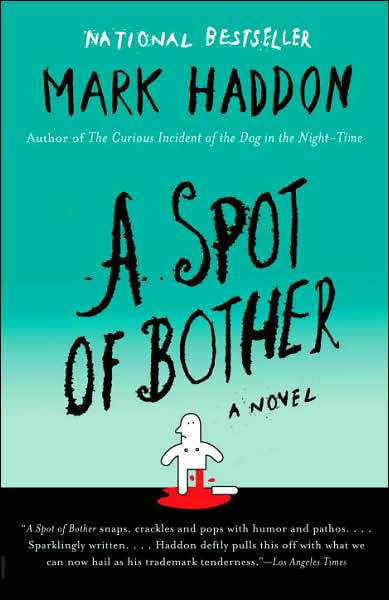
A Spot of Bother by Mark Haddon

A Spot of Bother by Mark Haddon

When I saw this book on the shelf of a used bookstore out in Alexandria last weekend, I knew instantly I had to have it. Several years ago I read and loved The Curious Incident of the Dog in the Night-Time, but for some reason never looked into other books by Haddon. I couldn’t wait to dive into this newest novel. (Okay, it was published in 2006, but it is new to me since I had no idea it existed!) I was expecting something similar to The Curious Incident of the Dog in the Night-Time, but found A Spot of Bother to stand entirely on its own.

George Hall, our protagonist, is just settling into retirement when he finds a spot of dry, diseased feeling skin on his hip. He immediately decides he has skin cancer and goes into a downward spiral, filled with panic attacks and self-destructive behavior. The fact that his family seems to be coming apart at the seams only adds to his stress, which increase the panic attacks. His daughter announces her marriage to a man that her parents don’t particularly care for and one that, while she appreciates him, she isn’t sure she loves. Their son’s boyfriend leaves him, saying he doesn’t know how to be in a real relationship. If that wasn’t enough drama, George’s wife has been sleeping with one of his former colleagues.  All of this drops into George’s lap as he thinks he has discovered he is dying.

As the wedding draws nearer, George’s depression spirals out of control. He is convinced he is dying, that his wife doesn’t love him and that he has made a mess of his entire life. The at-home surgery, self-medicating through codeine and alcohol and then abundant use of doctor prescribed Valium aren’t helping things.

I felt guilty laughing while George’s life seems to unravel, but Haddon’s telling of the tale weaves such a dark comedy that I couldn’t help but chuckle at times. At one point, on the day of Katie’s wedding, George takes off in an attempt to not have to be involved in the nuptials. He is found hiding in a ditch (he makes the excuse that he went for a walk, tripped and turned an ankle) and must return home. On his way home he remembers he has a stash of Valium that should get him through the day. With this thought being the only one in mind, he takes off at a full sprint back to the house, startling those who were watching him limp along the road just seconds before. As the family is in full-panic mode, thinking they’ve lost George, he goes zipping by the kitchen window at mach5 speed. The imagine of this slightly paunchy, bedraggled man flying by the kitchen window on the morning of a wedding just makes me laugh each time I imagine it. With writing like that, George’s predicament seems a little less serious and allows the reader to see the absurd and ridiculous side of even the most trying events.

The hardest part of this book for me was its British-ness. There were a few times I had to stop and look up what a word or phrase meant. When George goes to the surgery to see his doctor, I had to keep reminding myself that it was the hospital, not an operation that he was going in for. And, boy oh boy, was there a lot of tea drinking. Regardless of the situation, good or bad, tea was always the first thing offered. (Which I would think was far-fetched, but know from first-hand experience that tea really is a go-to for the British. After making a rather speedy exit from my apartment building during the Sichuan earthquake, I was sitting on the ground with a British teacher, with the earth still moving below us. As we watched landslides on the surrounding hills, she looked at me and said, “I could really go for a cup of tea right about now!”)

While this book was not at all what I expected, it was still enjoyable. I liked the dark comedy and the way the reader gets to peer into the lives of a family that looks “normal” on the outside, but in reality is scrambling to hold everything together. Mark Haddon’s A Spot of Bother earns:

The Unconquered: In Search of the Amazon’s Last Uncontacted Tribes by Scott Wallace

The Unconquered: In Search of the Amazon’s Last Uncontacted Tribes by Scott Wallace

Having grown up with towering stacks of the iconic yellow covered National Geographic just one room down the hallway from my bedroom, I spent hours poring over the shiny photographs bound within their golden spines. Often, those pictures were of peoples and places I could only dream of, imagining what life must be like in the wilds of the Amazon or the plains of the Serengeti.  As a reporter for that very same geographical society, Scott Wallace was given the rare opportunity to venture into that jungle world, skirting the edges of tribes that had yet to be contacted by the outside world. The results of his journey are chronicled in The Unconquered.

Wallace joins Sydney Possuelo, a Brazilian who has devoted his life to protecting the “indios bravos” of the Amazon, on his trek into the rainforest in an attempt to map the borders of a group known as the “flecheiros.” Possuelo is dedicated to the preservation of these tribes who have had little to no contact with the world beyond their own, but his single-minded devotion comes at the expense of his fellow trekkers. He rules with an iron fist while in the jungle, which both serves to keep his motley band of travelers safe, while at the same time alienating them from him as a leader.

While telling the tale of his easy boat trip up the Amazon, his arduous trek through the forest and the difficult process of building canoes to return to civilization, Wallace also gives us an insight into the competing factions when it comes to the issue of what to do with these previously uncontacted tribes. White man (defined by Possuelo as all non-natives) brings with him innumerable diseases that kill quickly. He brings a way of life so foreign to the natives that even once introduced to it, they are rarely able to assimilate to a point of upward mobility. On the other hand, keeping medical and technological advances from these people in hopes of them retaining their current way of life could be a construed as inhumane and condescending, as those decisions may not be within the rights of the Brazilians.

Becoming friends (or at least companions) with men from several different native tribes, coming close to disaster (if not death) on several occasions and being just feet away from members of a tribe not previously seen by outsiders are just a few of the experiences Wallace has on during his time in the Amazon.  The travel must have been difficult, but we rarely hear details about the day-to-day conditions. The focus of the book is definitely on the native tribes and their precarious situation, but a bit more description of the demanding hikes, the overwhelming flora and fauna, as well as his personal thoughts on the whole subject would be appreciated.

By the end of the book, we have seen Possuelo at his best and his worst. We come to see that the fight over tribal lands (taking up 11% if Brazil’s landmass, but harboring only 1% of the population) as being not only a huge gray area, but a battle with no end in sight. This ambiguity is reflected in what we learn of Wallace as a person. He attempts to inject himself into the narrative, talking about his sons and life in the US, but by the end of the book, we are left no knowing what came of several personal predicaments. This lack of a solid ending for both the natives and the author himself leaves us feeling unease about what the future holds, but anything more packaged would feel false and contrite.  The National Geographic photographs from my childhood came to life at the hands of Scott Wallace in The Unconquered: In Search of the Amazon’s Last Uncontacted Tribes, which earns:


Jasper Jones by Craig Silvey

Jasper Jones by Craig Silvey

Jasper Jones, Craig Silvey’s latest young adult novel, charts the journey of a teenage boy losing the naivety of his youth as he discovers the world around him, and especially the people, don’t fall into the neat frames he has created for each one. This is a definitely a book about growing up, but Charlie, the protagonist, is forced into maturity when confronted with the death (murder? suicide?) of Laura, the teenage daughter of a leading town politician.

This book is a bit of an enigma to me. The book is beautifully written and tells a captivating, if devastating story, but it seems to build on its own foundation in weird ways and at odd intervals. There were times where I thought I had a feel for the setting and characters, only to have the world I created in my head shattered by a new piece of background information. For example, I was probably a third of the way into the book before I realized that it was set in the 1960’s, while the Vietnam War was raging in Southeast Asia.  The fact that it is set in Australia also probably should have been apparent to me soon, but a name like Corrigan just drew to mind an English town, rather than one on the other side of the world. These two facts combined, once they were clear to me, fashioned an entirely different landscape than I had previously imagined. (It’s the difference between rainy, overcast days versus sunshine and heat or trails made by rabbits and rodents versus those created by kangaroos and wallabies.)

Once I had the setting straight I my mind, it was the plot that took a bit of mind-warping reconciliation. When Charlie is asked to help bury a dead girl at the bottom of a lake, he does so without hesitation, but then must keep the events of the evening a secret, as he continues on with his summer holiday. This foundation is horrifying, and yet it leads to a story even more devastating. The deceased is already gone, so while the actions are awful, they don’t change her fate. Instead, other fates are revealed as Charlie and Jasper go in search of her murderer.  The weeks following Laura’s death reveal new relationships, as well as see the destruction of existing ones.

But what are the characters doing when they are not deeply involved in the mystery of Laura’s death? Cricket. Lots and lots of cricket. This game of Down Under is one that baffles me. There are wickets and bats and runs and bowls and all sorts of doodads that are foreign to any sports understanding I may hold. While this made a great addition to the Australian setting, it was an aspect of the book I found hard to follow. (This is especially true when it came to the climactic game where Charlie’s best friend finally gets his shot and cricket stardom, which is narrated, in detail, along the course of several pages.)

For a tale based upon death and the subsequent destruction that plays out in the tragedy’s aftermath, I have to say that this is a really good book. It feels strange to like something so much, when the basis of it is so dark, but as the characters come alive throughout the story, I can’t help but feel  their pain as the rose colored glasses of childhood are removed and they discover that the world isn’t quite as kind as they had once believed. Craig Silvey’s Jasper Jones , a powerful young adult novel aimed at mature teens, that takes a powerful look at growing up, tough choices and the inevitable consequences of those decisions, earns:

Brave Dragons: A Chinese Basketball Team, an American Coach, and Two Cultures Clashing by Jim Yardley

Brave Dragons: A Chinese Basketball Team, an American Coach, and Two Cultures Clashing by Jim Yardley

Professional basketball and Chinese history and culture are not topics commonly lumped together, but Jim Yardley takes on the challenge in Brave Dragons. I originally picked this book looking for a new take on China, which I got, but I do have to say that I wasn’t expected to be quite so overwhelmed with basketball. (Okay, to be fair, the cover sporting a basketball jersey should have given me a clue that the book would be heavy on the sports, but I looked right past that to the awesome font that also adorns the cover.)

Right off the bat, I must admit that this was not the book for me, but I definitely would have bought it and put it on the shelf of my classroom. There is a strong market for this book. I am not that market. I had some hoop-obsessed students who would have devoured this book, which is filled with the jargon of the game, court-side wheelings and dealings and an insider’s look at what a budding professional basketball league looks like.

Yardley, after a handful of setbacks in is NBA coaching career in the US, is offered the position of head coach of the Shangxi Dragons, a bottom of the barrel Chinese professional team based in Taiyuan, part of the northern coal country in China. He goes there, having no previous experience living abroad, expecting to take full-coaching responsibilities (with the help of a translator) and with a hope of improving the team’s horrible record. Yardley quickly learns that not only is China physically on the other side of the world from his home in Washington state, but that the mental shift needed for this new lifestyle and job is nearly as large.

I love that Yardley took his story off the hardwood, trying to dig into the culture of China to understand what factors might be playing into the decisions being made by his players and his front office. He includes tidbits about the country’s history, about their sports training programs and a view into where the nation might be headed. Like with many things in China, the Chinese Basketball Association (CBA) is built on layers of bureaucracy and an ever-present need to “save face.” I had to laugh to myself as Yardley learned to navigate the world of appearances versus reality that becomes so confusing when the concept of “face saving” rears its sometimes befuddling head.

Having read extensively about Chinese history and lived the culture on a daily basis, at times I felt like the book took too cursory of a glance at some of these aspects, maybe playing up the ones Westerners would find odd in an attempt to draw readers into the story. For those unfamiliar with the Middle Kingdom, the book is a great starting place. As a teacher, I would have proffered it to the students who I knew had a love of the game and then hoped it would spark a wider interest in the world. This book is perfectly suited to do that- start with a topic that is familiar and of interest to a wide population and through the medium, introduce an entire new area of exploration to the reader.

Basketball isn’t my thing. China is (kinda’) my thing. Combine them and I end up on the fence about ranking this book. Would I recommend it to others? Yes! There are definitely some of my students who will be getting emails about it. Would I read it again? No. I like the idea, but it was just too detailed when it came to that large orange ball with the black stripes that tall guys (and gals) bounce up and down a hardwood floor and attempt to get in that woven basket hanging from a round, metal hoop. With that said, Jim Yardley’s Brave Dragons: A Chinese Basketball Team, an American Coach, and Two Cultures Clashing earns: